Zerebro
 Bitcoin
 Quantus
 Pearl
Pearl Starknet
 ZKsync
 NEAR Protocol

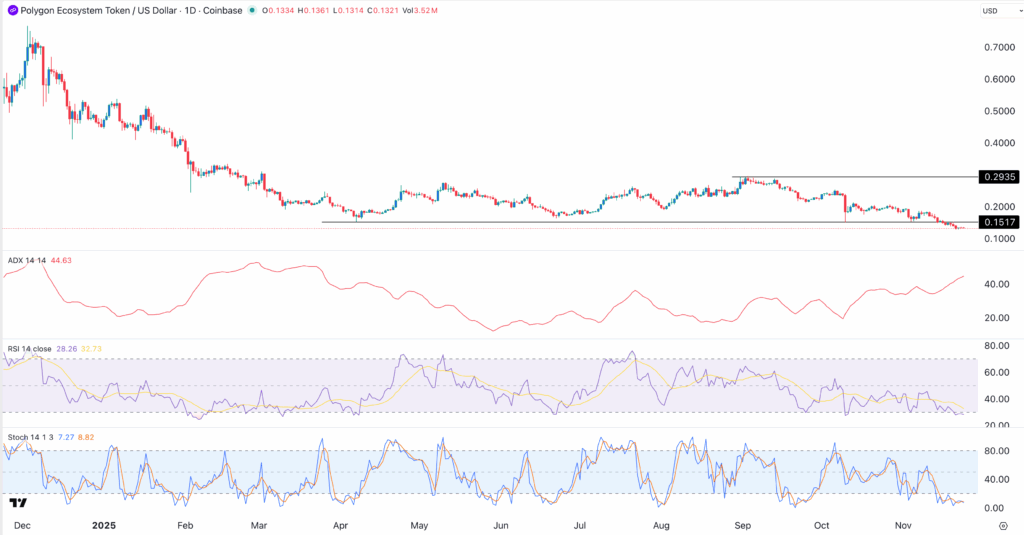
Polygon price crashed to the lowest level this year, erasing billions of dollars in value. The POL token plummeted to a low of $0.1318 on Monday, down 82% from its December high and 55% below its highest point this year. This crash occurred even as network growth accelerated.
Polygon Price Has Moved to Oversold Zone
The daily timeframe chart shows that the POL price has been in a strong downward trend this year. Bears have constantly overpowered bulls anytime it attempted to rebound.
POL, previously known as MATIC, has recently crashed below the important support at $0.1517, its lowest swing in April and October this year. Moving below that level confirmed that bears are in control.
The coin remains below the 50-day Exponential Moving Average (EMA), which is a highly bearish sign. It also remains below the Supertrend indicator, while the Average Directional Index (ADX) has reached its highest level this year at 44. A high ADX multiple means that an asset’s trend is strengthening.
On the other hand, the Relative Strength Index (RSI) and the Stochastic Oscillator have moved to the oversold levels. The RSI has dropped to 28, while the two lines of the Stochastic have moved to the extreme oversold levels.
Therefore, these oscillators likely point to a rebound in the next few weeks. If this happens, the next important target level to watch will be at the psychological point at $0.20, which is ~48% above the current level. This rebound will only happen if there is a broader crypto market rally.
Polygon Ecosystem is Doing Well
The ongoing Polygon price crash is happening even as the network growth accelerates. Data compiled by Nansen shows that Polygon is one of the fastest-growing players in the layer-1 and layer-2 industry.
The data show that the number of active addresses increased by 60% over the last 30 days, reaching over 10.6 million. Transactions in the network soared by 80% to 135 million, while the amount of fees collected jumped by 45% to $875k.

Some of these numbers mean that it has overtaken Base and Arbitrum, its biggest competitors. For example, while Base’s transactions rose to 397 million, its active users were 8.4 million. Meanwhile, Arbitrum’s transactions dropped by 108% to 70.9 million, while its active addresses fell by 14% to 3.3 million.
Therefore, there are signs that Polygon is bridging the gap with its top competitors in terms of growth.
Stablecoin and DEX Growth
Meanwhile, the amount of stablecoins in the network jumped to a record high of $3.2 billion. Most of these tokens, worth about $1.16 billion, are Circle’s USDC, while Tether (USDC) is worth over $921 million.
One reason for the ongoing growth of stablecoins is that Polygon powers Polymarket, one of the top players in the prediction market. DeFi Llama data indicate that Polymarket’s total value locked (TVL) has increased by 13% over the last 30 days, reaching over $261 million.
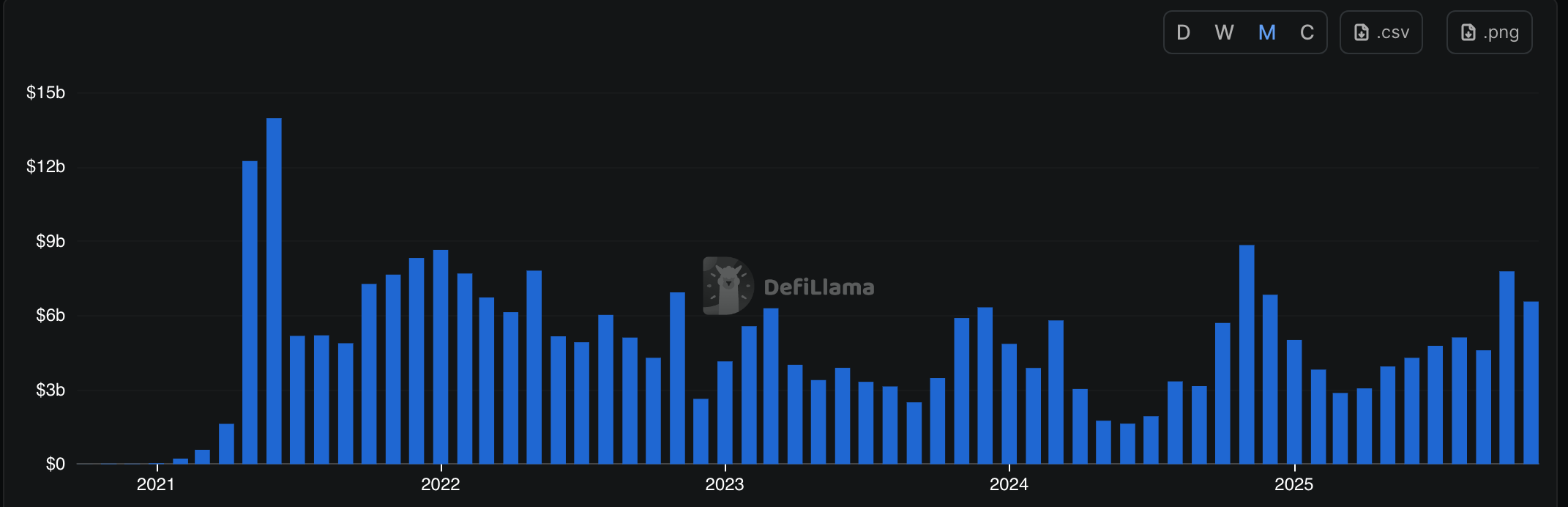
Additionally, Polygon’s DEX ecosystem is doing well, thanks to Polymarket, Quickswap, Uniswap, and WOOFi. Polymarket handled over $141 million in transactions in the last 24 hours, bringing its 30-day volume to $3.7 billion. QuickSwap and Uniswap handled $1.66 billion and $2.41 billion in the previous 30 days, bringing Polygon’s transaction volume this month to $6.56 billion.
Notably, Polygon has emerged as a significant player in the real-world asset (RWA) tokenization industry. It has a TVL of $761 million, making it the fifth-biggest chain in the industry after Ethereum, BNB Chain, Avalanche, and Solana. BlackRock’s BUIDL is the biggest RWA asset in the network.
Summary
It is common for a cryptocurrency token to crash even when its underlying network is performing well. A good example of this is Avalanche, which has tumbled to the year-to-date low despite its network growth accelerating. Polygon is also in the same situation, where the market is not appreciating its fundamentals. This could change now that the Polygon price has moved to the oversold level.