Dacity Coin
 Pearl
Pearl Bitcoin
 Injective
 Pudgy Penguins
 Quantus
 Starknet

Bitcoin news shifted sharply on Dec. 9 as Binance tightened its grip on global Bitcoin trading. Data shared by Coin Bureau showed Binance controlled 35.4% of all Bitcoin trading volume. The figure placed it far ahead of rivals such as Crypto.com, Coinbase, and Bybit.
The market interpreted the dominance as a signal of liquidity concentration during a sensitive phase for Bitcoin. Traders tracked growing institutional exposure and rising treasury accumulation across multiple jurisdictions.
The same Bitcoin news cycle also reflected deeper structural trends shaping global adoption. Bitcoin treasuries surpassed four million coins across public firms, governments, exchange-traded funds, and custodians, according to Coin Bureau. The metric highlighted accelerating balance sheet exposure beyond retail participation.
Binance Bitcoin Trading Lead Reshapes Market Liquidity
Bitcoin news around exchange dominance sharpened after Coin Bureau published fresh market share data sourced from Kaiko. The dataset showed Binance holding 35.4% of daily Bitcoin trading volume as of Dec. 2, 2025. Crypto.com followed at 16.5%, while Coinbase and Bybit each captured 8.5%.
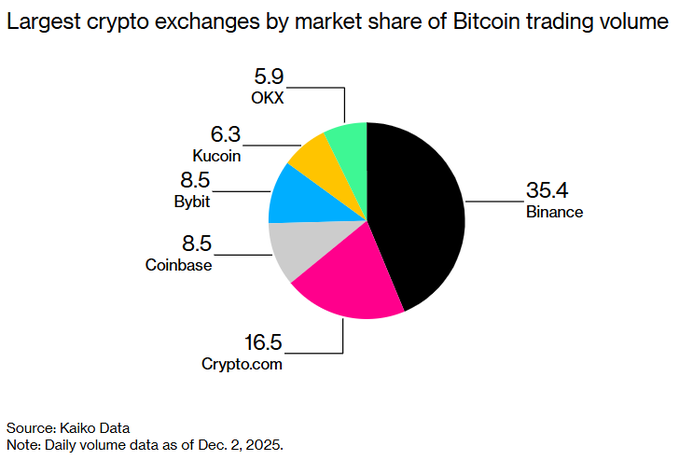
KuCoin held 6.3% of market share, and OKX accounted for 5.9%. The rest of the market spread across smaller venues.
The concentration raised questions about systemic liquidity risks tied to a single venue. Binance already handled the largest share of spot and derivatives activity across major trading pairs. The fresh Bitcoin news reinforced how deeply market execution depended on one exchange during volatile macro cycles.
Traders continued routing executions through Binance due to deeper order books and tighter spreads. However, risk desks increasingly flagged the exchange’s oversized influence on price discovery during high volatility events.
Bitcoin Treasuries Pass Four Million Coins Across Institutions
Bitcoin news also turned toward balance sheet accumulation trends. Coin Bureau reported that over four million Bitcoins now sit across treasuries held by public firms, private companies, governments, custodians, exchange-traded funds, and decentralized finance protocols.
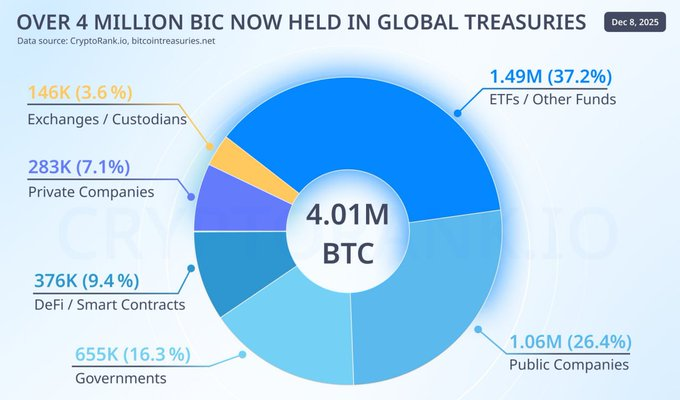
The number underscored how Bitcoin shifted from a speculative asset into a reserve holding for diverse institutions. The scale of holdings placed meaningful supply outside of active circulation.
Large exchange-traded fund issuers continued absorbing spot Bitcoin through daily inflows. Governments and corporates still disclosed limited public purchases. However, the aggregate balance suggested long-term capital parked outside trading venues.
The accumulation coincided with tightening liquidity across open markets. As more Bitcoin moved into long-hold treasuries, available supply for directional trading narrowed. That dynamic supported higher volatility during breakout phases.
Coinbase CEO Signals Global Strategic Bitcoin Reserve Push
Bitcoin news gained geopolitical weight after comments attributed to the Coinbase chief executive. Vivek Sen reported the Coinbase CEO said live on Fox that all G20 nations would establish strategic Bitcoin reserves. The statement framed Bitcoin as a potential sovereign-grade reserve asset.

The claim triggered rapid debate across policy and digital asset circles. No official confirmations followed from G20 governments at the time of publication. Still, the narrative added momentum to the treasury accumulation theme already reflected in on-chain reserve data.
Market participants viewed the remarks as aspirational rather than policy-backed guidance. Yet the timing aligned with rising sovereign interest in digital asset custody frameworks and central bank digital asset strategies.
The statement also reflected how quickly Bitcoin entered sovereign reserve discussions previously dominated by gold and foreign currency holdings.
China Strategic Bitcoin Reserve Rumors Stir Market Speculation
Bitcoin news took a more speculative turn after market personality That Martini Guy shared unverified claims regarding China. The post alleged China planned a strategic Bitcoin reserve to compete with the United States. He flagged the development as a rumor without official confirmation.

The rumor followed a broader pattern of traders tracking potential state-driven accumulation. China’s prior history of crypto market intervention amplified the sensitivity around unverified policy shifts.
Traders treated the report cautiously due to the absence of official documentation. Still, the narrative added fuel to the broader reserve accumulation theme already shaping December sentiment.
The market reaction stayed measured. Bitcoin prices showed no immediate breakout tied directly to the claim. Derivatives funding remained stable across major exchanges following the rumor.
Bitcoin News Reflects Institutional Shift from Trading to Storage
The combined Bitcoin news flow pointed toward a structural shift from speculative turnover to long-term storage. Binance’s trading dominance highlighted where liquidity interacted with price. Treasury accumulation showed where Bitcoin exited active circulation.
Exchange dominance and treasury expansion often move in opposing directions. Rising trading dominance increases short-term volatility exposure. Treasury accumulation reduces circulating supply and dampens sustained sell pressure.
Together, the trends created tighter supply-demand conditions across spot markets. Market participants tracked on-chain wallet growth among institutional-sized addresses for confirmation.
The dual forces continued shaping Bitcoin’s risk profile as December progressed.
What Traders Watched Next After the Reserve Narrative
Bitcoin news now centers on how reserve narratives translate into actual sovereign policy actions. Traders will monitor official government filings, custody mandates, and regulatory commentary across G20 economies.
Liquidity conditions on Binance will also remain under scrutiny. A 35.4% share of Bitcoin trading volume places the exchange at the core of price formation during macro-driven volatility.
Treasury accumulation trends will remain critical for measuring long-term supply compression. The four-million-coin threshold marks a behavioral shift in how Bitcoin functions within capital markets.
The next phase for Bitcoin depends on whether reserve speculation becomes documented policy adoption. Until confirmations arrive, price action will continue tracking exchange liquidity flows and institutional positioning patterns.