
 astronaut
 Pearl
Pearl Zcash
Zcash Walrus
 NEAR Protocol
 Starknet
 Pudgy Penguins

Ethereum co-founder Vitalik Buterin made a clear statement on X. He said decentralized applications are the answer to centralized service outages. He explained that dApps can keep services running when centralized systems fail.
Buterin outlined Ethereum‘s mission to build applications that run without fraud, censorship, or third-party interference. The dApps should continue functioning even if original developers disappear or major infrastructure providers like Cloudflare experience failures.
Ethereum Achieved Technical Milestones in 2025
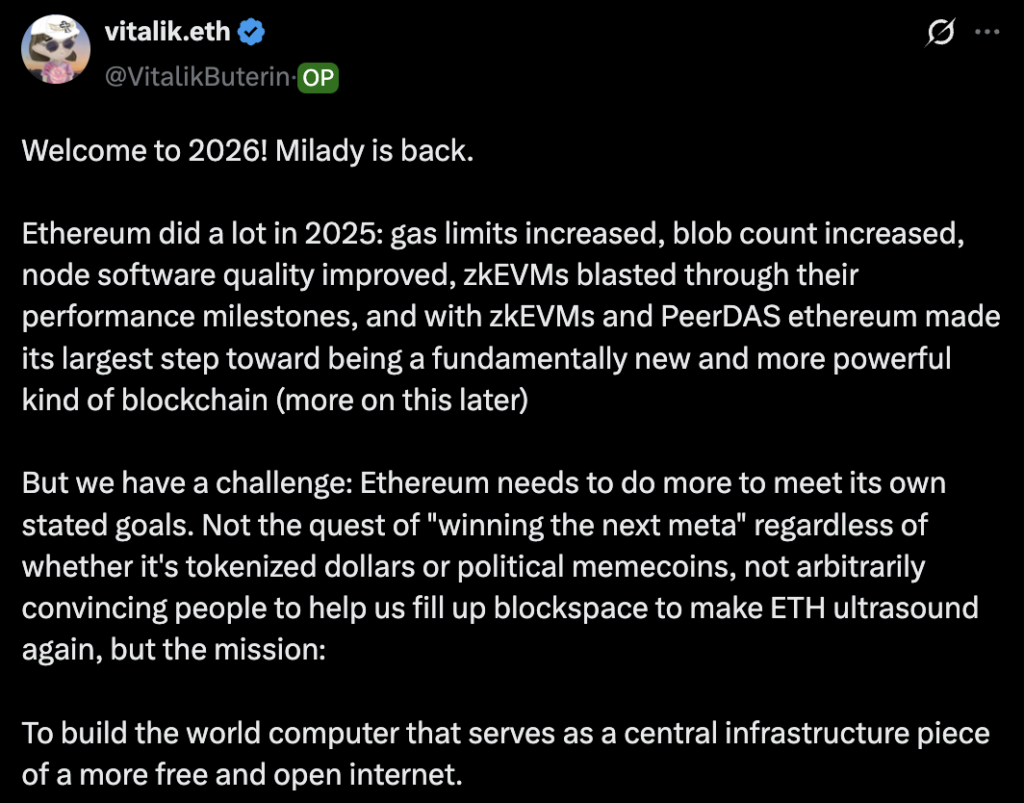
Ethereum made progress across multiple technical areas during 2025. Gas limits increased, allowing more transactions per block.
Blob count rose, expanding data availability for layer-2 networks. Node software quality improved through ongoing development efforts by client teams.
Zero-knowledge Ethereum Virtual Machines (zkEVMs) achieved performance milestones throughout the year.
The technology allows layer-2 scaling solutions to process transactions off-chain while maintaining Ethereum’s security guarantees. zkEVMs reached targets for transaction throughput and proof generation speeds.
Ethereum implemented zkEVMs and PeerDAS, taking its largest step toward becoming a fundamentally new and more powerful blockchain.
PeerDAS improves data availability sampling, allowing nodes to verify data without downloading entire blocks.
Buterin stated that Ethereum needs to do more to meet its stated goals. The focus should not be on winning the next trend, regardless of whether it involves tokenized dollars or political memecoins.
dApps Designed to Survive Centralized Failures
Ethereum aims to build decentralized applications that operate without centralized dependencies.
Buterin explained that users should not notice if Cloudflare experiences downtime. The dApps should continue functioning even if all of Cloudflare gets hacked by a nation-state actor like North Korea.
The applications must pass the walkaway test, meaning they keep running even if the original developers disappear.
This property ensures long-term stability independent of any single entity. dApps achieve this through smart contracts deployed on Ethereum that execute automatically without human intervention.
Buterin stated that the decentralized architecture removes single points of failure that plague traditional applications. Users maintain control over their data and assets without relying on corporate intermediaries.
Buterin noted that any wallet, kitchen appliance, book, or car would fulfill every single requirement of permanence and user ownership.
Today, all these items are becoming subscription services by default, creating permanent dependence on centralized providers.
Applications Must Pass the Walkaway Test
The walkaway test establishes whether an application can survive without ongoing developer support. Traditional applications fail this test and need constant maintenance from their creators.
Server shutdowns, company bankruptcies, or strategic pivots can render applications unusable overnight.
Ethereum dApps pass the walkaway test through immutable smart contracts. Once deployed to the blockchain, the code executes exactly as written without possibility of alteration.
No central authority can shut down, modify, or censor the application. Users access the application directly through the blockchain rather than through corporate servers.
The test applies to finance, identity, governance, and other civilizational infrastructure. Financial applications like decentralized exchanges continue operating without the founding team.
Identity systems persist independently of any single organization. Governance mechanisms function autonomously according to programmed rules.
Vitalik Buterin said these properties are essential for finance. He added that they are also needed for identity and governance. He explained that they matter for any civilizational infrastructure people want to build. Any application requiring censorship resistance and permanence benefits from a decentralized architecture.
Ethereum Requires Improvements at Multiple Layers
Buterin shared two requirements for achieving Ethereum’s mission. The blockchain must be usable at scale. The system must remain decentralized. Both requirements need fulfillment at the blockchain layer and the application layer.
The blockchain layer includes the software used to run and talk to the blockchain. Node client diversity prevents single points of failure.
Multiple independent implementations of the Ethereum protocol provide redundancy. Improvements to execution clients, consensus clients, and networking protocols continue throughout development.
All these pieces are already being improved, but they must be improved further. Buterin stated that Ethereum has powerful tools available, but needs to apply them.




