
 Wisp
Wisp Doge Pepe
 Crawlerpad
 Zylo Ecosystem
 Pearl
Pearl Basic Attention
 Quantus
Tether, the issuer of the world’s largest stablecoin USDT, has invested in SQRIL, a fintech startup based in Southeast Asia. The company is building the first real-time cross-border “Scan-to-Pay” QR code payment switch.
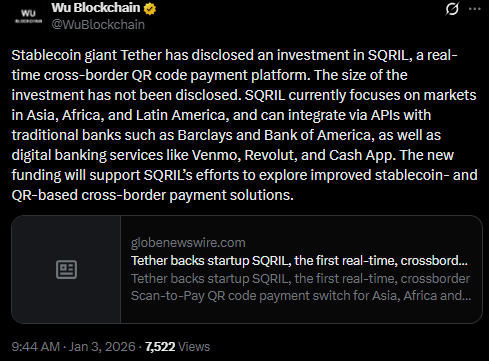
The investment is undisclosed. It aims to connect national payment systems and facilitate the use of stablecoins in daily transactions. The move highlights Tether’s push into real-world utility and SQRIL’s role in emerging markets.
How SQRIL Works
SQRIL offers a payments API. It allows banks, neobanks, and digital wallets to support cross-border QR payments. Users can scan local QR codes while travelling or shopping abroad. They pay in their home currency. Merchants receive instant settlement in their local currency.
The platform manages foreign exchange, compliance, and payouts in the background. This removes friction from remittance or card-based systems.
“Any traditional bank, such as Barclays or Bank of America, or neobanks such as Venmo, Revolut, or Cash App, can integrate with our APIs and allow their user base to scan & pay local QR codes across Asia, Africa, and Latam,” said Malcolm Weed, SQRIL’s Founder and CEO. “Users would pay with their home currency, and the merchant in the foreign country would receive their local currency. SQRIL would handle the forex and local payout in the destination currency.”
SQRIL’s API already supports QR payments in the Philippines, Vietnam, and Indonesia. Bank transfers are available in Malaysia and Thailand. The company plans to expand to more countries in Asia, Africa, and Latin America in the first quarter of 2026.
A Vision for Interoperability
Weed has 13 years of experience in cross-border payments and three years living in Southeast Asia. He stressed the timeliness of the technology.
“With the rise of national QR code schemes, stablecoins, and the global movement of people, there needs to be a better way to pay across borders,” he said. “I believe we are at the early stages of instant payment interoperability between banks, ewallets and merchants of different countries, and SQRIL plans to be an important part of that infrastructure.”
He also predicted a reversal of typical innovation flows. “Having worked in cross-border payments for the past thirteen years… I can confidently say that scan-to-pay QR code payments will become universal worldwide in the coming years. Usually, you see developed world technologies making their way to emerging markets, but I really believe this will happen in the reverse.”
Tether’s Strategy and Market Potential
For Tether, the investment fits its diversification strategy. USDT remains dominant in crypto trading and DeFi. But Tether is focusing more on real-world use. It recently made Bitcoin treasury allocations.
Backing SQRIL could allow USDT integration in backend settlements. This may reduce costs and expedite remittances and merchant payments in regions where QR adoption is more rapid than card infrastructure development.
Emerging markets are leading the QR boom. In Southeast Asia, QR transactions are rising with mobile wallet growth. Tourism recovery and large unbanked populations drive demand.
Africa’s mobile money systems and Latin America’s push for digital inclusion add momentum. Combining national QR schemes with stablecoins could unlock payments that bypass slow, expensive legacy rails.




