Injective
 Celestia
 streamoors
 Sui
Sui Pudgy Penguins
 Bitcoin
 Pearl
Pearl

Binance Coin price traded above the $900 level after the opBNB network completed its Fourier mainnet hardfork. BNB briefly pushed towards the $920 area before cooling, showing sustained market participation, not speculative spikes. The price stability came hand in hand with a major infrastructure upgrade that significantly enhances the opBNB network performance.
BNB Price Holds Above $900 as opBNB Upgrade Goes Live
Binance Coin price held strong above $900 after opBNB Fourier mainnet hardfork confirmation. At the time of writing, BNB was consolidating around the $910 to $920 range after a previous intraday high.
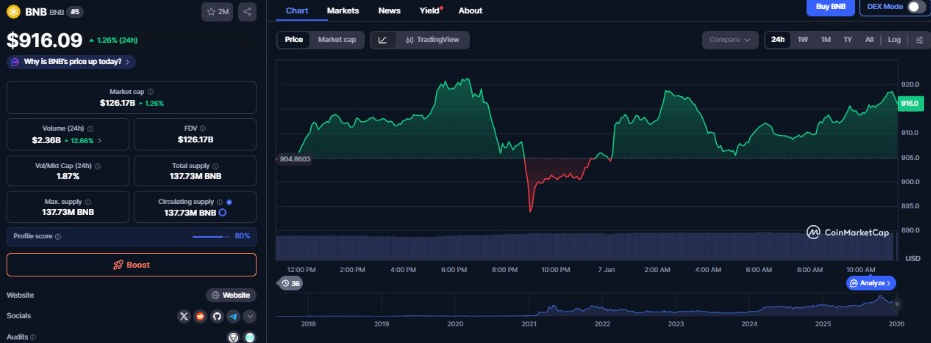
BNBUSD | Source: CMC
The upgrade went live around 03:00 UTC on January 7. Former Binance CEO Changpeng Zhao has revealed the completion about an hour after activation. Market reaction was still measured, without any sharp volatility or liquidity-driven moves. Instead, price action indicated cautious optimism associated with infrastructure improvements.
The opBNB network is a layer 2 of the Ethereum Virtual Machine, built on the OP Stack. It focuses on scaling applications on BNB Chain while keeping the transaction fees low.
The Fourier hardfork brought a significant decrease in the block time. This change has a direct effect on the transaction speed, confirmation latency, and application responsiveness.
Fourier Hardfork Improves Network Efficiency
The main change implemented with the Fourier hardfork was reducing the amount of time between blocks from 500 milliseconds to 250 milliseconds. This modification was made as part of pull request #305.
Shorter block times make the transactions faster and finalize more quickly. For users, interactions feel closer to real time across opBNB-based applications. Developers benefit from faster state updates and smoother execution environments. High-frequency use cases, such as gaming and DeFi, benefit from better responsiveness.
opBNB already supports a 100 million gas block size. The reduced block interval further improves the throughput without increasing network congestion. The upgrade also included some changes aimed at enhancing long-term stability. opBNB now refers to finalized layer 1 blocks instead of the latest head during derivation.
This change helps to ensure consistency when the BNB Smart Chain block time changes. It also limits the problems of reorganization for sequencers and verifiers.
Node Reliability and Protocol Stability
Beyond speed improvements, the Fourier hardfork bundled several technical fixes for node operators. These changes were concentrated on reliability, compatibility, and synchronization behavior.
Support for compiling opBNB with Golang 1.24.x was added. Compatibility improvements were also introduced for Windows-based systems.
One fix resolved the computation of block numbers in the case of long node shutdowns. Nodes that restart after going down for a long time will now finalize blocks correctly. Another problem affected the op-geth fast node mode. In some cases, missing state data was a cause of synchronization failures.
The update causes the op-node to wait for the unsafe blocks from the peer-to-peer network. This helps prevent premature block derivation requests that could prevent synchronization.
Additional fixes were done to address concurrent map use issues in the reference metric. Fourier hardfork timestamp was also added to the mainnet parameters.
Node operators were instructed to upgrade supported client versions as soon as possible.
These backend changes make opBNB more operationally reliable.
BNB Chain Activity Rises as Technical Price Levels Tighten
The opBNB upgrade came after a strong year for the BNB Chain ecosystem. End-of-2025 data revealed a 40.5% year-over-year increase in the total value locked.
Daily transaction volumes averaged 10.78 million across the BNB Smart Chain and opBNB. Unique addresses totaled more than 700 million, indicating continued use of the network. Both networks had an average of more than four million active daily users. These figures reflect steady demand, rather than short-term hype.
BNB price action reflects that stability. Charts are in consolidation above the level of $900 after recovering from previous pullbacks near $850.
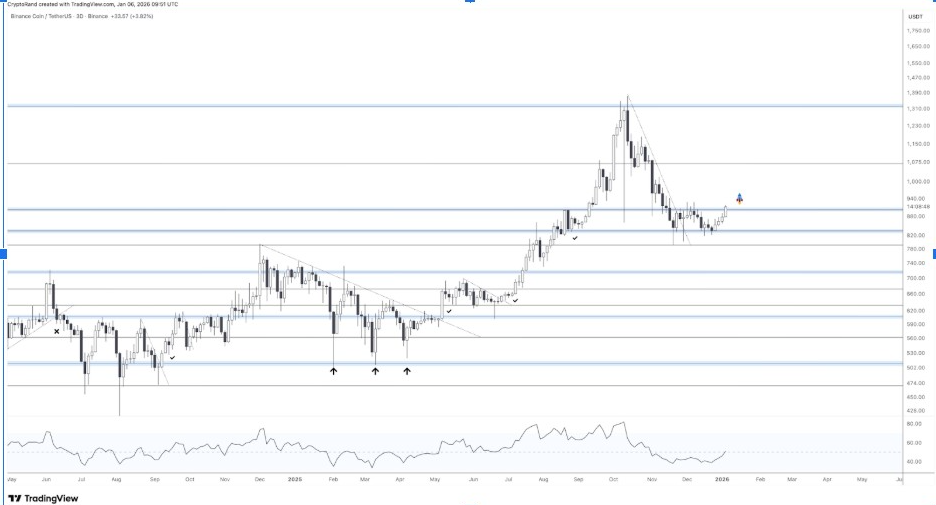
Traders who follow technical levels have noted that resistance is approaching the $1,000 zone. Support around $880-$900 is critical for near-term structure.
BNB is up about 5% in the past seven days. However, it is still trading roughly 33% below its October all-time high of nearly $1,370.
Volume trends indicate steady accumulation as opposed to breakout-driven momentum. Attention is now turning to the forthcoming Fermi hard fork, scheduled for January 14th. That upgrade is expected to further increase BNB Chain’s capacity to 20,000 transactions per second.