
 astronaut
 Pearl
Pearl Hyperliquid
 Walrus
 Pudgy Penguins
 Bitcoin
 NEAR Protocol

HYPE price has crashed in the past few months, moving from a high of $60 in September to the current $25.35. It has also formed numerous bearish chart patterns, indicating further downside as key Hyperliquid metrics decline.
HYPE Price Technical Analysis Points to a Steeper Crash
The daily chart shows that the Hyperliquid price has plummeted from a record high of $59 in September to its current level of $25. It has moved below the 61.8% Fibonacci Retracement level, confirming the ongoing downward trend.
The token has formed a bearish flag pattern, which happens when an asset plunges and then consolidates. It resembles an inverted hoisted flag.
HYPE price has formed a head-and-shoulders pattern, which is another popular bearish reversal sign. If moved below the neckline at $34.41, which coincided with the 50% Fibonacci Retracement level.
The coin has moved below the Supertrend indicator and its long-term and short-term moving averages. Therefore, the token will likely have a strong bearish breakdown, potentially to the psychological level at $20, which is ~20% below the current level. This price coincides with the 78.6% retracement level.
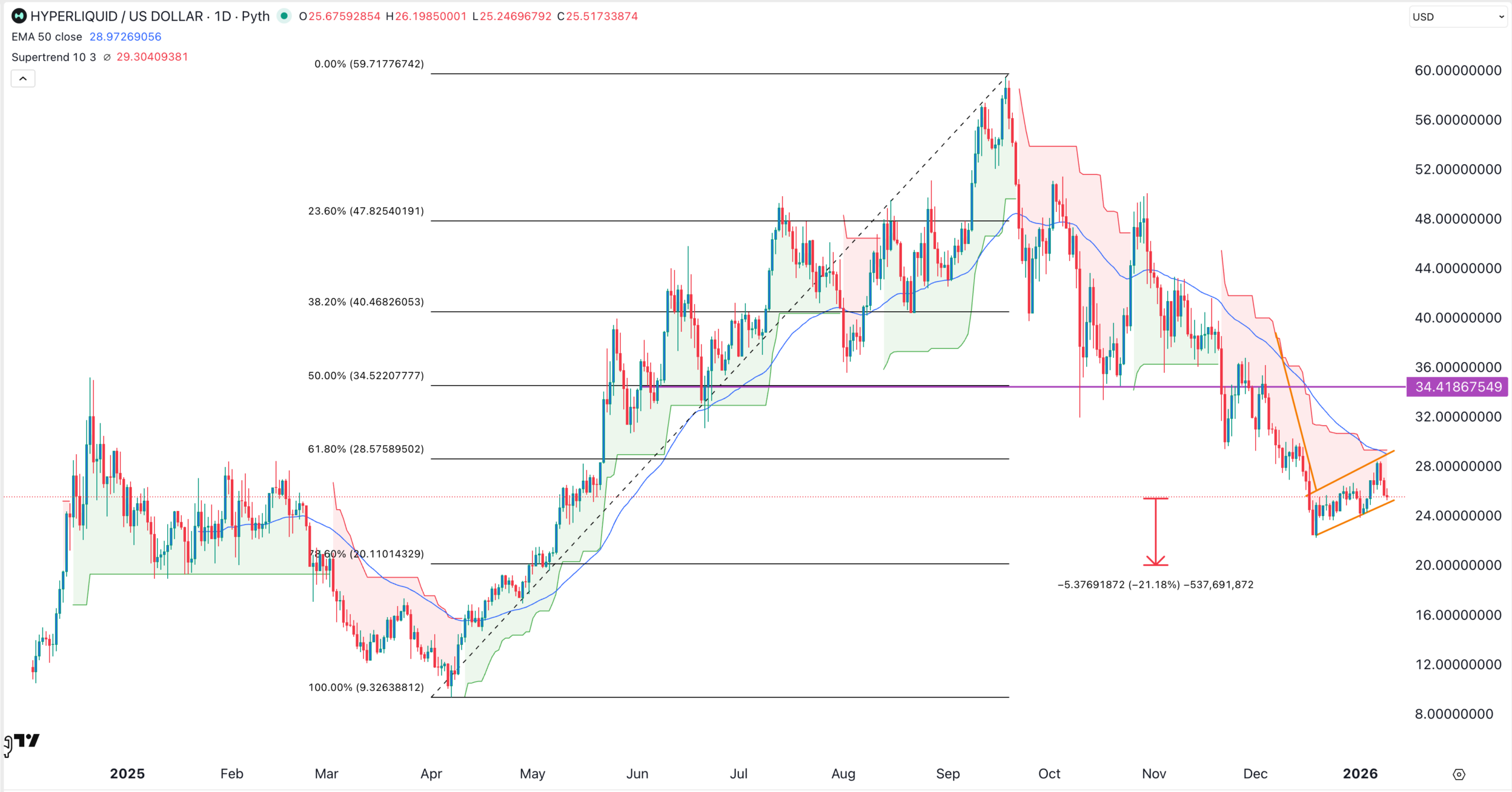
HYPE price chart | Source: TradingView
Hyperliquid Layer 1 Metrics Have Slumped
The ongoing HYPE price crash has coincided with the performance of other tokens, including Bitcoin and Ethereum. Its fundamentals have also deteriorated in the past few months.
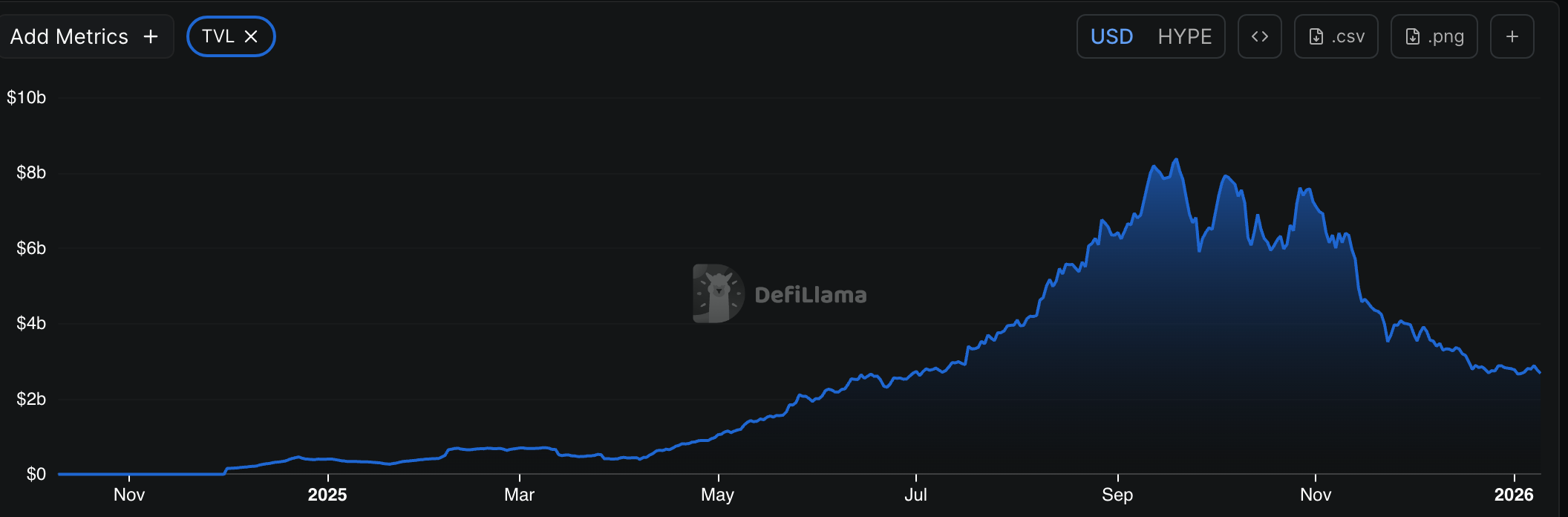
For example, the total value locked (TVL) in the Hyperliquid L1 has continued to decline, dropping from a high of $8.37 billion in September to its current level of $2.6 billion. Most protocols in the network, including Morpho, Hyperlend, Felix, and Hyperbeat, have shed millions of assets in the past few months.
More data reveals that the stablecoin supply on the Hyperliquid L1 has continued to decline in the past few months. It has moved to $4.8 billion, down from over $6.25 billion in September. Most of the stablecoins in the network are USD Coin (USDC), followed by other tokens like Tether (USDT), Ethena USDe (USDe), and USDH.
The ongoing performance of Hyperliquid’s Layer 1 network has resulted in lower fees within the network. Its fees dropped from $1.87 million in October to $1.15 million in November, and $693,523 in December last year.
Competition in the Perpetual DEX Industry Has Soared
Meanwhile, third-party data shows that the perpetual futures industry is getting highly competitive. In addition to Hyperliquid, the network faces competition from other companies, including Aster, Lighter, edgeX, and Extended.
Data shows that Hyperliquid’s perpetual futures platform handled over $153 billion in volume in the last 30 days. Aster, which is associated with Changpeng Zhao, handled over $146 billion in the same period.
Lighter handled over $150 billion, while edgeX handled $90 billion in the same period. As such, there are signs that the industry has become highly competitive, as Hyperliquid used to be the most dominant player in the industry.
The ongoing crypto market crash has also contributed to the decline in DEX volume, which dropped from a high of $396 billion in August to $169 billion in December last year.
Like Layer-1, Hyperliquid’s perpetual fees and revenue have continued to fall in the past few months. Its fees dropped from a high of $144 million in August to $68 million last month. Its revenue moved from $127 million to $60 million.
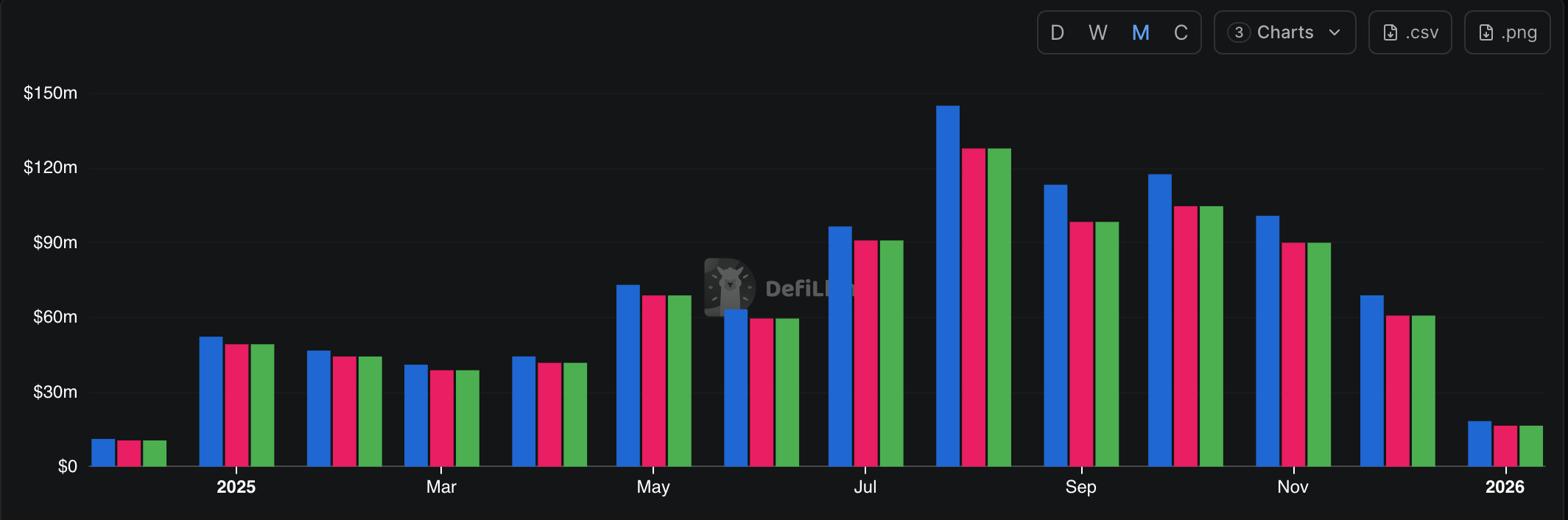
The falling revenue and fees has an impact on the HYPE price. For example, its burn rate and buybacks have continued falling in this period. Data shows that 3.7k HYPE tokens were burned on December 12 to a low of 2.7k on Thursday.
Summary
HYPE price has been in a strong downward trend in the past few months, moving from a high of $59.9 in September to the current $25. It has moved below the support at $34.41, and has formed a bearish flag pattern.
Therefore, the token will likely continue falling as sellers target the next key support level at $20.



