
 astronaut
 Pearl
Pearl Hyperliquid
 Walrus
 Pudgy Penguins
 Bitcoin
 NEAR Protocol

Vitalik Buterin has sparked debate over the blockchain architecture again, saying the crypto industry doesn’t need more layer-1 networks. His comments come as activity across major chains slows and liquidity thins in a broader market downturn.
At the same time, Buterin’s recent Ether sales have added to market sensitivity, linking infrastructure critique with capital discipline.
Vitalik Buterin Advocates for Fewer L1s and More Real Products
Vitalik Buterin said the crypto space has reached saturation at the base layer. He noted that launching new layer-1 chains, if they are copycat EVM networks, don’t add much user value.
In a worded post, he criticized EVM chains without optimistic bridges to Ethereum, calling them redundant and unnecessary.
According to Buterin, being close to Ethereum is no longer an attractive feature in itself. Many projects, he said, depend on hype instead of delivering products users actually need. He also pushed back against teams using his reputation to advance new networks without meaningful innovation.
Instead, Vitalik Buterin advocated for the need to build applications that are useful. He cited privacy tools, fast consumer apps, and low-latency systems as areas where there was real demand.
He encouraged teams to cease using “connection to Ethereum” as a major selling point.
Usage Data Shows L1 Growth Has Stalled
On-chain data supports Buterin’s argument. According to metrics from Token Terminal, daily active wallets on many layer-1 networks have plateaued. While chains operate at a higher baseline usage than they once did, growth has been mostly stalled over the last year.
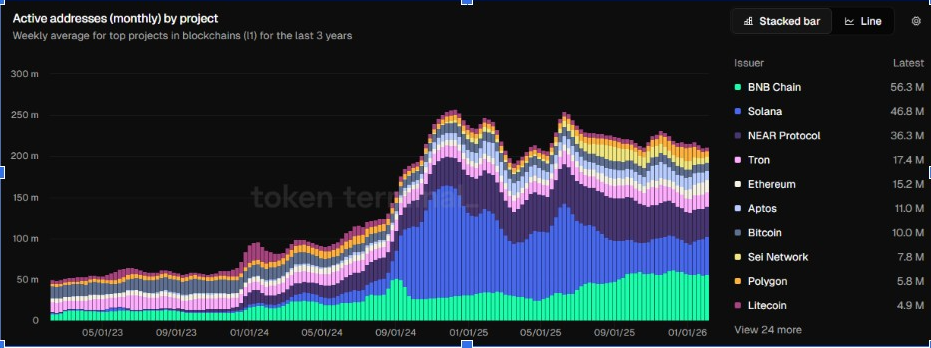
Ethereum continues to be an exception, maintaining its status as a core DeFi hub. Other large chains like Solana and BNB Chain have remained active largely because of meme token trading. Outside of these niches, many smaller L1s exhibit limited actual economic activity.
Value locked across layer-1 networks has also dipped following the recent market crash. Solana’s TVL fell by around 21%, and Ethereum saw outflows close to 22%. Smaller chains had trouble maintaining liquidity, despite expansion periods in 2024.
Buterin recognized a place for app-specific chains. He said networks built around a single strong use case, like prediction markets, can make sense. General-purpose chains, however, encounter diminishing returns.
ETH Sales Add Context to Infrastructure Push
In addition to his infrastructure critique, Vitalik Buterin has been heavily managing his personal holdings. Blockchain tracker Lookonchain reported that he sold around 2,961 ETH, worth approximately $6.6 million, over three days.
Data from Arkham Intelligence indicates that the swaps used the CoW Protocol via multiple small transactions.
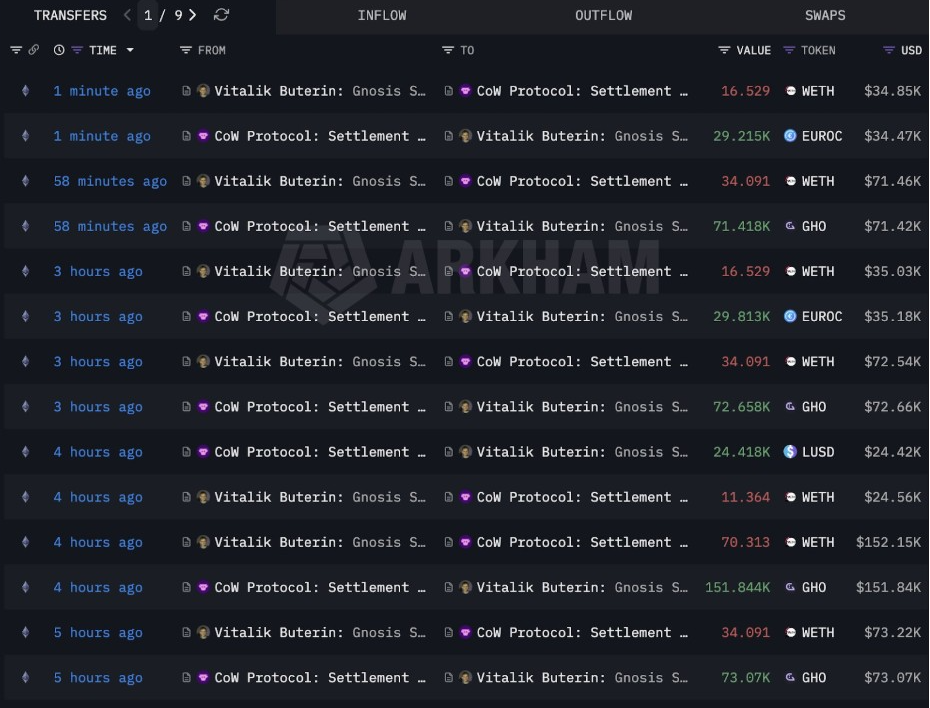
Such execution methods generally minimize the market impact. Still, the timing raised eyebrows when the Ether price slid. ETH hit its lowest point since May last year and is down more than 50% from its all-time high.
Vitalik Buterin clarified that funds from sales are for long-term initiatives. He recently allocated 16,384 ETH, roughly $45 million, to fund privacy-preserving technologies and open infrastructure. He said deployments would be slow as the Ethereum Foundation enters a time of “mild austerity.”
Market Pressure Meets Structural Reset
The weakness in Ethereum’s price has reflected broader market stress. Bitcoin fell below $66K, which triggered leveraged liquidations. Also, ETH bulls lost over $237 million in the last 24 hours, according to liquidation data.
Spot Ethereum ETFs have also been consistently drained from their reserves, losing more than $68 million in February alone.
Technical analysts note that ETH has just broken key support at around $2,125, invalidating an earlier bullish reversal pattern.
Indicators such as RSI and stochastic oscillators are still close to oversold territory, and pressure is still present. Some predictions are now at $1,500 as a potential downside goal if recovery doesn’t occur.



