
 Pearl
Pearl Zylo Ecosystem
 Bitway
 Walrus
 Starknet
 Quantus
 Pudgy Penguins

Bitcoin fell sharply during the recent market drawdown as macro pressure tightened global liquidity conditions. Bernstein analysts said the decline reflected fading confidence rather than stress within Bitcoin’s market structure.
The pullback occurred as investors reduced exposure to liquid assets amid elevated interest rates. That shift weighed on Bitcoin even as its underlying infrastructure remained intact, reinforcing its role as a liquidity-sensitive risk asset rather than a defensive hedge.
Market Reaction Reflected Liquidity Stress, Not Systemic Damage
Bernstein analysts wrote in a Monday investor note that Bitcoin’s sell-off represented the weakest bear case in its history. The firm said no major failures emerged across exchanges, custodians, or settlement layers during the decline.

This assessment followed a period where Bitcoin’s price fell by roughly half from its peak. The analysts noted that spot Bitcoin exchange-traded funds recorded net outflows of only seven percent during the move, which suggested restrained institutional selling pressure.
That reaction contrasted with previous downturns where forced liquidations and counterparty failures amplified losses. Bernstein argued that the absence of cascading failures showed improved market plumbing and deeper capital resilience.
The firm also addressed Bitcoin’s recent underperformance versus gold. Analysts said tight financial conditions favored precious metals and artificial intelligence-linked equities, limiting near-term upside for Bitcoin despite rising adoption by institutions and corporates.
This divergence occurred because investors treated Bitcoin as a high-beta asset during liquidity stress. Bernstein maintained that this behavior reflected macro positioning rather than a reassessment of Bitcoin’s long-term role.
Technical Signals Show Liquidity Clusters Near Key Levels
Market technicians noted that liquidity has been concentrated around recent price levels. Ted Pillows said Bitcoin developed a large liquidity cluster between the low seventy-thousand and eighty-thousand range, which often attracts price action during consolidation phases.
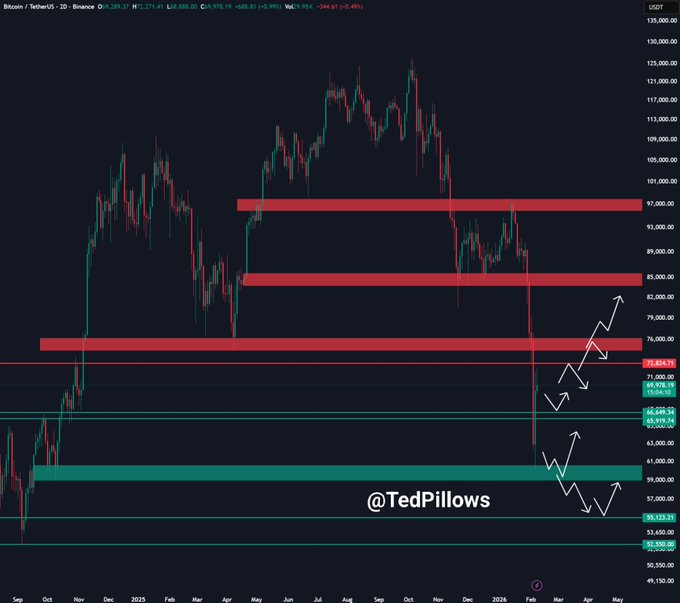
On the downside, traders identified a thinner liquidity pocket near the high sixty-thousand area. That level aligned closely with long-term moving averages watched by institutional desks, increasing its relevance as a short-term inflection point.
Ted Pillows also noted that bears faced growing pressure as Bitcoin approached these zones. Liquidity clustering often precedes sharp directional moves when price revisits heavily traded ranges.
Other technical analysts remained cautious. They warned that failure to hold the long-term average could trigger a deeper correction as leveraged positions unwound further.
At the same time, on-chain data showed contrasting behavior among larger holders. Glassnode data cited by BSC News showed wallets holding between 1,000 and 100,000 Bitcoin accumulated aggressively during dips below 60,000.
Those cohorts added about forty thousand Bitcoin during the decline. This behavior suggested that long-term participants treated weakness as an accumulation opportunity rather than an exit signal.
Institutional Context Undermined Bear Case Narratives
Bernstein also pushed back against emerging narratives around structural threats to Bitcoin. The firm dismissed claims that artificial intelligence diverted capital permanently away from crypto markets.
Analysts argued that capital rotations followed broader liquidity cycles rather than technological rivalry. They also rejected the idea that quantum computing posed an imminent risk to Bitcoin’s security model.
The note said the entire digital ecosystem faced similar cryptographic challenges and would migrate together through upgrade paths when needed. This context weakened arguments framing quantum advances as a Bitcoin-specific threat.
Bernstein further addressed concerns about leverage among large corporate holders. The firm said Strategy relied primarily on long-dated preferred equity rather than short-term debt.
Analysts noted that the company held sufficient cash to service dividend obligations without near-term refinancing risk. This structure reduced the risk of forced selling even during prolonged price weakness.
The firm acknowledged pressure on Bitcoin miners as prices approached production costs. Analysts expected some miners to capitulate and sell holdings under sustained stress, which could add near-term supply.
However, Bernstein framed this dynamic as cyclical rather than existential. Past miner capitulation phases often marked late-stage corrections rather than structural breakdowns.
Outlook Hinged on Liquidity Conditions, Not Internal Failures
Bernstein concluded that Bitcoin’s path forward depended largely on macro liquidity trends. The firm said easing financial conditions would likely restore risk appetite across liquid assets.
As liquidity improved, analysts expected Bitcoin to revisit previous highs. Bernstein reiterated its long-term price target of one hundred fifty thousand by 2026, unchanged by the recent drawdown.
In the near term, traders focused on whether Bitcoin could hold its long-term average around the high sixty-thousand zone. A sustained hold could force short sellers to unwind positions, while a breakdown risked extending the correction before broader liquidity relief emerged.



