
 astronaut
 Pearl
Pearl Hyperliquid
 Walrus
 Pudgy Penguins
 Bitcoin
 NEAR Protocol
A crypto hack involving Volo hit the decentralized finance sector in April 2026, resulting in losses of about $3.5 million across multiple vaults. The incident occurred on the Sui network and involved assets such as wrapped Bitcoin, tokenized gold, and USD Coin.
The breach came days after the KelpDAO exploit, adding to mounting losses across DeFi platforms. While Volo recovered a large portion of the funds through coordinated action with ecosystem partners, the incident renewed scrutiny around private key security and the limits of decentralization in crypto systems.
Crypto Hack: Volo Exploit and Fund Recovery
The crypto hack did not result from a flaw in smart contracts or the Sui network. Instead, Volo confirmed that attackers compromised private keys linked to its vault infrastructure.
According to the project’s community report, attackers drained approximately $3.5 million in assets, including wrapped Bitcoin (WBTC), Matrixdock’s gold-backed token (XAUm), and USDC.
The team responded quickly by alerting the Sui Foundation and other ecosystem participants. They froze affected vaults to prevent further losses and began tracking the stolen funds.
Initial recovery efforts secured about $500,000 shortly after the breach. Hours later, the team intercepted 19.6 WBTC, worth roughly $1.52 million, during an attempted bridge transfer by the attacker.
This brought total recovered assets to around $2 million, representing close to 60% of the stolen funds. Volo stated that it would cover the remaining $1.5 million to protect users from losses.
The team also confirmed that a full technical breakdown of the exploit would follow once investigations conclude.
Volo’s TVL and Revenue in the Aftermath of the Crypto Hack
Other crypto scams resulted in a massive withdrawal of funds from the affected DeFi protocols. For instance, Aave Protocol lost more than $6 billion in TVL in just a day. However, the situation was different for Volo Protocol.
The TVL remained around the levels it had during the hack across all its vaults. In fact, there was a slight increase of less than a million US dollars, from about $27.55 million to $28.14 million. Other metrics like fees and revenue remained flat as activity was stopped to mitigate the risk.
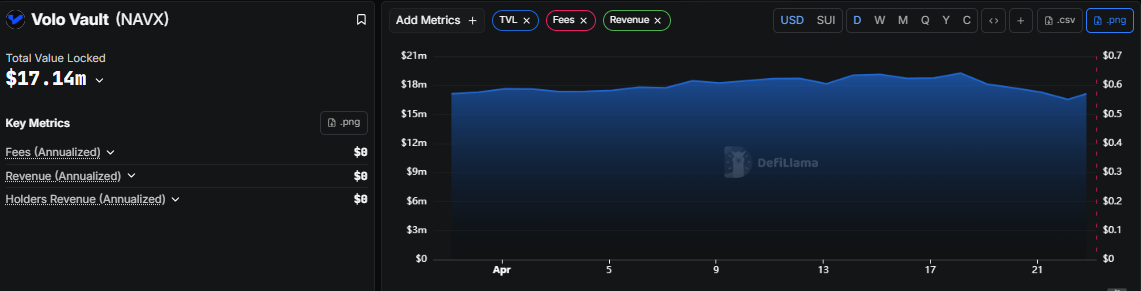
Since the TVL was unaffected, it suggested users still had confidence in holding their funds in Volo Protocol. It also assured security of the Sui blockchain, as the network infrastructure was unaffected.
However, the recovery of control of funds from the hackers raises questions about whether crypto is truly decentralized.
Crypto Hack Trends Point to Rising Systemic Risk
The Volo incident occurred during a period of elevated crypto hack activity. Industry data showed that more than $600 million was lost to exploits in April alone, with major breaches affecting protocols such as KelpDAO and Drift.
Over the past decade, crypto-related scams and hacks have resulted in losses exceeding $17 billion across more than 500 incidents. The growth of DeFi platforms has expanded the attack surface, particularly through cross-chain bridges and key management systems.
Blockchain investigator ZachXBT linked several recent attacks to organized hacking groups, including those associated with North Korea. These groups have increasingly targeted DeFi protocols due to their high liquidity and complex infrastructure.
The pattern suggests that attackers are shifting focus from centralized exchanges to decentralized systems, where security responsibility often falls on protocol operators.
Decentralization Debate Intensifies After Fund Freeze
The recovery of stolen funds raised broader questions about decentralization. In theory, decentralized systems operate without centralized control. However, the ability to freeze assets or intercept transactions suggests that some level of coordination still exists.
In the Volo case, collaboration between the protocol team, validators, and ecosystem partners enabled fund recovery. Similar interventions have occurred in other incidents involving networks such as Arbitrum and Sui.
These actions demonstrate that while blockchain systems are distributed, operational control can still be exercised under certain conditions. This creates tension between security and decentralization principles.
Supporters argue that intervention protects users and improves trust. Critics argue that it introduces centralized elements that contradict the core philosophy of DeFi.
Conclusion
The Volo crypto hack highlights both progress and limitations in DeFi security. While rapid response efforts helped recover a large share of funds, the breach exposed ongoing risks tied to private key management and system design.
At the same time, the ability to freeze and recover assets challenges assumptions about full decentralization. As crypto hacks increase, the industry faces a trade-off between security intervention and maintaining decentralized integrity.
Future developments will likely focus on improving key management, strengthening infrastructure, and balancing control with decentralization principles.




