
 astronaut
 Pearl
Pearl NEAR Protocol
 Walrus
 Zylo Ecosystem
 Bitcoin
 Hyperliquid

Pi Network price traded near $0.169 this week as selling pressure continued despite the project expanding into artificial intelligence tools and app-building infrastructure.
The token has fallen sharply since March and now trades more than 40% below its yearly high near $0.297. Traders continue questioning whether Pi can convert its large user base into real network activity and developer adoption.
Pi Network Price Falls Despite Entry Into Vibe Coding
Pi Coin token has been in a strong downward spiral since March this year, when Kraken listed it. This crash continued this month, even after the developers made some major announcements.
For example, Changpeng Zhao and Nikolas Kokkalis, the founders, delivered statements at the Consensus event in Miami this week. Their focus was on the artificial intelligence industry and ways for incorporating verification. They pointed to its KYC features, which have verified over 18 million people in the past few years.
In a separate statement this week, the developers mentioned that Pi Network had now moved to the vibe coding industry. This is a fast-growing area that allows people to use artificial intelligence to build applications and websites within hours.

Pi aims to take part in this industry by letting developers tap into its massive user base of over 60 million people. Creators can build their applications and then use the Pi App Studio to convert them into Pi applications, a move that will help them in their distribution.
This is a major development that, if it works, will make it easier for people to build applications and make them available to millions of people from around the world.
The challenge, however, is whether there are, indeed, 60 million active users in the Pi ecosystem. This number likely refers to all people who were involved in the platform a few years ago. So far, about 18 million people have successfully migrated their Pi coins to the mainnet.
Narrowing this down, there are chances that many of these users moved their tokens to the mainnet and then sold them. Besides, the token has crashed by over 90% from its highest point last year.
Pi Smart Contracts Also Face Some Major Challenges
Meanwhile, Pi Network price has crashed despite the recent upgrades that have introduced smart contracts to the platform. This upgrade has shifted it from v19 to v23 of Stellar Consensus.
The upgrades have introduced some major changes to the network, including smart contracts and parallel processing. Smart contracts will allow it to become a competitor to chains like Solana and Ethereum. Parallel processing, on the other hand, will make it much faster than other chains.
Still, the main challenge is that the smart contract industry is highly competitive, with hundreds of chains. Some of the top chains in the industry are Ethereum, BNB Chain, Solana, Base, and Arbitrum.
Many chains have been launched in the past few years, including Cardano, IOTA, Zilliqa, Berachain, and Scroll. Most of these, however, have not attracted any developer and user interest and are now ghost chains. Chances are that Pi will experience the same fate.
Pi Network Price Technical Analysis
The daily chart reveals that the Pi Coin price has crashed in the past few months and is now hovering near the crucial support at $0.1643. It formed a double-top pattern at $0.1993, its highest point on March 21 and April 29.
The coin has crashed to the 78.6% Fibonacci Retracement level. It has also remained below all moving averages. At the same time, the coin has dropped below the Ichimoku cloud.
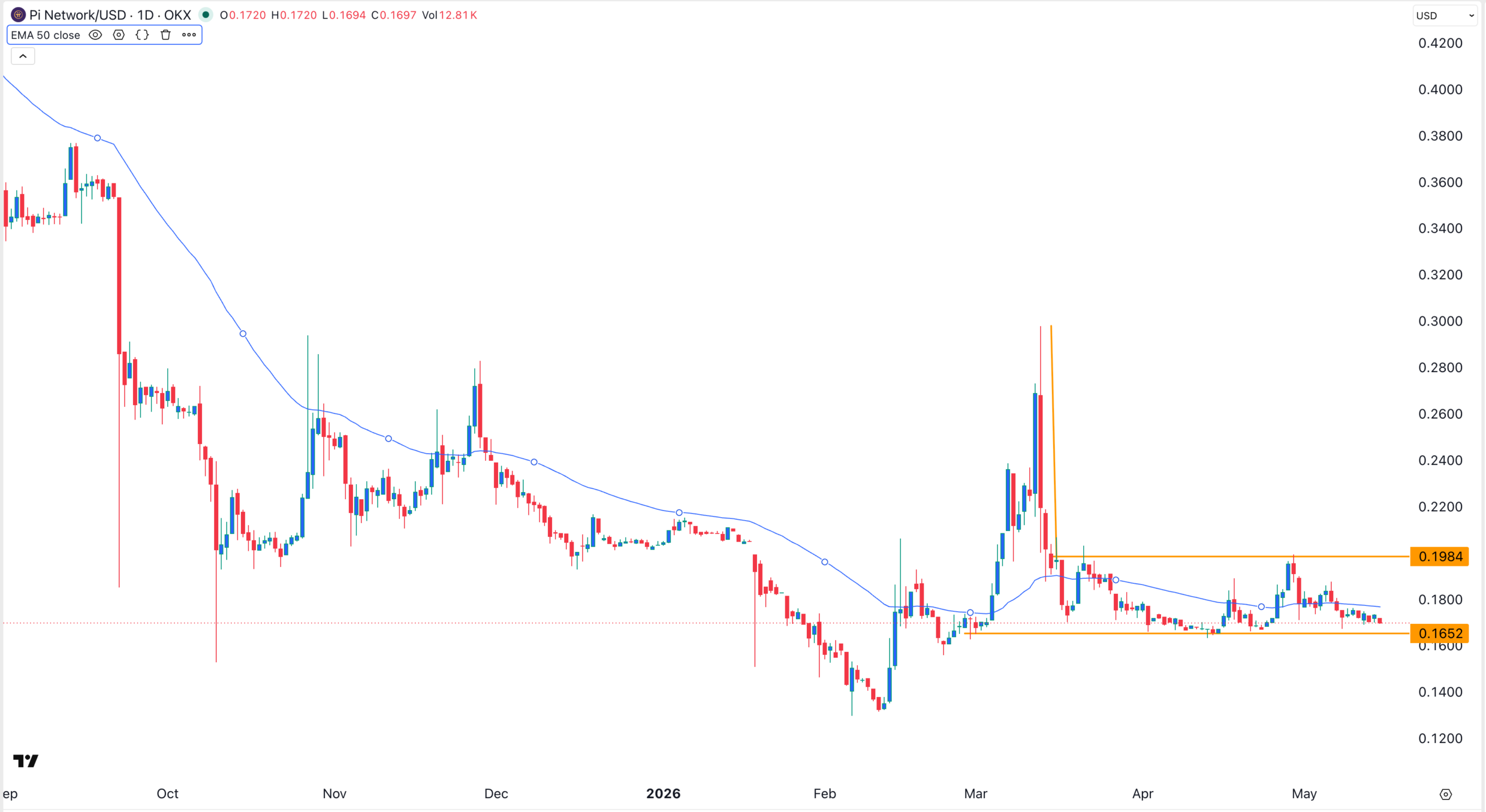
Therefore, there is a risk that the value of Pi will continue falling. This will be confirmed when it moves below the key support level at $0.1643, its lowest point in April. It is also along the 78.6% Fibonacci Retracement level. If this happens, the next level to watch will be at $0.1320, its lowest point on record.




