
 Wisp
Wisp Doge Pepe
 Zylo Ecosystem
 Crawlerpad
 Basic Attention
 Pearl
Pearl Quantus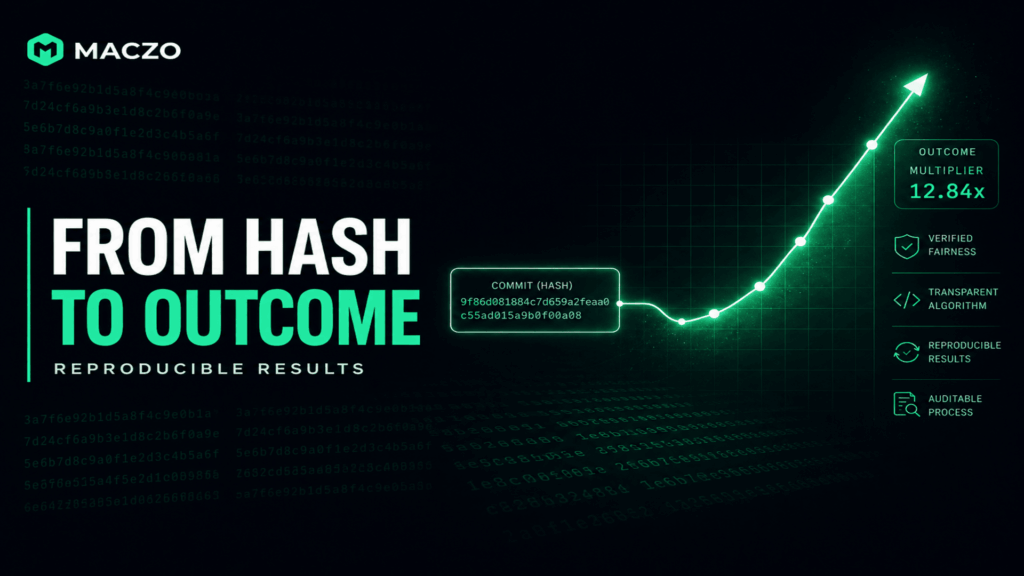
- Provably fair verification needs to reproduce the game result, not only confirm a seed hash.
- Plinko derives a path from individual bits, while Crash converts a 32-bit value into a multiplier.
- Public resolvers, paytables, and test vectors make the full mapping available for review.
Crypto gaming has made the phrase “provably fair” familiar, but familiarity can blur an important technical distinction. Confirming that a server seed matches an earlier commitment is useful. It does not, by itself, explain how the resulting cryptographic data became a Plinko bucket or a Crash multiplier.
Maczo’s Provably Fair help center presents verification as a complete path from inputs to a settled outcome. Its Maczo-developed Originals use a shared cryptographic engine, then apply a resolver written for each game’s rules. Plinko and Crash are a useful pair because their visual experiences look simple, while their verification logic is fundamentally different.
The Missing Layer Between Randomness and Result
A typical commit-and-reveal process begins with a secret server seed. The platform publishes its SHA-256 hash before play, creating a commitment that can be checked later. A client seed and nonce are combined with the server seed through HMAC-SHA256 to produce deterministic data.
If the revealed server seed hashes to the original commitment, a reviewer can confirm that the seed was not quietly replaced after the wager. Running the same server seed, client seed, and nonce through the public recipe should also reproduce the same stream of unsigned integers.
The next step is where games diverge. A resolver turns that stream into the visible result and payout. Without the resolver and its paytable, a valid hash proves less than many users assume.
Plinko: A Path Built One Bit at a Time
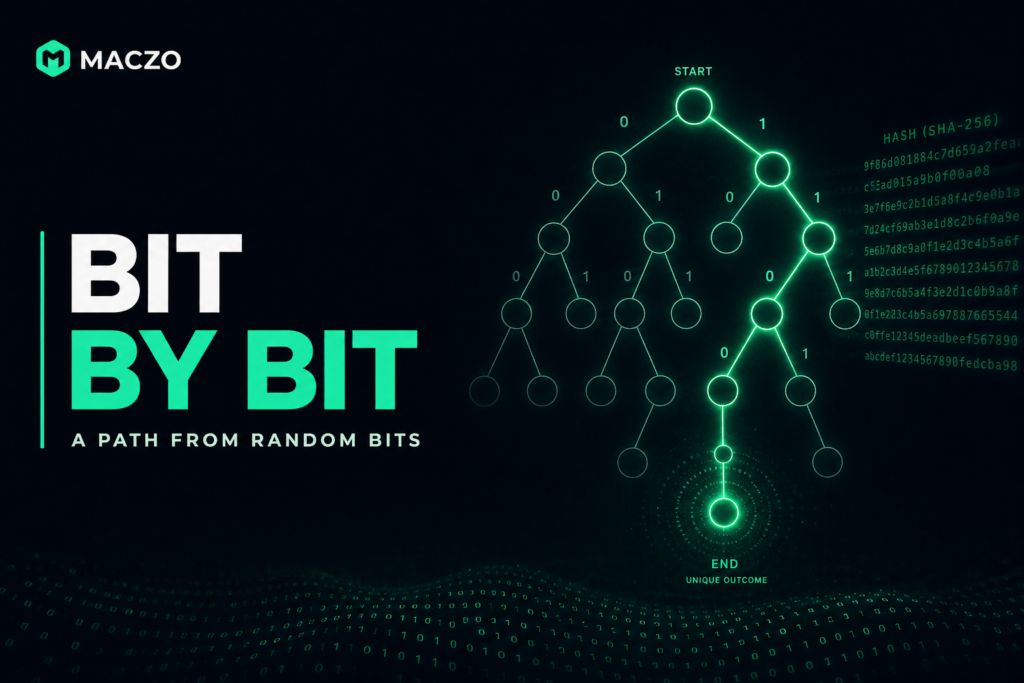
Plinko is displayed as a ball moving through rows of pegs before landing in a bucket. The open resolver does not need to simulate animation or physics. For each configured row, it reads one bit from the deterministic integer stream. One value sends the path left; the other sends it right.
Counting the rightward moves identifies the final bucket. The multiplier is then read from the published paytable for the chosen row count and risk configuration. Maczo’s Plinko repository classifies this mapping as uniform because the resolver uses bit extraction rather than a biased modulo reduction.
This makes verification compact but meaningful. A reviewer can regenerate every left-or-right decision, count the resulting position, and compare the bucket multiplier with the one shown in the settled bet.
Crash: Turning an Integer Into a Multiplier
Crash uses a different shape of uncertainty. A multiplier rises until the round ends, and a player’s selected cash-out point determines whether the bet wins. The resolver, therefore, needs to reproduce both the crash point and the comparison with the chosen cash-out value.
Maczo’s published recipe takes a 32-bit unsigned integer and applies a fixed formula based on the configured RTP. The result is represented with E8 fixed-point precision and clamped between 1.00x and a documented upper bound. The bet wins when the reproduced crash value reaches or exceeds the player’s cash-out setting.
The Crash repository labels its mapping as a modulo class and documents the residual bias as below, roughly 1e-5. Publishing that detail is important. Transparency is stronger when an implementation exposes its exact characteristics instead of replacing technical trade-offs with a broad promise.

Why the Two Verifiers Should Not Look the Same
Plinko needs enough deterministic decisions to build a path across multiple rows. Crash needs one value that can be transformed into a multiplier. Forcing both games into a generic “hash matched” screen would hide the part users actually want to check.
Maczo addresses this with a shared engine for commitments and HMAC output, plus a separate pure resolver for each Original. The public GitHub organization contains the shared component as well as game-specific repositories. Each game can publish its own resolve.js, paytable, known-answer test vectors, and command-line self-test.
That architecture also reduces unnecessary duplication. The cryptographic core lives in one place, while the game repository focuses on the rules that make its outcome unique.
What Test Vectors Add
Source code is useful, but a verifier also needs examples that establish what the correct output looks like. Known-answer test vectors pair fixed inputs with expected outcomes. Running the JavaScript implementation against those vectors checks whether it agrees with the authoritative server-side recipe.
For both Plinko and Crash, the public repositories include test vectors and published odds. The paytables map a cryptographic outcome to the multiplier, while the tests verify that another environment can produce the same result.
A Practical Verification Checklist
A settled result should provide enough information to repeat the process. A reviewer can work through four questions:
- Does the revealed server seed match the commitment published before play?
- Do the server seed, client seed, and nonce reproduce the same integer stream?
- Does the correct game resolver reproduce the Plinko path or the Crash point?
- Does the published paytable produce the same multiplier and payout?
Players do not have to inspect every line of JavaScript to benefit. Browser-based tools make the process accessible, while the source code gives developers and independent researchers a way to audit the implementation more deeply.
Why This Matters for an Asia-Focused Platform
An online platform serving audiences across Asia may localize language, payments, and game selection, but verification has a different advantage: it travels. The same public inputs and deterministic code can be checked from any location without relying on a region-specific marketing claim.
That does not make every game equally suitable for every user or jurisdiction. It does give technically curious players a clearer basis for evaluating Maczo-developed Originals and separating reproducible evidence from promotional language.
The Limits Still Matter
Provably fair verification does not eliminate the house edge, guarantee a favorable result, or cover proprietary games from external studios. It also does not replace licensing, account security, local legal requirements, or responsible-play controls.
Its value is narrower and more defensible: once the required seed data is available, a settled result can be independently reconstructed under the published rules. Plinko and Crash show why the strongest proof includes the complete mapping from hash to outcome, not the hash alone.





