
 Pearl
Pearl Walrus
 Starknet
 Quantus
 Bitway
 Sui
Sui Zylo Ecosystem

Hyperliquid is preparing to open its HIP-4 outcome markets to permissionless deployment, giving builders a clearer route to launch prediction markets on the platform.
The update arrives as HYPE trades near the $60 region, where traders are watching whether support can hold after a retest of the former resistance zone.
This article is for informational purposes only and does not constitute investment or financial advice. Cryptocurrency markets are highly volatile, and protocol upgrades or governance proposals do not guarantee future token price performance.
Hyperliquid Expands HIP-4 Outcome Markets
According to Hyperliquid‘s official HIP-4 governance proposal and developer documentation, permissionless deployment support for outcome markets will be introduced in a future protocol upgrade, beginning on testnet before a mainnet release.
The platform said outcome markets needed enough battle testing under validator deployment before broader access could begin. That approach keeps the rollout gradual while allowing Hyperliquid to expand beyond curated market launches.
Under the new model, builders will use validator-approved templates to deploy prediction markets. This structure aims to reduce spam, improve market quality, and limit poorly defined contracts before they reach users.
Notably, permissionless deployment matters because prediction market events can scale faster than standard spot or perpetual trading pairs. If all goes well, Hyperliquid crypto might enable a broader scope of event-based markets without having to apply directly for each launch.
Builders Face Strict Staking Rules
Meanwhile, the deployers will have to stake 500,000 HYPE tokens before deploying markets. The stake will be locked for 6 months, and the deployers will be required to settle all the active markets before they can unstake.
The stake can also be sliced by the validator votes if the deployer is producing bad settlements and poorly defined markets. This ensures validators have an enforcement role and maintains an open deployment process for qualified builders.
Deployers can earn up to 50% of trading fees from prediction markets they launch. That fee-sharing model gives builders a direct incentive to create active markets with strong user demand.
Additionally, Hyperliquid will not restrict identical markets. Multiple deployers can launch similar contracts, which may increase competition and push builders to offer better liquidity, clearer terms, or stronger user experience.
Fee Updates and Auctions Add Next Layer
Hyperliquid crypto has also outlined follow-up features for HIP-4 as the prediction market system grows. These include fee configurability and an auction mechanism, both designed to improve market deployment and pricing flexibility.
HIP-4 already gained attention earlier this year after its May launch. At the time, Hyperliquid introduced outcome market features through a validator-deployed model, including non-linear and fixed-range contracts. These markets allow users to trade event outcomes without traditional leverage or liquidation risk.
The HYPE token rallied almost 100% after the initial HIP-4 rollout, showing how strongly the market reacted to the prediction-market narrative. The next upgrade may now test whether the same theme can attract fresh demand.
However, derivatives data still show a measured tone. HYPE futures open interest recently slipped more than 2% to around $1.36 billion, while some activity improved across Hyperliquid, Binance and Bybit in shorter windows. That suggests traders remain active, but conviction is not yet one-sided.
HYPE Price Retests Major Support
HYPE is trading near $60 after retesting the $55–$60 weekly support zone. Whale Factor’s chart showed that former resistance has now turned into support, which keeps the bullish structure intact as long as buyers defend the range.
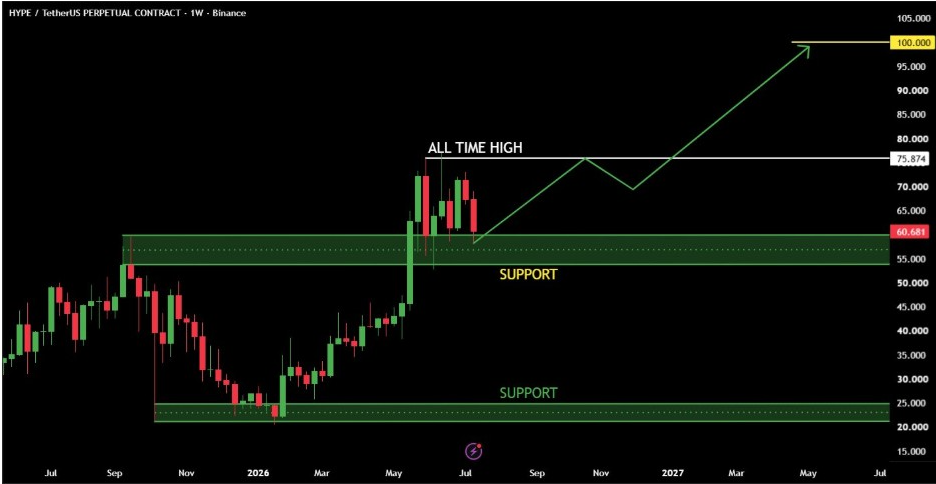
The first major upside level sits near the previous peak at $75.87. A move above that level would confirm renewed strength and could open the next leg higher. The chart also shows a macro extension path toward $100 or more if momentum expands after the retest.
At the same time, the $55–$60 zone remains the key invalidation area for the current setup. A weekly close below that region would weaken the breakout structure and place the lower support area near $30 back into view.



