
 Pearl
Pearl Bitway
 Pudgy Penguins
 Optimism
 Walrus
 NEAR Protocol
 Pons
Pons

Bitcoin traded near $63,200 on Aug. 2 after holding the $62,500 support zone. The daily chart showed a weak rebound, while sellers defended resistance near $65,000.
The setup mattered because Bitcoin remained below its broken rising channel. Derivatives activity also increased, raising liquidation risk around the next directional move.
Bitcoin Price Holds Above $62,500 After July Weakness
Bitstamp data on TradingView showed Bitcoin opening Sunday near $62,760. It reached $63,565 before settling around $63,170 at 09:28 UTC.
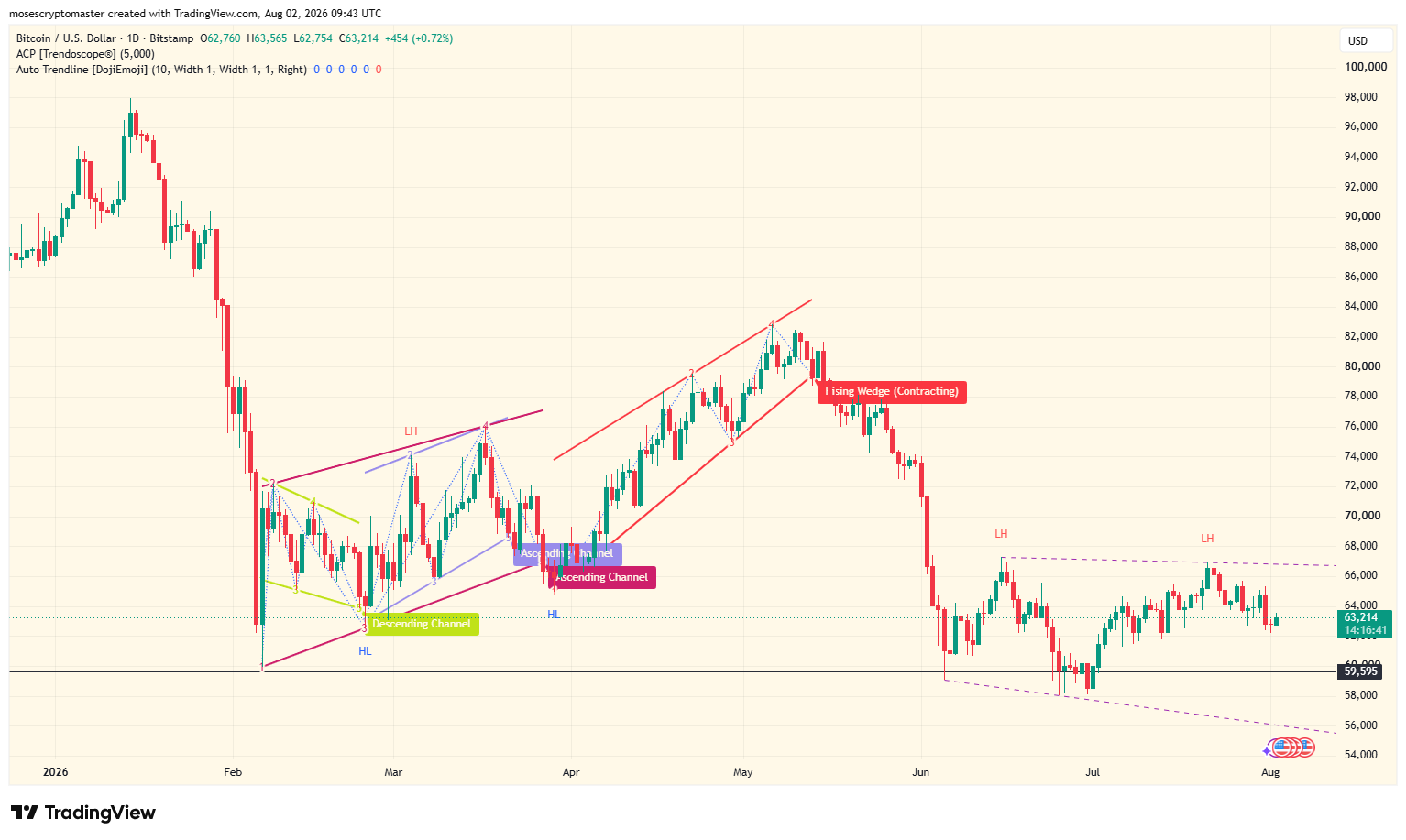
The session gained about 0.7%, but the broader structure remained defensive. Bitcoin had fallen from May’s area above $82,000 and failed to recover June losses.
The supplied daily chart placed immediate support near $62,500. A stronger horizontal floor sat near $59,600, close to the market’s June trough.
Trader Ted said Bitcoin closed above the $62,500 support zone. He argued that bulls still required a quick recovery above $65,000.
That level aligned with repeated July rejection points on the chart. A successful daily close there could weaken the current lower-high sequence.
Bitcoin Price Remains Inside a Bearish Technical Structure
Crypto Patel said Bitcoin had broken below its prior rising channel. He also identified $72,000 to $74,000 as a bearish order block.
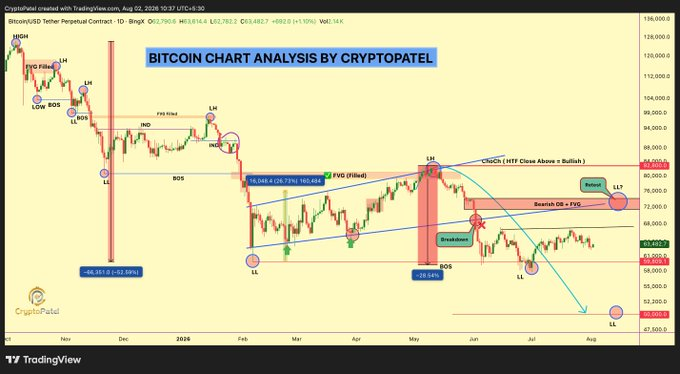
The chart supported the first part of that assessment. Price left its April-to-May channel before accelerating lower during June.
However, the $72,000 target remained distant from current trading. Buyers first faced resistance near $65,000 and the July lower high around $67,000.
The chart also showed a descending channel developing since June. Its upper boundary limited rebounds, while its lower boundary approached the mid-$50,000 region.
That formation did not guarantee another decline. It indicated that sellers had retained control across successive recovery attempts.
July seasonality offered limited support for a bullish case. Draxen said six of seven July periods since 2020 closed positively.
Historical seasonality does not establish future returns. This year’s July recovery also failed below the chart’s June breakdown area.
Futures Activity Raises Liquidation Risk
CryptoQuant data showed aggregate Bitcoin futures open interest reaching a two-month high during late July. Binance led the 30-day increase, the research platform said.
Rising open interest reflected growing active derivatives positions. It did not reveal whether traders held a net bullish or bearish bias.
The combination of higher leverage and narrow spot movement increased sensitivity to forced liquidations. A break from the range could accelerate through clustered stop orders.
CME Group’s Bitcoin futures page also showed active August contracts around the current spot area. The regulated market offered another reference for institutional positioning.
Coinbase’s August futures contract showed roughly $45 million in open interest on Aug. 2. Its displayed range stretched from about $63,370 to $65,840.
Those figures indicated participation, but not directional conviction. Traders still required spot confirmation above resistance or below support.
Bitcoin Price Faces Policy and ETF Catalysts
The Digital Asset Market Clarity Act remained a policy catalyst for U.S. crypto markets. House Clerk records showed lawmakers passed H.R. 3633 by 294-134 in July 2025.
The bill defined a mature blockchain through control and governance tests. Its text focused on systems not controlled by one person or a coordinated group.
House Financial Services Chairman French Hill presented the framework as a division of oversight responsibilities. The proposal assigned roles to securities and commodities regulators.
A July 17, 2026, committee hearing revisited the measure one year after House passage. Subcommittee Chairman Bryan Steil argued that clearer rules could support domestic digital-asset activity.
The policy debate mattered for Bitcoin because decentralization affects commodity treatment under the proposed framework. It did not create an immediate price trigger or guarantee Senate approval.
The broader exchange-traded fund market also expanded rapidly during 2026. MarketWatch cited 953 launches through late July, with leveraged products driving much activity.
Investment Company Institute guidance warned that leveraged and inverse funds target daily results. Compounding can produce wider tracking differences across longer holding periods.
Bitcoin’s next verifiable levels remain $65,000 resistance and $62,500 support. A support failure would expose $60,000, while $67,000 marks the next recovery test.




