Wisp
Wisp Identity.md 6900
 Crawlerpad
 Bunker Mode
 Pearl
Pearl Starknet
 Quantus

Iran crypto use expanded as authorities relaxed enforcement around foreign-exchange repatriation. Exporters increasingly used Bitcoin and USDT to move overseas earnings back into the country.
The Financial Times reported the shift on Sept. 9. However, the policy represented greater enforcement flexibility rather than a formal legalization of crypto settlement.
Iran Crypto Use Expands as FX Rules Loosen
Citing sources familiar with the matter, the Financial Times reported on Sept. 9 that Iranian companies can receive crypto payments in USDT and BTC, for cross-border transactions. “Receiving export payments in crypto has now become completely normalized,” said an executive associated with the government.
With these reported changes, exporters would be able to repatriate overseas funds through domestic cryptocurrency exchanges. Businesses could also convert foreign currency through open markets or use export proceeds directly to finance imports.
Such an arrangement will reduce exporters’ reliance on Iran’s official foreign-exchange system. However, the Financial Times report points to a shift in enforcement rather than a new law or formal central bank directive towards crypto regulations. No public document from the Central Bank of Iran has confirmed authorizing crypto as a legal settlement method for all exporters.
Thus, the legal uncertainty around this matter persists, with no official policy on the matter. Policies could change, while transactions may remain subject to domestic reporting, tax and foreign-exchange requirements.
Iranian officials are also seeking to repatriate export proceeds held overseas. More than 20,000 individuals and companies have allegedly failed to return around €94 billion, according to figures cited by the Financial Times. However, the claim has not been independently verified through a filing with the Central Bank of Iran.
Using USDT Could Be Risky for Iranians In Cross-Border Transactions
While USDT could help Iran evade the US sanctions for now, it may not be a permanent solution. This is because Tether can freeze these tokens at the issuer level. Thus, USDT is not as decentralized as Bitcoin, which has no central bank issuer.
When the US-Iran war was at its peak in April 2026, Tether froze approximately $344 million in USDT across two Tron addresses that U.S. authorities had linked to Iranian state and military networks. The freeze targeted funds allegedly connected to Iran’s Islamic Revolutionary Guard Corps (IRGC).
Thus, bypassing US sanctions via blockchain transactions is not always possible. Stablecoin issuers, centralized exchanges and compliant intermediaries can freeze assets or restrict addresses when authorities identify activity subject to sanctions.
Iran’s Rial Crashes 21% Since July
One of the major reasons businesses in Iran are turning to crypto is the freefall of the Rial. Former Goldman Sachs executive and economist Robin Brooks explained that the Iranian rial has fallen 21% since July 14, when the U.S. blockade was reimposed.
Brooks described the decline as evidence that Iran is facing a “full-blown, all-out currency crisis”. He argued that the currency weakness of the Iranian Rial reflects a rapidly deteriorating economy.
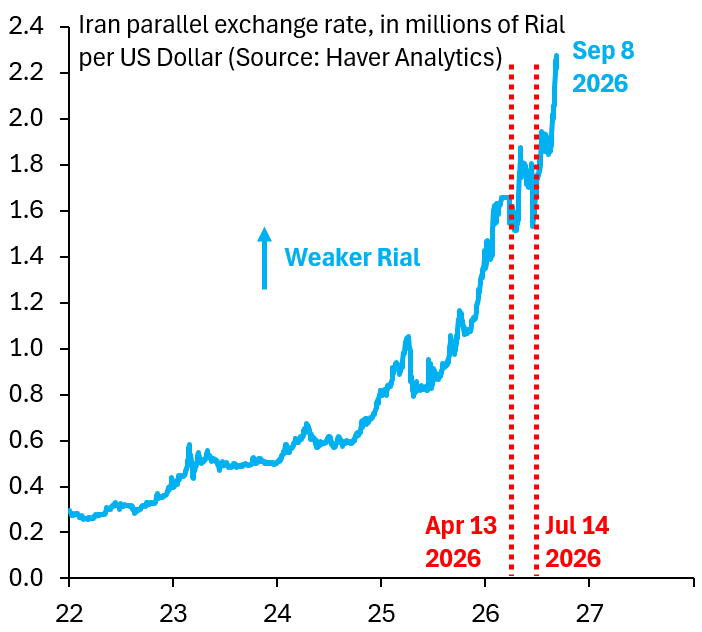
Brooks added that the economic crisis could make it increasingly difficult for Iran to sustain its ongoing conflict. Such a circumstance would increasingly push towards the greater adoption of cryptocurrencies.
However, the US sanctions would also make Iranian crypto transactions risky. The U.S. Treasury treats Iranian digital asset exchanges as Iranian financial institutions. This means their property must be blocked when it falls under U.S. jurisdiction.
In June, the U.S. Treasury designated Nobitex, Wallex, Bitpin, and Ramzinex. The regulators accused the platforms of operating within Iran’s financial sector and facilitating activity linked to sanctioned entities.
This article is for informational purposes only and should not be considered legal, sanctions-compliance, financial, or investment advice. Businesses should review applicable laws before conducting cross-border crypto transactions.