astronaut
 Pearl
Pearl NEAR Protocol
 Starknet
 Zcash
Zcash Pudgy Penguins
 Ethena

Robinhood stock extended its pullback on Sept. 28, closing at $116.46 after losing 2.46%. HOOD has declined from recent highs near $126 but remains well above its March low.
The stock still sits about 24% below Robinhood’s all-time closing high of $152.46. A return toward the roughly $154 intraday record would represent about 32% upside from the latest close.
Robinhood Stock Could Benefit From Higher Short-Term Yields
HOOD share price may benefit from the rising government bond yields. The ten-year yield rose to 5.22%, while the five-year and three-month rose to 5.05% and 4.22%.
These rising bond yields may benefit Robinhood because of its huge cash balances, which are now earning higher returns. Interest is an important part of Robinhood’s business, with this business generating over $389 million in revenue, up by 9% from a year earlier. Revenue rose due to the ongoing increase in interest-bearing assets, but was offset by a drop in interest rates during the quarter.
Now, however, bond yields and the amount of yield-earning assets have continued to rise recently. This makes Robinhood one of the top companies that may benefit from the rising bond yields.
Analysts Remain Bullish on HOOD Shares
The other key reason why Robinhood stock may do well in the coming months is that analysts remain highly bullish on the company. Earlier this month, Devin Ryan, a Citizens Bank analyst, maintained his market-outperform rating on the company and hiked his target from $155 to $165.
Mizuho’s Dan Dolev maintained his outperform rating, boosting his target from $130 to 140, while Bernstein’s Gautam Chhugani hiked to $160. Other analysts who are highly bullish on the company are from banks like Jefferies, Goldman Sachs, Morgan Stanley, and Cantor Fitzgerald.
These analysts point to its revenue growth, which is expected to jump by 17% this year, followed by 28% next year.
Robinhood Chain Metrics are Soaring
Meanwhile, the recently launched Robinhood Chain is doing significantly well, with more developers and assets continuing to rise. The total value locked (TVL) in the network has just crossed the $1 billion metric. Some of the top players in the network are Morpho Blue, Steakhouse Financial, and Uniswap.
The DEX volume is also gaining momentum. Data show that the network has handled over $55.7 billion in the last 30 days, exceeding Ethereum’s $41.2 billion. It was also more than double what Base Chain handled in the same period. The biggest DEX protocols in the chain are Uniswap, Fables, RamsesX, and Up.
These numbers indicate that Robinhood Chain is now generating millions of dollars, some of which it transfers to Arbitrum. Its network fees rose to $35 million, up sharply from last month’s $6.6 million.
Robinhood Chain’s total Real-World Assets (RWA) are soaring, with a market capitalization of $295 million. This growth may continue now that the Securities and Exchange Commission (SEC) has given an innovation exemption to tokenized assets.
Robinhood Stock Technical Setup Keeps $126 and $154 in Focus
Robinhood stock reached $126.41 on Sept. 21 and $126.74 on Sept. 23. Those two highs created a possible double-top structure around $126. HOOD then fell to $116.46 by Sept. 28. The latest session low was $116.06.
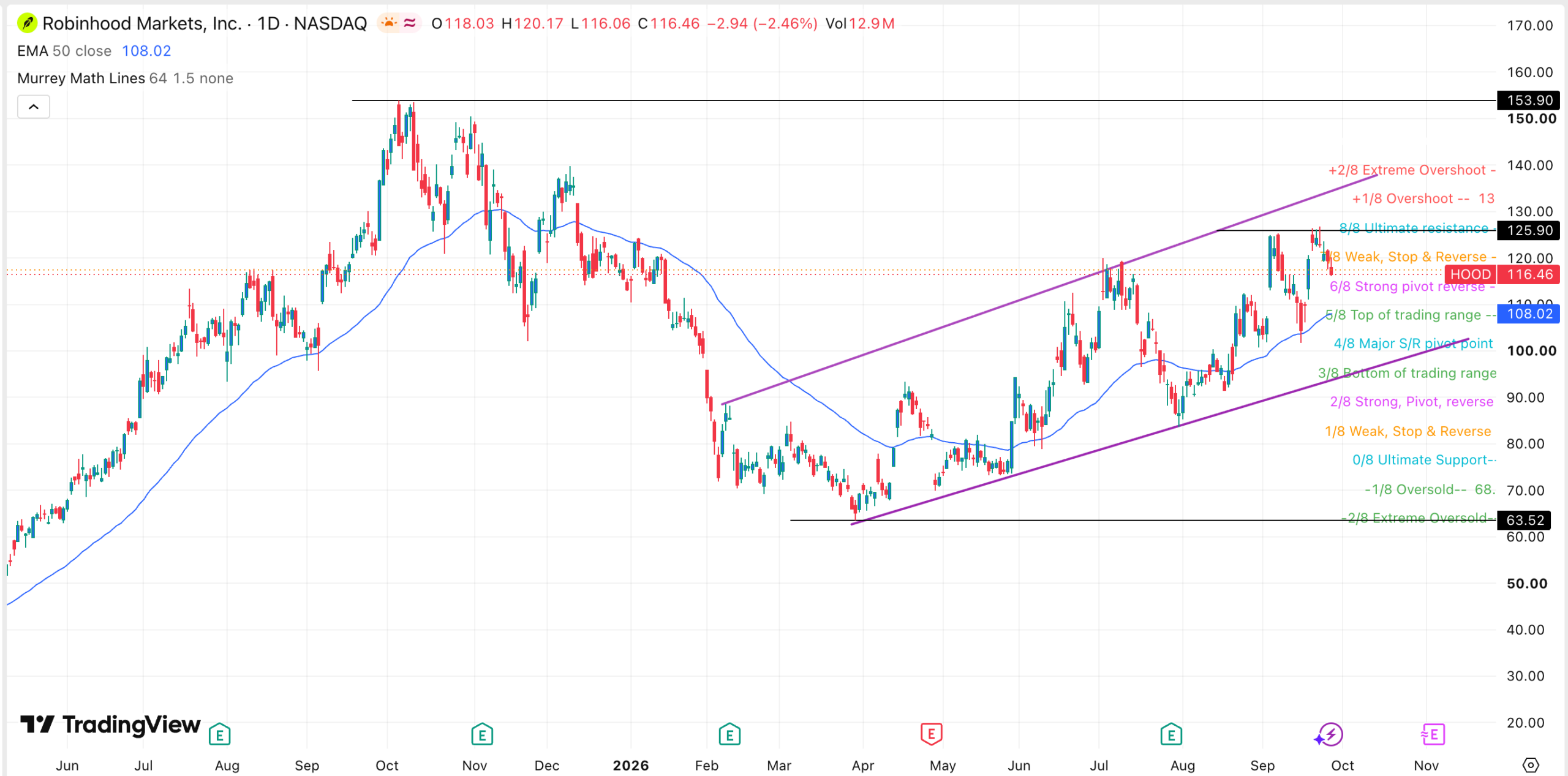
The supplied TradingView chart places the stock above its 50-day exponential moving average and Supertrend indicator. It also shows a broader ascending structure from the March low.
A recovery above the $126 area would weaken the double-top setup and reopen the path toward higher resistance.
The historical all-time closing high stands at $152.46, while the intraday 52-week high was about $153.86.
From $116.46, a move back toward $153.86 would represent roughly 32% upside. That remains a conditional technical scenario rather than a price forecast.
A sustained break below $100 would weaken the broader bullish structure shown on the supplied chart. The near-term test is whether buyers can defend the $116 area and reclaim the recent $126 resistance zone.
This article is for informational purposes only and does not constitute financial or investment advice. Analyst targets and technical scenarios remain conditional.