Zerebro
 Bitcoin
 Aerodrome Finance
 ZKsync
 Pearl
Pearl Pudgy Penguins
 Bitway
Nvidia stock finished last week near its record after extending a late-September rally. Shares reached $237.88 on Oct. 2 before closing at $233.95.
The rally came as DBS Chief Investment Officer Hou Wey Fook challenged concerns around an artificial intelligence bubble. He pointed to Nvidia’s earnings growth and forward valuation as evidence supporting his view.
However, Nvidia shares now sit near resistance after a strong advance. A rising wedge on the daily chart also introduces a possible downside scenario.
Analyst Says There’s No AI Bubble
Hou Wey Fook, the Chief Investment Officer at DBS Group, a bank with over $728 billion in assets, argues that there is no AI bubble. In a Bloomberg interview, he used the valuations of many companies in the industry to justify the view.
He pointed to the fact that Nvidia trades at a forward price-to-earnings ratio of 24, much lower than the five-year average of 42. Its trailing twelve-month (TTM) multiple of 33 is also lower than the five-year average of 58.70.
Based on GAAP numbers, the forward P/E ratio has moved to 23.43, also lower than the five-year average of 51. In theory, a company experiencing strong revenue and profitability growth should trade at a bigger multiple.
The cheap valuation explains why the company decided to announce a large share buyback program last week. It will repurchase shares worth $150 billion on top of the $80 billion that it is currently buying. The hope is to reduce the number of shares in circulation, which normally leads to higher earnings per share (EPS).
Other companies in the AI space also spot a relatively tiny valuation. A good example of this is Micron, which has a forward PE ratio of 8 despite its strong financial results. This valuation multiple is much lower than the S&P 500 Index’s average of 19. Its earnings report last week showed that its revenue jumped by over 330%.
Still, some analysts believe that we are in an AI bubble that may burst in the near future. Some of the most notable analysts to warn of a bubble are Michael Burry and Ray Dalio.
Big-Tech Earnings are Coming Up
The next important catalyst for the NVDA stock will be the upcoming earnings by its top clients and suppliers. These results will provide more hints on whether spending is continuing.
The first important earnings report to watch will be from Taiwan Semiconductor, which is its biggest supplier. Other top companies that will publish their numbers are its clients like Microsoft, Amazon, and Meta Platforms.
Nvidia is usually one of the last companies to publish its financial results. In this case, it will release its numbers on November 17. These results are expected to show that its revenue will come in at $109 billion, up by 91% from a year earlier.
Nvidia Stock Price Technical Analysis
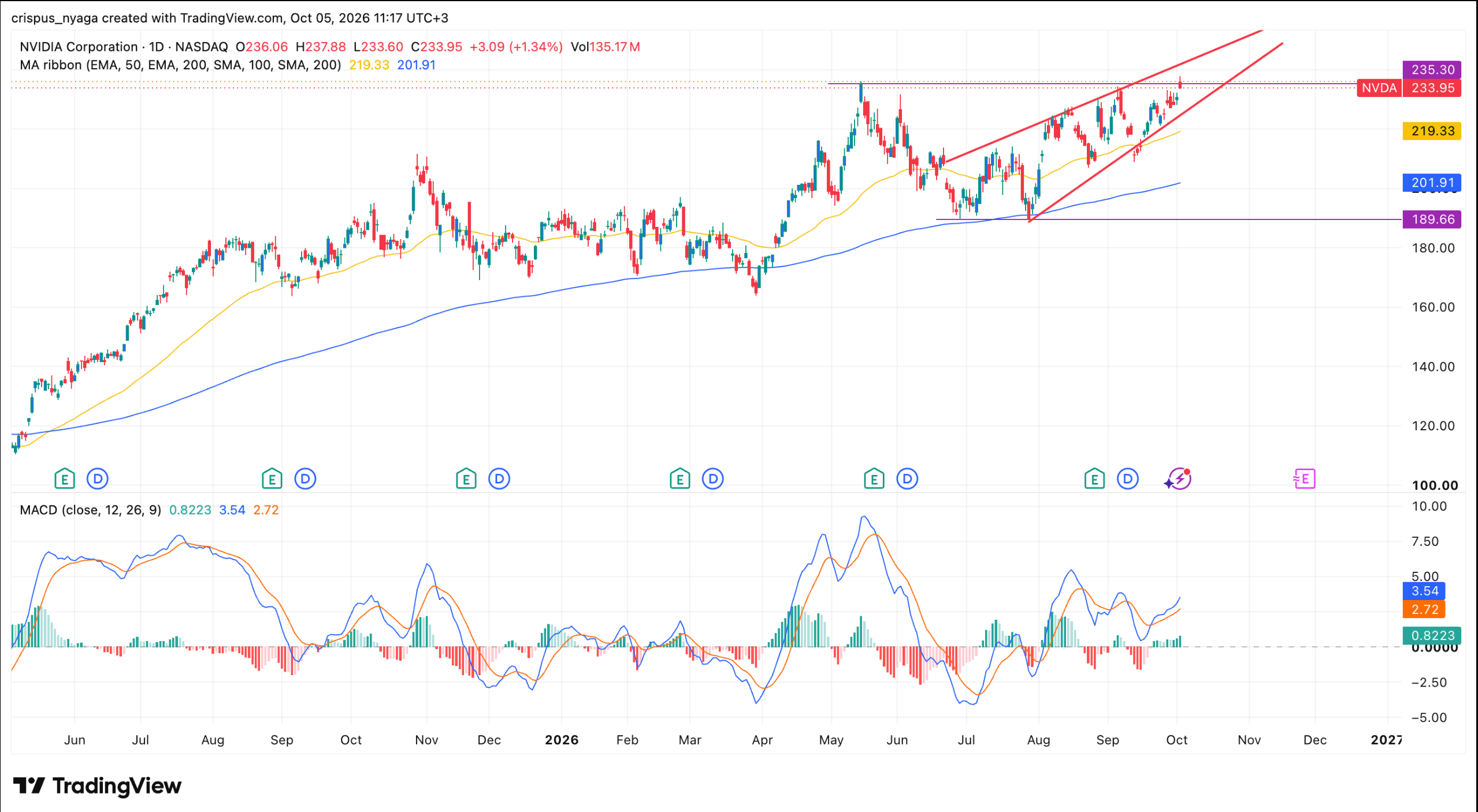
The daily chart shows that NVDA stock has been in an upward trend in the past few weeks. It has jumped from a low of $189.66 on July 29 to a record high of $237.6.
It is now hovering at its previous all-time high. At the same time, the stock has remained above the 50-day and 100-day Exponential Moving Averages (EMA). The two MACD lines have continued to rise. These technicals suggest that the stock will continue rising, potentially to the psychological level of $250.
On the other hand, the stock has formed a rising wedge pattern, which is a common reversal sign. This pattern consists of two ascending, converging trendlines. In most cases, this pattern usually leads to a bearish breakout, potentially to $200.
This article is for informational purposes only and does not constitute financial or investment advice. Valuation metrics, technical patterns and analyst opinions do not guarantee future stock performance.