
 streamoors
 Sword Inu
 Altai the Tiger
 IGNITION
 no crying in the casino
 NEAR Protocol
 Pudgy Penguins

Bitcoin mining economics showed signs of improvement as MARA Holdings’ estimated production cost fell below Bitcoin’s market price. CryptoQuant Chief Executive Officer Ki Young Ju reported a mining cost of $59,774 per BTC on Oct. 14.
Ju based his calculation on operating figures from MARA’s financial disclosures. The estimate suggested improved mining margins, although it did not establish company-wide profitability.
Meanwhile, Bitcoin’s network hashrate reportedly increased during the preceding two months. The recovery coincided with stronger analyst sentiment, even as BTC faced renewed selling pressure.
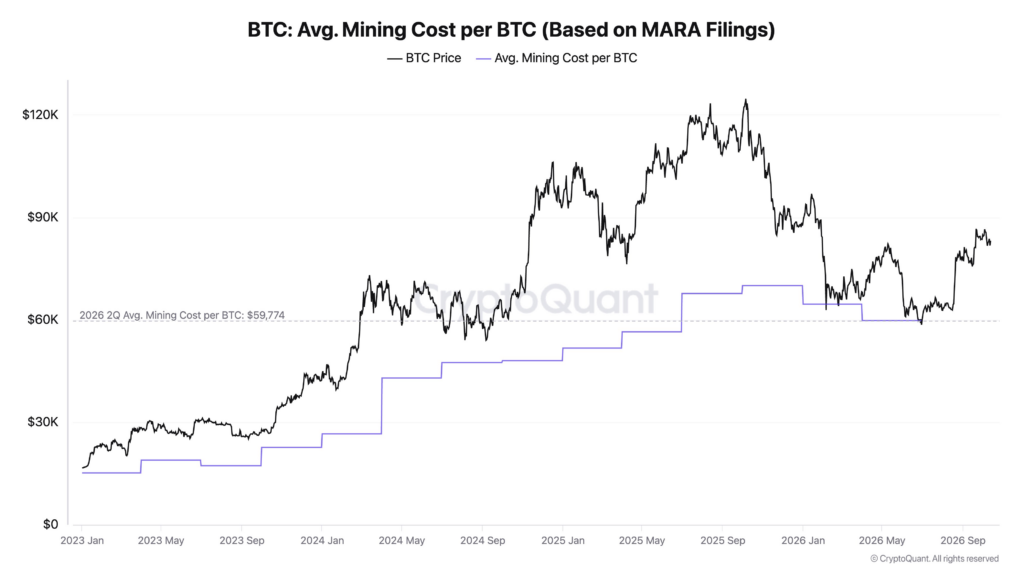
Analysts multiply its average operational hashrate by its cost per petahash, then divide the result by the average BTC mined per day. The firm’s most recent mining cost has declined sharply from $70,027 per BTC, calculated in February 2026.
Rising Bitcoin Hashrate Reflects Miners’ Bullishness
The sharp decline in cost comes amid a rising Bitcoin hashrate, a sign that more miners are joining the network.
In February, the network had a 7-day simple moving average (SMA) of as low as 909 EH/s according to Hashrate Index. That has now increased to 1,007 EH/s by October 14.
While this is still below the peak hashrate of around 1,115 EH/s in October 2025, when Bitcoin was trading at its all-time high, the rise highlights how improved price performance is bringing back more miners.
Ju also acknowledged this, noting that Bitcoin hashrate has been rising for two months after falling for nine months. He noted that “More mining rigs = miners are bullish.”
Meanwhile, Bitcoin mining difficulty is rising again. After several falls in the past year, three of the last four mining difficulty adjustments have been increases, a sign that miners could soon face more challenges mining BTC.
Bitcoin Price Falls Toward $80K Despite Bullish Sentiment
Bitcoin price weakened on Oct. 15 despite reports of improving mining economics. Barron’s reported BTC near $80,743, down approximately 1.2% during the session.
The cryptocurrency also fell to an overnight low around $80,247. The decline followed September’s stronger-than-expected U.S. inflation report.
Higher inflation increased concerns that the Federal Reserve could raise interest rates again. Those expectations weighed on risk assets as investors assessed tighter financial conditions.
Meanwhile, CryptoQuant reported growing bullish sentiment among analysts tracked by its platform. Approximately 84% of 164 analysts held positive Bitcoin views, compared with 37% in July.
The reading marked the strongest reported sentiment since August 2025. However, the percentage covered CryptoQuant’s tracked analysts rather than the entire investment research industry.
The improvement contrasted with Bitcoin’s recent price performance. Despite stronger analyst expectations, BTC continued struggling to sustain a recovery above nearby resistance levels.
The $80,000 region now represents an immediate psychological price reference. A sustained breakdown could weaken the near-term outlook, while renewed buying could support another recovery attempt.
However, analyst sentiment does not guarantee future price gains. Bitcoin also remains sensitive to institutional demand, market liquidity, and monetary policy expectations.
What Comes Next for Bitcoin Mining and BTC Price?
Bitcoin mining economics will remain sensitive to production expenses, network difficulty, and BTC market prices. MARA’s estimated $59,774 production cost suggests a favorable operating spread under the reported conditions.
However, its quarterly financial results highlight expenses beyond direct mining operations. Further difficulty increases could also affect production economics even if network hashrate continues recovering.
The next development to monitor is whether mining activity remains elevated while Bitcoin trades near $80,000. Sustained price weakness could narrow operating margins and affect equipment deployment decisions.
CryptoQuant’s analyst sentiment figures suggest optimism among its tracked participants. However, stronger demand and confirmed price recovery would provide clearer evidence of improving market conditions.
For now, MARA’s estimated production cost remains below Bitcoin’s reported market price. Whether that spread persists will depend on energy costs, network competition, and future BTC price movements.
This article is for informational purposes only and does not constitute financial or investment advice.



