
 streamoors
 Sword Inu
 Altai the Tiger
 IGNITION
 no crying in the casino
 NEAR Protocol
 Pudgy Penguins

Ethereum co-founder Vitalik Buterin issued a strong critique of World, the iris-scanning identity project by Tools for Humanity, backed by Sam Altman. While he acknowledged the need to combat bots and AI-generated spam, Buterin warned that enforcing a single global digital identity—even with zero-knowledge privacy layerswould likely end online anonymity.
He proposed a more decentralized structure called pluralistic identity, which relies on multiple verification sources. Buterin argued that this model better aligns with individual freedoms and the need for flexible identity management across different social contexts.
Vitalik Buterin Criticizes Worldcoin’s Unified Digital ID Model
World, formerly known as Worldcoin, requires users to undergo iris scans to receive a digital identity and cryptocurrency tokens. The project claims that it uses zero-knowledge proofs (ZKPs) to secure user privacy while confirming human identity.
However, Buterin argues that a one-person-one-ID system, even when ZK-wrapped, makes it easier for governments, employers, or platforms to track individuals.
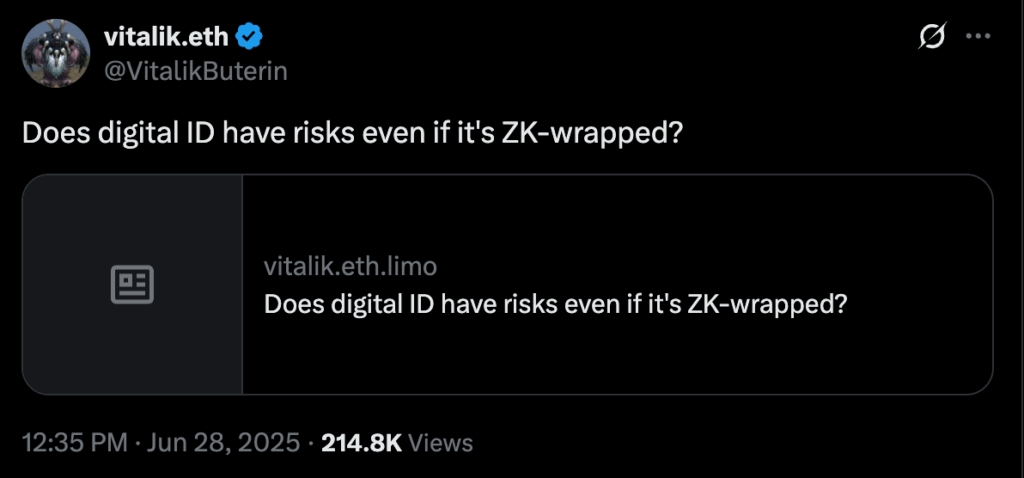
Buterin notes that in the current internet environment, most people use several pseudonymous accounts to enhance privacy, advocacy, or creativity. Implementation of a single identity system may subject the user to manipulation, particularly in politically volatile settings.
He stresses the fact that as individuals are compelled to associate all their actions with one and the same ID, they lose the possibility to act anonymously.
Pluralistic Identity Offers a Balanced Alternative
As a solution to these threats, Buterin suggests a system of a pluralistic identity that would allow a decentralized verification of identity.
This model promotes the adoption of multiple identity sources, including social networks, government IDs, crypto wallets, and biometric data. It also reduces the chances of abuse and monopoly of data since it does not rely on one authority.
Such systems may be explicit, such as social trust based on endorsements, or implicit, based on multiple ID providers.
Buterin is of the opinion that the strategy would produce a stronger identity infrastructure that is flexible to various situations and safeguards individual freedom. It also provides access to individuals who do not have or live in repressive regimes.
Vitalik Buterin Rejects Wealth-Based Verification Models
Buterin is also critical of identity systems running on the proof of wealth, where users would obtain verification through financial assets. He states that this practice favours the wealthy and disregards the poor, which is not fair and inclusive.
Rather, he proposes models of identity in which it would be progressively more costly to obtain more than one ID, but no one is excluded.
He cautions that should such platforms as World gain close to monopoly status in the market, they may impose a fixed identity model on the rest of the world.
This control might pose a danger to the freedom of expression, especially in areas where there is harsh surveillance. Buterin emphasizes that pluralistic identity is the most effective to maintain privacy and fight centralization.
The Call for Decentralized Identity Governance
With the growing popularity of digital identity systems in various industries, Buterin calls on the community to embrace models that focus on human rights and data sovereignty. He says that innovation should not be at the cost of civil liberties.
Institutions and developers need to work together in creating identity networks that do not expose users but protect them.
The fast global growth of the World, such as collaborations with such platforms as Tinder and the intention to launch a payment card, makes the concerns of Buterin even more urgent.
Although the project is marketed as a solution to AI interference and online fraud, critics are concerned about the privacy consequences in the long term.
To sum up, the pluralistic identity proposal by Buterin provides a necessary protection against the digital verification world.
He advocates a flexible and inclusive framework to strike the right balance between anti-fraud measures and the right to privacy. His vision is an interesting roadmap of ethical identity management in the digital era.




