
 streamoors
 Altai the Tiger
 Sword Inu
 IGNITION
 no crying in the casino
 Quantus
 NEAR Protocol

Key Highlights:
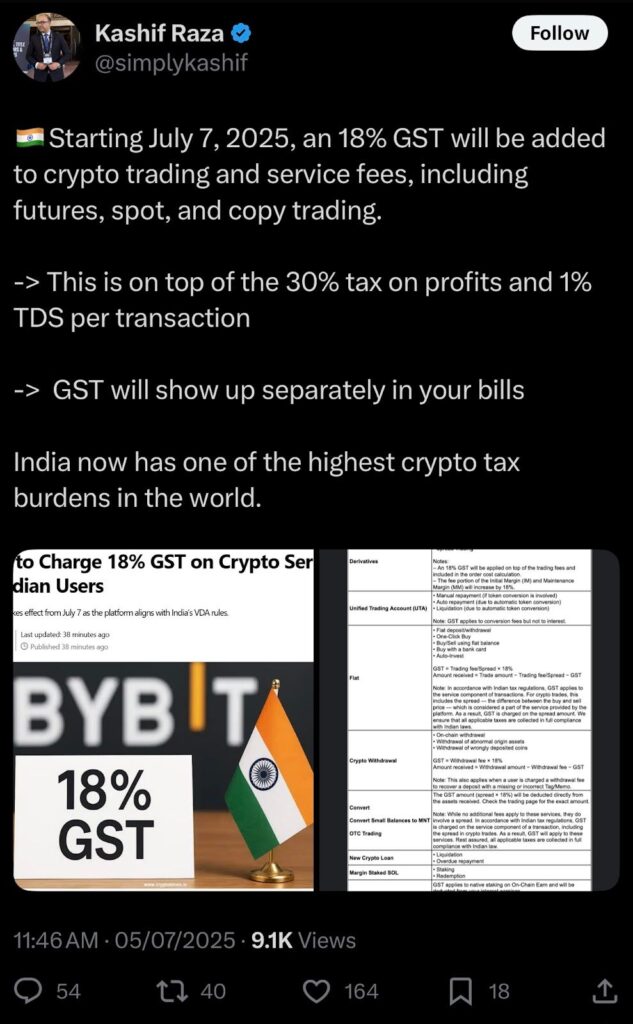
- Starting July 7, 2025, an 18% GST will apply to all crypto services and trading fees, including spot, futures, and copy trading.
- This is in addition to the existing 30% tax on profits and 1% TDS per transaction.
- The GST will appear separately on user bills, further increasing the cost of trading.
The Indian government has significantly changed taxes concerning the crypto market. Any crypto services and trading fees from July 7 will become subject to GST of 18% each.
This is in spot trades, futures, and copy trading. The action enters another chapter of the changing state of digital assets tax in India.
Tax on Crypto Services Substantially Rises on the Part of Users
Since July 7, crypto exchanges and platforms in India must add 18 percent GST to any user-paid trading fees. This will be counted as five line items in each bill.
Earlier, traders had to pay 30 percent of profit earnings and 1 percent per transaction as TDS. The cost of trading fees is now going to be expensive as well.
In the case of a typical trade, this switch entails that all the associated transaction taxes remain. Also, users pay the trading fee and GST on that fee.
GST will also be charged on derivatives, copy trading, and algorithmic services fees. Trading professionals fear this may dampen trade volumes and limit liquidity across the crypto market.
Exchanges Dig Deep to Adjust Billing Systems Ahead of the Deadline
Indian crypto exchanges hurried to implement such alterations. They are altering the billing systems so that GST is broken down separately.
The base trading fee will also be displayed as part of the user dashboard and invoices, along with the 18% GST. This will be simpler to follow but harder to understand.
In some exchanges, businesses have begun to train the users of the new billing process. They are blasting pop-ups, emails, and social media notifications informing people how much each trade will add under GST.
Otherwise, through non-compliances, the platforms can be candidates for sanctions or even prosecution processes by tax authorities.
Raised Fees May Affect the Trader and Market Dynamics
Analysts claim that the introduction of GST on fees has the potential to change user behaviour. Small traders can also cut their trading since the cost of trading is effectively rising.
This can transfer the facilities to the low-cost trading platforms or offshore versions for older investors. The transfer may affect international trade and DeFi.
Other traders might move to decentralized or foreign exchanges, not in India, and are exempt from GST. The shift can take more trade further out of monitoring by local regulators, and regional exchanges experience a decline in growth.
Government Wants to Increase Taxes on Crypto Boom
The Indian government is interested in tapping into the increased revenues of a fast-growing market in the last two years. This new GST is applied to all spot, margin, future, copy trading, staking, and other services.
The policy aims to make the crypto market more transparent and accessible. It proposes taxing digital assets using existing financial regulations.
Policymakers plan to introduce trading fees as part of this framework. This approach would bring parts of the crypto economy into the formal tax system.
As of July 7, crypto traders in India will also be stung by an additional 18% GST on charges. This will make the normal trading expensive and can alter the market dynamics. The exchanges rush to modify billing platforms, and consumers are gearing up to pay increased transaction fees.
It is still uncertain whether this will increase tax compliance or cause a move offshore. India is integrating this broad-based tax move in its developing crypto climate. This way, it monitors the trading volumes and the exchange policies.
Disclaimer
This article is for informational purposes only and provides no financial, investment, or other advice. The author or any people mentioned in this article are not responsible for any financial loss that may occur from investing in or trading. Please do your research before making any financial decisions.




