
 streamoors
 IGNITION
 Sui
Sui Quantus
 Bitcoin
 Pearl
Pearl Solana
Key Highlights:
- Ethereum Foundation will start integrating zk-proofs with Ethereum mainnet, beginning with the launch of a Layer-1 zkEVM within a year.
- To maintain Ethereum’s core values of security, liveness, and censorship resistance, the Foundation is setting performance and security benchmarks for zkVMs
- Amid rising ETH prices and ETF inflows, the Foundation addressed concerns over a reported 1,210 ETH sale, clarifying that Argot Collective conducted the transaction
The Ethereum Foundation announced that it would be going all-in with the adoption of zero-knowledge proof (zk-proof) while revealing a comprehensive plan to integrate them to the Ethereum mainnet at all stack layers. The Foundation noted that it will begin with the rollout of a Layer-1 zkEVM. By completely embracing the ZK technology, the Foundation seeks to simplify the protocol, enhance privacy, and replace traditional block execution with proof verification.
Ethereum Foundation to Launch L1 zk-EVM With A Year
In their latest blog post, the Ethereum Foundation noted that the first step in the transition will be to offer validators the option to run stateless ZK clients that verify execution payloads using multiple zkVM-generated proofs rather than re-executing blocks.
These clients would check proofs from different EVM implementations, using the same “defense-in-depth” strategy already employed through client diversity. The compact nature of zk-proofs makes it easy to verify multiple proofs seamlessly.
The Ethereum Foundation stated that the initial rollout pipelining introduced in the upcoming “Glamsterdam” upgrade will facilitate more time for proof generation. It also expects a gradual increase in validator adoption of L1 zkEVM through formal verification, audits, and bug bounties.
After a large majority of validators adopt ZK clients, Ethereum Network can raise the gas limit to levels requiring proof verification over full re-execution. This will, in turn, make zk-proofs the default validation method.
Establishing Realtime zk-Proving for L1 Security
The Ethereum Foundation said that it would establish a standard for real-time zk-proving, thereby preserving the core Ethereum mainnet properties of security, liveness, and censorship resistance.
The zkEVM teams will need to aim for 128-bit cryptographic security, with a temporary lower bound of 100 bits accepted during the early rollout. Proof sizes should remain under 300KiB and avoid recursive constructs requiring trusted setups.
The Foundation defines “realtime” proving as completing proofs in 10 seconds or less, aligning with Ethereum’s 12-second slot time and accounting for network propagation latency. zkVMs should be able to prove at least 99% of mainnet blocks within this window, with mitigation for outliers and denial-of-service vectors planned via future hard forks.
A key design goal is enabling “home proving” to empower solo stakers to contribute to Ethereum’s zk infrastructure. This would require provers to operate with a maximum power consumption of 10kW and with hardware costs not exceeding $100,000.
As zkEVM development accelerates and proof systems mature, Ethereum is positioning itself to become the world’s largest ZK application. This would not only transform the network’s scalability and privacy, but also the fundamental architecture of blockchain validation.
Ethereum Foundation Addresses Sell-off Concerns
The Ethereum Foundation has been moving ETH to multisig wallets, and has moved a total of 21,000 ETH over the past month. According to on-chain data flagged by EmberCN, the 1,210 ETH were sold for approximately 3.496 million USDC at an average price of $2,889.5.
The funds originated from a series of transfers totaling 21,000 ETH over the past month to wallets beginning with 0xc06, with the specific sale routed through the 0x340 address.
However, Hsiao-Wei Wang, co-executive director of the Ethereum Foundation clarified that they did not sell 1,210 ETH today as initially reported. Instead, Argot Collective, an independent non-profit development group spun out of the Ethereum Foundation, conducted the transaction. Argot Collective operates independently to support Ethereum ecosystem development.
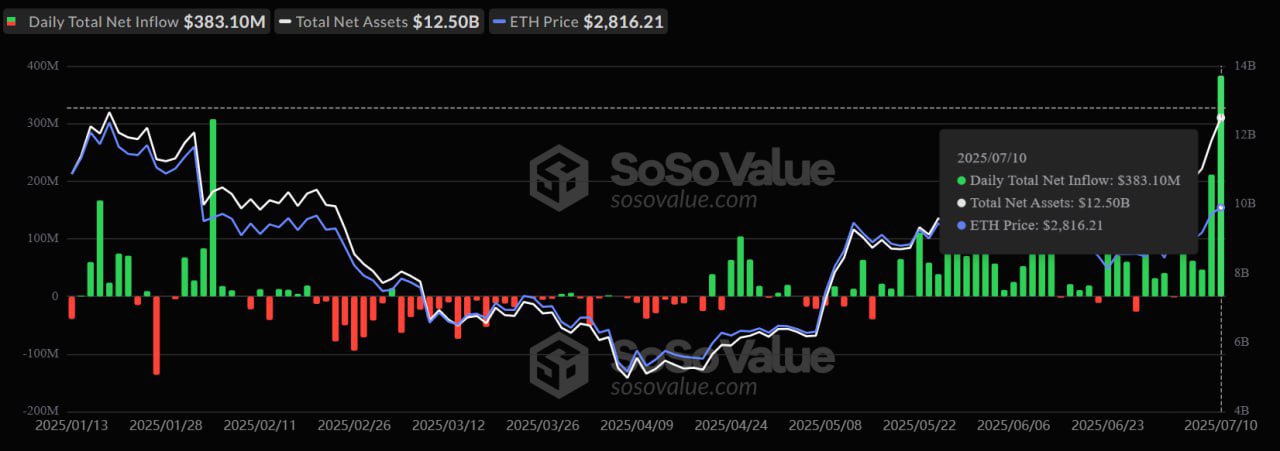
This development comes as the ETH price is seeing another 7% upside, moving to $3,000, with daily trading volume surging 26% to $40 billion. On Thursday, inflows into spot Ethereum ETF skyrocketed to $383 million, with the BlackRock Ethereum Trust (ETHA) alone contributing more than $300 million.
Disclaimer
This article is for informational purposes only and provides no financial, investment, or other advice. The author or any people mentioned in this article are not responsible for any financial loss that may occur from investing in or trading. Please do your research before making any financial decisions.




