
 streamoors
 Altai the Tiger
 Sword Inu
 IGNITION
 no crying in the casino
 Quantus
 Pearl
Pearl
Key Insights:
- Bitcoin dominance tried to reclaim support, raising fears of a fakeout.
- Markets expected a September interest rate cut in the US.
- More companies added Bitcoin to their balance sheets in 2025.
Bitcoin price is currently facing the risk of a fakeout this month as its dominance rating staged a recovery.
Attention also turned to expectations of a United States interest rate cut and the steady rise of corporate Bitcoin adoption.
This has also raised fresh questions about the top coin’s next direction.
Bitcoin Dominance Under Pressure
Bitcoin dominance, a measure of Bitcoin’s share of the overall crypto market, moved lower in early September.
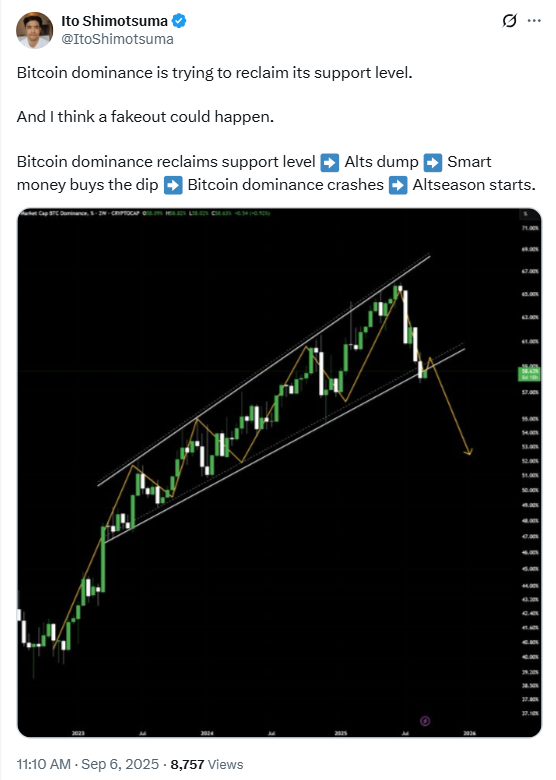
Analysts said the chart showed a possible attempt to retake support with a possibility it could end in a fakeout.
Ito Shimotsuma, a crypto commentator, explained what this could mean. He noted that altcoins could see heavy selling if dominance climbed back up.
Shimotsuma added that big investors might then step in to buy cheaper tokens before dominance weakened again. If this played out, it could open the way for a fresh altcoin rally.
The warning came as Bitcoin traded at about $110,889. Its market value stood at $2.2 trillion, with daily trading volume around $40.51 billion, down more than 22% in 24 hours.
The numbers showed that interest remained strong, but traders were cautious about where the market might head next.
Notably, Bitcoin has a history of sudden moves, both up and down. Past cycles have seen dominance shifts trigger wider changes across the market.
The question this time was whether the attempted recovery would hold or break down.
Bitcoin Price and Interest Rate Cut in Focus
While traders studied chart signals, they also paid close attention to interest rate expectations in the United States.
The Federal Reserve was due to meet on 17–18 September 2025. Data showed markets fully expected a rate cut at the meeting.
Figures pointed to an 8% chance of a cut of 50 basis points and a 32% chance of a 25 basis points cut.
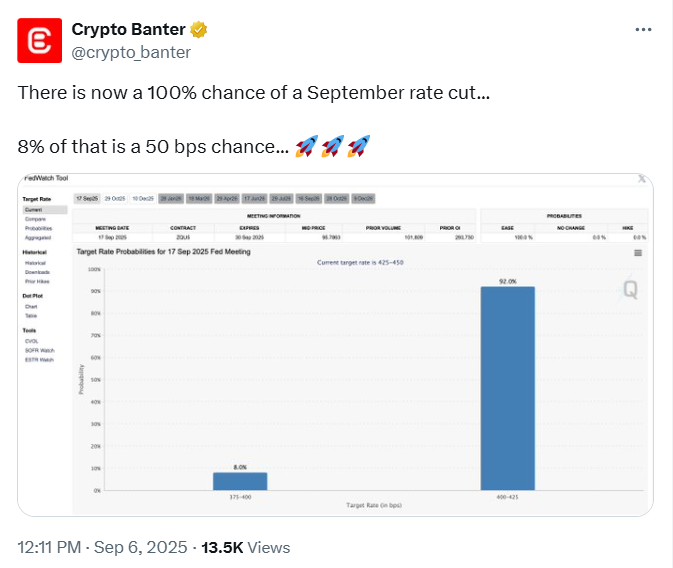
The largest share of forecasts is pegged at 60%, as experts see no change as most likely. No probability was assigned to a possible increase.
This sentiment is shaping the mood across financial markets. A rate cut would make borrowing cheaper and could push more money into risk assets, including Bitcoin.
However, the size of any cut remained unclear. A smaller cut might have little impact, while a bigger move could spark stronger reactions.
Investors have often linked Bitcoin’s price swings to wider economic policy. When interest rates rise, money tends to move away from risk assets. When they fall, traders often return.
The September decision was therefore seen as an important moment for the crypto market.
More Firms Explore Bitcoin on Balance Sheets
Alongside chart analysis and rate policy, another factor shaped the bullish BTC debate: the corporate adoption of Bitcoin.
In 2025, more firms and institutions began to add the asset to their financial planning. This followed President Trump’s Strategic Bitcoin Reserve Executive Order and came as the dollar’s dominance weakened.
Reports said sovereign-wealth funds, state treasuries, and retirement plans looked at possible allocations.
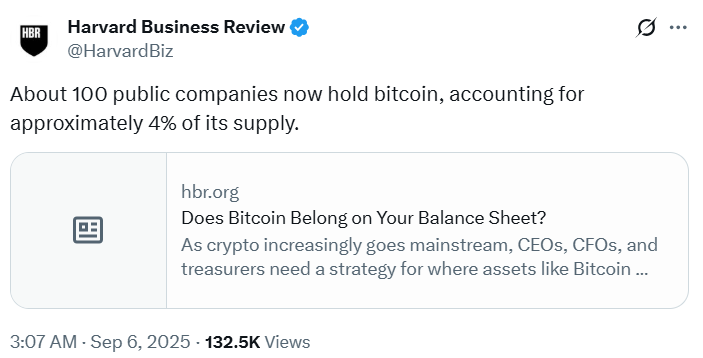
Companies including Tesla, Block, Figma, Metaplanet, Strategy, and MassMutual already list Bitcoin on their balance sheets.
Some businesses, like MicroStrategy, used aggressive models to grow their BTC holdings. They sold shares, raised funds, and bought more Bitcoin, repeating the cycle as prices climbed.
However, analysts warned that such methods could backfire if prices dropped or funding tightened.
Experts suggested that firms needed a clear strategy before adding Bitcoin. They advised that treasurers should first decide the role of the asset.
It could serve as liquidity, collateral, or a way to diversify. They also noted that Bitcoin’s price swings remained sharp, often tracking moves in tech stocks rather than gold.
At the same time, the Bitcoin network itself drew interest. Layer 2 tools promised faster payments and new financial services built on top of Bitcoin.
More importantly, some believed this could increase long-term use. Others pointed to risks, including volatility and technical challenges.
Disclaimer
This article is for informational purposes only and provides no financial, investment, or other advice. The author or any people mentioned in this article are not responsible for any financial loss that may occur from investing in or trading. Please do your research before making any financial decisions.




