
 Puffer
 Bitcoin
 ZKsync
 NEAR Protocol
 Walrus
 Pearl
Pearl Ondo
Ondo

Key Insights:
- Bitcoin price climbed above $112,000 on Sept. 8, moving away from $108,000 lows.
- Options skew rose as demand for puts increased, signaling persistent caution.
- ETF outflows and rising Ether reserves added pressure on market sentiment.
Bitcoin (BTC) price crossed $112,000 on Sept. 8, extending a rebound from last week’s $108,000 level. The move failed to lift confidence, with derivatives data pointing to persistent caution among traders.
Options skew and funding rates suggested risk aversion. Spot Bitcoin exchange-traded funds (ETFs) also faced heavy outflows, while Ether (ETH) gained traction as a corporate reserve asset.
Options Market Shows Rising Demand for Puts
Data from derivatives exchange Deribit showed the 30-day delta skew at 9%. That indicated traders paid more for downside protection, reflecting hedging demand rather than retail panic.
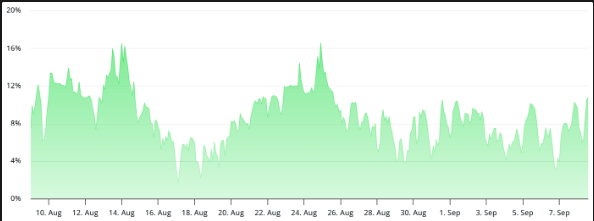
Laevitas data confirmed the shift. After two sessions of weaker demand, put option buying accelerated on Sept. 8. This pointed to a renewed appetite for neutral-to-bearish strategies.
Degen_Hardy noted a bullish ascending triangle forming alongside a Chicago Mercantile Exchange (CME) gap at $116,000. “$BTC’s next move … looks bullish,” he wrote on X.
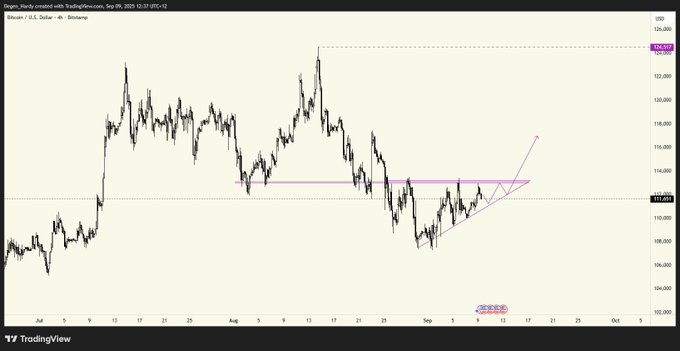
Others stressed caution. BitBull argued traders misunderstood the skew. “Everyone’s staring at $BTC price, but the real action is in the options market,” he posted. He added that institutions often buy spot Bitcoin while hedging exposure with puts, making the skew “bullish fuel in disguise.”
Futures Funding Neutral but Outflows Pressure ETFs
The Bitcoin futures market showed a neutral stance. Deribit data placed annualized funding at 11%, within the expected 6–12% range. This marked a recovery from bearish 4% levels seen on Sept. 7.
Still, ETF flows raised concerns. Spot Bitcoin ETFs recorded $383 million in outflows between Sept. 5 and Sept. 6, according to Laevitas. The withdrawals pressured sentiment despite Bitcoin defending $110,000 support.
Ether meanwhile attracted $200 million in new corporate reserve allocations during the week, data from StrategicETHReserve showed. The shift raised concerns that institutional preference may be tilting toward ETH.
Macro Conditions Support Lower Rates
Macroeconomic factors added another layer. CME’s FedWatch tool showed traders now assign a 73% probability that U.S. interest rates will drop to 3.5% or lower by March 2026. The figure was 41% one month earlier.
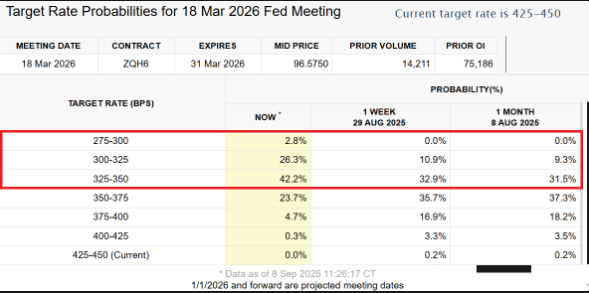
Weak U.S. labor market data contributed to the shift. The expectations of easing normally benefit risk assets, but Bitcoin failed to mirror the new all-time highs in gold and the S&P 500.
The exclusion of MicroStrategy (MSTR) from the S&P 500 rebalance on Sept. 6 further weighed on sentiment. Bulls had anticipated inclusion, which could have strengthened institutional exposure to Bitcoin.
Traders Eye $120K but Sentiment Remains Fragile
Bitcoin price momentum toward $120,000 remains capped by cautious positioning. Options skew and ETF outflows underscored that confidence has not fully returned.
Still, institutional hedging suggests capital is entering rather than exiting, according to BitBull. “This isn’t bearish, it’s bullish fuel in disguise,” he said, adding that hedged exposure could lead to sharp upside when pressure eases.
If ETF flows stabilize, sentiment may improve quickly. For now, the derivatives market suggests caution is still the dominant strategy, even with Bitcoin price above $112,000.
Disclaimer
This article is for informational purposes only and provides no financial, investment, or other advice. The author or any people mentioned in this article are not responsible for any financial loss that may occur from investing in or trading. Please do your research before making any financial decisions.


