
 streamoors
 Sword Inu
 Altai the Tiger
 IGNITION
 no crying in the casino
 NEAR Protocol
 Pudgy Penguins

Yesterday, Congressman Troy Downing (MT-02) introduced the Retirement Investment Choice Act in Congress. The act aims to formalize President Trump’s August 7 executive order. Its goal is to expand 401(k) investors’ access to alternative assets.
In the August 7 EO, Trump claimed that “more than 90 million Americans participate in employer-sponsored defined-contribution plans, the vast majority of these investors do not have the opportunity to participate, either directly or through their retirement plans, in the potential growth and diversification opportunities associated with alternative asset investments.”
Now Retirement Plans Could Include Crypto and Other Lucrative Asset Classes
Existing 401(k) plans typically include stocks, bonds, and other traditional asset classes. Real estate and digital assets are uncommon in these retirement plans. If the bill passes Congress and becomes law, a wide range of asset classes will be accessible to these 401(k) investors.
The order stated that 401(k) plans failed to deliver satisfactory returns. It blamed regulatory overreach and legal barriers for limiting investor gains.
“A combination of regulatory overreach and encouragement of lawsuits filed by opportunistic trial lawyers has stifled investment innovation and largely relegated 401(k) and other defined-contribution retirement plan participants to asset classes whose returns lack the very same long-term net benefits allowed for and achieved by public pension plans and other institutional investors.” The order noted.
Bitcoin (BTC), the largest cryptocurrency by market capitalization, has increased in value by nearly 70% over the past year. However, Bitcoin’s returns are just as stunning as the volatility that comes associated with it.
BTC was trading at around $111,000 at press time, yet to recover to last Friday’s price zone near $121,000. Bitcoin has declined by at least 9% over the past week.
What About Risks?
Opening access to alternative assets carries notable risks. These concerns are expected to spark debate between the GOP and Democrats over the bill.
Stock markets, digital asset markets, and commodity markets are known to be supremely rewarding, but they are equally risky. Market observers unsurprisingly pointed out that while the bill could democratize access, it could also ‘democratize risk’.
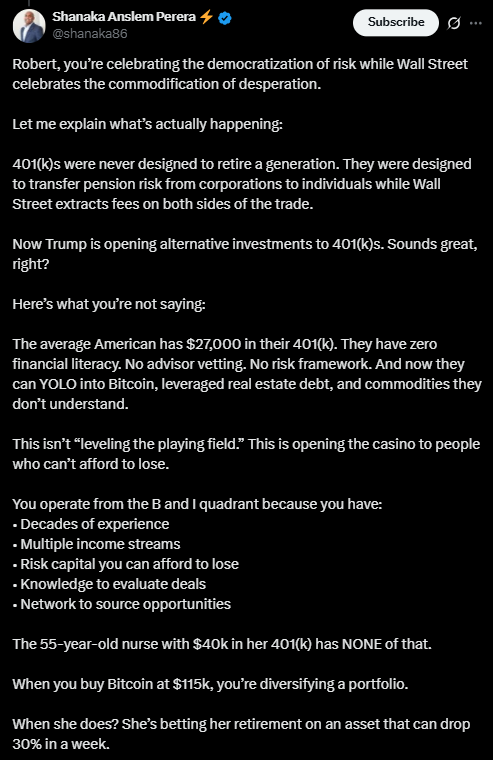
Last Friday’s market leverage reset highlighted the significant risk retailers faced. The rise of leverage trading has exponentially increased the market risk quotient. This is because leverage boosts the risk-reward ratio of investments.
While leverage trading is a tempting avenue for retail traders, it also presents a potential hunting ground for larger investors. Institutions and whales (people who hold large amounts of crypto) have the power to spook markets with large buy and sell orders.
Retirement Investments: The Ultimate Validation that Crypto is Mainstream?
401(k) plans are a significant part of American culture. Millions of working-class Americans rely on these plans for retirement or in times of emergency. The inclusion of alternative assets, such as digital assets, is undoubtedly a significant political decision.
The current administration has made it clear that it intends to make the US the global crypto capital. In March of this year, Trump announced the establishment of the Strategic Bitcoin Reserve. This national BTC reserve would likely be funded by seized cryptocurrency.
Apart from Bitcoin, other cryptocurrencies, such as XRP and ADA, have received significant attention from the Federal government. Regulatory oversight will be essential for the bill’s success. Digital assets remain a relatively unfamiliar domain for most regulators.



