
 Puffer
 ZKsync
 Bitcoin
 NEAR Protocol
 Pearl
Pearl Quantus
 Sui
Sui

Last weekend, the Institute for the Study of War (ISW) faced criticism over map manipulations. The issue arose in a Polymarket bet on Russian advances in Ukraine. Internet Child, a pseudonymous Polymarket trader, alleged that the ISW had openly defrauded Polymarket bettors.
According to him, the ISW’s map was manipulated to mark a Russian advance into Ukrainian territory. This caused a bet to settle incorrectly. The bet resolved in favor of Yes, despite odds of 0.3%, alongside no supporting reports from other mappers.
The ISW reverted the map shortly after the resolution. However, the incident has raised concerns about the efficiency of Prediction Market Oracles. Ethereum’s Buterin suggested that the platform could have used multiple oracles to ensure the accuracy of betting results.
Ethereum’s Buterin Advocates a Decentralized Oracle System
Ethereum’s Buterin, in a recent statement, contended that decentralized oracles must be introduced to prevent malicious manipulation in prediction markets.
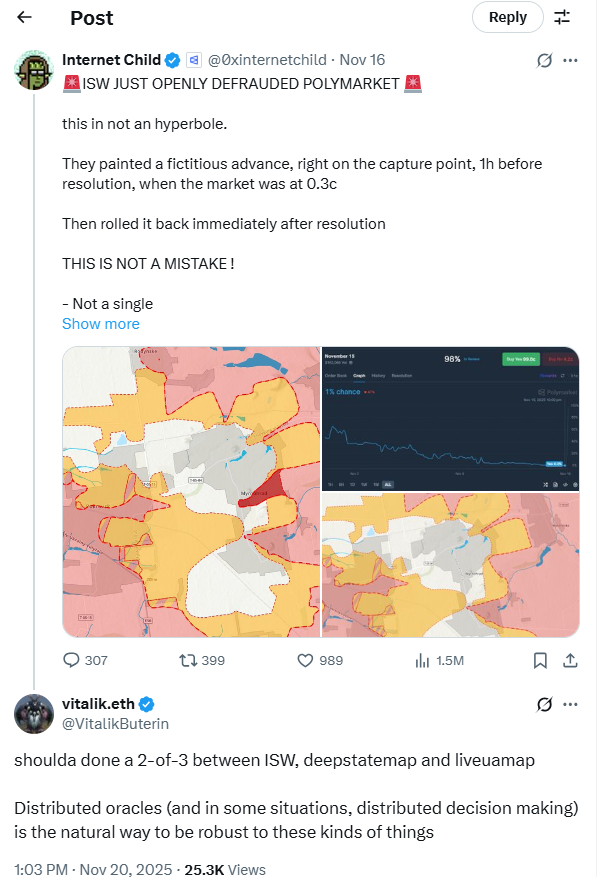
According to him, the controversial bet should have used at least three map providers, including ISW, Deepstatemap, and Liveuamap. The bet’s settlement would, however, require confirmation from at least 2 of the 3 Oracles before it’s completed.
He said;
The ISW incident has highlighted that centralized Oracles are prone to manipulation and could cause single points of failure. Hence, Buterin’s suggestion indicates that the adoption of decentralized Oracles will help prediction markets in avoiding bias and error.
This would enable the decision-making process regarding the bet’s resolution to rely on multiple sources, ensuring credibility and efficiency. This is expected to reduce the risk of single points of failure or manipulations often associated with centralized oracles.
The adoption of multiple independent data sources by decentralized oracles allows participants to verify and report outcomes. This makes it harder for a single party to manipulate the system, whether knowingly or unintentionally.
Polymarket’s Controversial Bet History
Meanwhile, the incident represents the latest controversy related to Polymarket and betting. In July 2025, Polymarket faced backlash at least twice over the reliability of its resolution system and dispute mechanism.
The first issue arose from a $200 million bet on whether Ukrainian President Volodymyr Zelensky would wear a suit before the end of June. On June 24, the President attended a NATO summit wearing what many media outlets described as a suit.
Thus, Polymarket’s oracle, UMA, ruled that the outfit met the suit criteria. However, this result was challenged by token holders, leading to its reversal and making the resolution contentious.
In the same month, Polymarket Oracle UMA recorded issues involving a Major League Baseball game and a NASCAR race bet. The MLB game bet erupted in controversy after the game was mistakenly resolved in favour of the losers.
The issue was initially linked to whale manipulation and later attributed to a technical glitch. Conversely, the NASCAR incident led to a major dispute, which reduced the market value from $10,000 to $60,000.
These issues raised questions about the credibility and efficiency of Polymarket’s Oracles. Overall, the incidents suggest that despite the recent improvement in the prediction market, Oracle still poses significant worries.
That is, the growth of the market and its integration into the mainstream sector could require improvements, including decentralized oracles.


