Zylo Ecosystem
 astronaut
 Pearl
Pearl Walrus
 Starknet
 Pudgy Penguins
 Bitcoin
Per Cardano news, Cardano suffered a node glitch on November 21, 2025. A flawed transaction hit the mainnet and split the network.
Input Output Global, EMURGO, Intersect, and the Cardano Foundation quickly restored the network. They secured the healthy chain to stabilize operations. In the post-disruption analysis, the platform said users are mostly unaffected.
Cardano News: Node Glitch Causes Network Split
On November 21, 2025, at around 08:00 UTC, the Cardano network experienced a glitch that split the blockchain. As reported, a malformed delegation transaction caused one chain to process the invalid transaction while another chain rejected it.
It is worth noting that a similar problem had occurred the day before on the Preview testnet. The glitch came from a software bug in the deserialization of a hash. This bug had existed since 2022 but was only triggered recently in new node versions.
Older nodes, including Daedalus and light wallets, rejected the faulty transaction, but newer nodes accepted it. Cardano news suggested that the difference caused a disagreement between nodes, which ended up splitting the chain.
Notably, block production continued on both chains. However, some exchanges paused deposits and withdrawals as a precaution. To resolve the issue, Input Output Global, EMURGO, Intersect, and the Cardano Foundation quickly organized a response.
They released node updates 10.5.2 and 10.5.3. The upgrades were designed to block similar transactions and let the healthy chain grow stronger. Additionally, Stake Pool Operators upgraded their nodes to support the healthy chain.
The Ouroboros protocol ensured that the chain with the most work would eventually dominate. Invalid blocks are expected to be removed once the chain settles.
According to the report released, a data reconciliation group is reviewing transactions to ensure records are correct. Authorities are involved because the transaction could be treated as a cyberattack.
Charles Hoskinson Comments on the Incident
In a sequel to the Cardano news, founder Charles Hoskinson addressed the glitch publicly. He said the problem was caused by a user who acted deliberately to harm the network. Hoskinson explained that the user had spent months looking for ways to disrupt Cardano.
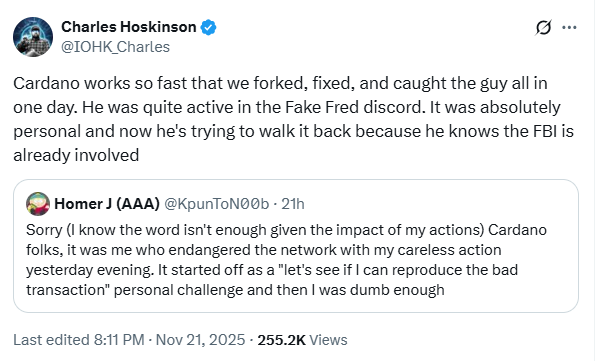
The attack affected his personal stake pool and caused network-wide disruption. The Cardano founder said all users felt the impact. Stake Pool Operators risked losing rewards. Also, some decentralized finance services experienced temporary interruptions.
He noted that the team acted quickly to fix the network. The healthy chain was restored in one day, and the immediate threat ended. One user admitted responsibility online, saying he tried to reproduce the faulty transaction as a challenge.
Another community member urged caution and perspective, warning against focusing only on blame. More importantly, Hoskinson confirmed that some transactions from the “poisoned” chain might replay on the healthy chain.
The teams are making sure the ledger is correct. He said fully cleaning up the incident and repairing reputational damage will take time.
Community Response and Ongoing Recovery
After the distressing Cardano news, community members expressed appreciation to Hoskinson and the technical teams. Comments on X highlighted the work of Input Output Global, EMURGO, Intersect, and the Cardano Foundation in stabilizing the network.
Based on the post, the response was described as coordinated and fast, showing the network’s resilience. Again, retail users do not need to take action. Wallets such as Daedalus remained secure and unaffected.
Stake Pool Operators are required to update to node version 10.5.3 immediately. The updates help the healthy chain become dominant and prevent future similar problems.
Technical teams continue to monitor the network while both chains converge. They aim to ensure all transactions are accurate and the ledger is consistent. The incident showed that the network could recover quickly even when facing a deliberate attack.