
 Pearl
Pearl NEAR Protocol
 Bitway
 Starknet
 Walrus
 Pudgy Penguins
 Hyperliquid
NVIDIA’s stock price rose by over 1.5% in the premarket as investors reacted to Beijing’s decision to approve H200 chip imports for three major tech firms. This announcement came as the NVDA stock remains in a correction after falling by 10% from its all-time high.
China Approves First Batch of H200 Chips Imports
NVIDIA stock price rose after Beijing gave its approval for Alibaba, ByteDance, and Tencent to buy its H200 chips.
These companies have given permission to buy 400,000 chips in total, and media reports say that other large Chinese companies are joining the queue for subsequent approvals.
It is estimated that the H200 chips cost $27,000 each, meaning the approved deal will make the company over $10 billion. NVIDIA has over 700,000 of these in its inventory and is planning to sell them in cash. As such, these orders are likely to be part of its first-quarter results.
In a recent report, Reuters noted that Chinese companies had placed an order of 2 million H200 chips. As such, by only accepting a few of them, Beijing is focused on balancing this demand and boosting demand for chips made by local companies. The challenge, however, is that some popular Chinese chips, including Huawei’s H20, are still 6x slower than the H200.
NVIDIA Has Become a Bargain Company
A closer look at NVIDIA’s valuation metrics shows the company is a bargain based on its historical trends.
Data compiled by Seeking Alpha shows that the company’s forward price-to-earnings ratio is 40, well below its five-year average of 45.
The challenge with the P/E ratio is that it does not factor in a company’s growth. Instead, it only focuses on its earnings per share and its stock.
Therefore, a better metric to consider is the PEG ratio, which accounts for a company’s growth. In this case, the forward PEG ratio is 1.07, which is much lower than the sector median of 1.54 and its five-year average of 1.59.
NVIDIA’s forward price-to-earnings ratio is much higher than the S&P 500 average of 22. However, the average S&P 500 Index’s average growth rate in the third quarter was 12%.
In contrast, NVIDIA is one of the fastest-growing companies in the United States, with revenue growth exceeding 50%. As such, it deserves a higher valuation number when one factors in its strong growth, market share, and its superior margins.
Meanwhile, NVIDIA has one of the best Rule-of-40 metrics in Wall Street. This metric looks at a company’s revenue growth and its profit margins.
Data shows that NVIDIA has a 53% profit margin and 70% forward revenue growth, giving it a multiple of 123%. This is notable because a company is considered cheap when its multiple is 40%.
Wall Street analysts are optimistic about the company’s stock, with the average estimate at $253, well above the current $190.
NVIDIA Stock Price Technical Analysis
NVIDIA has some of the best fundamentals in the stock market. However, technical analysis suggests that the stock may be on the cusp of a strong bearish breakdown in the coming weeks.
The main bearish catalyst is that it has formed a highly bearish head-and-shoulders pattern on the daily chart. Additionally, the stock has remained below the 50-day Exponential Moving Average (EMA) and the Supertrend indicator.
Therefore, the most likely scenario is where the stock retreats in the coming weeks. The bearish outlook will be confirmed if it moves below the important support level at $170, which is the neckline of the head and shoulders pattern.
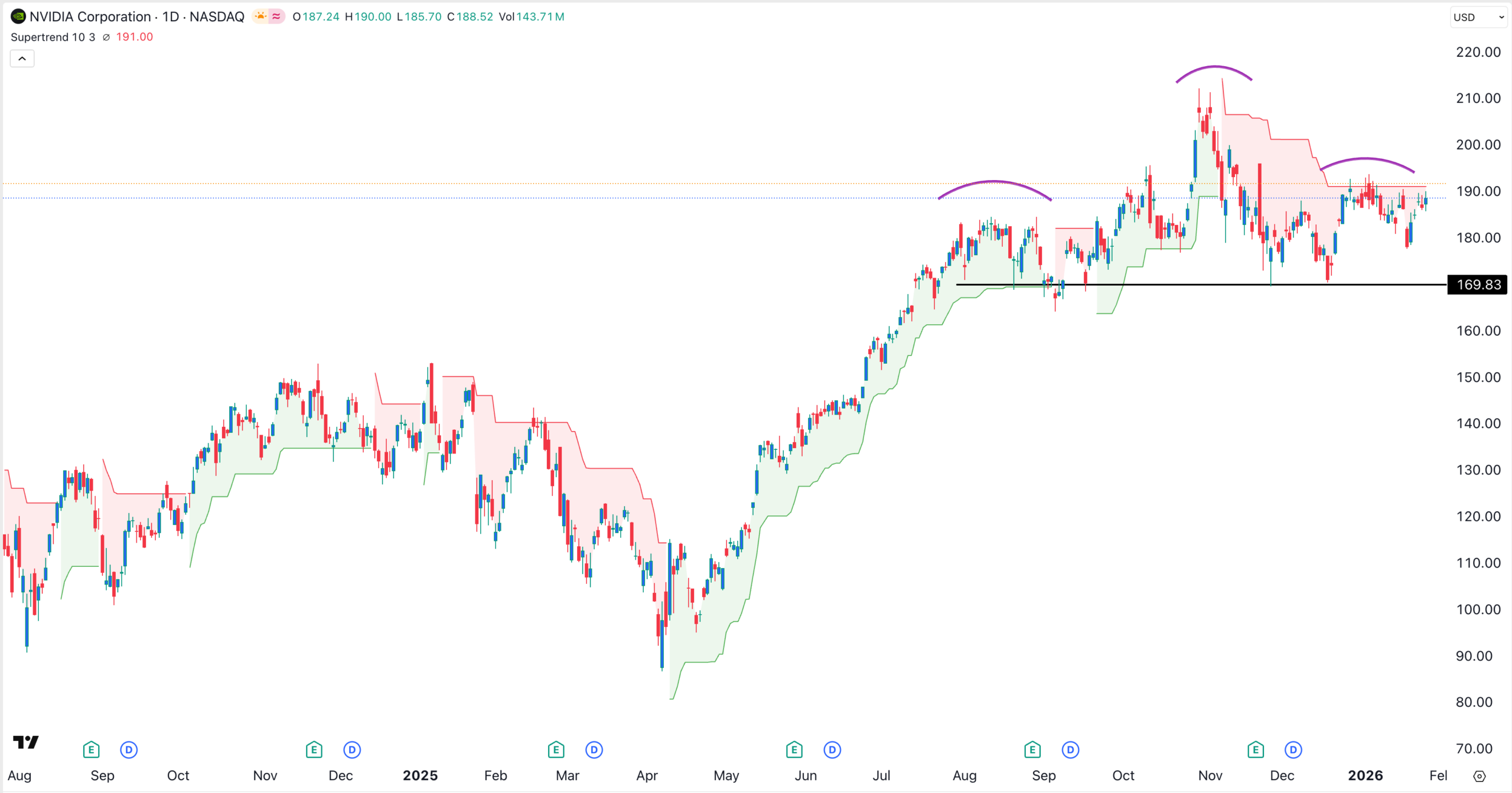
A drop below that level will signal more downside, potentially to the psychological level at $150, followed by the H&S target at $130.




