
 Altai the Tiger
 IGNITION
 streamoors
 Sword Inu
 NEAR Protocol
 Injective
 Quantus

Danske Bank, Denmark’s largest lender, has entered the latest Bitcoin news by facilitating crypto ETP trading. The bank has also enabled its clients to purchase Bitcoin and Ether ETP products via its eBanking and Mobile Banking platforms. The launch represents a significant policy shift for the Nordic institution. It reflects an increase in customer demand and greater clarity in regulation across the European Union.
The rollout comes after the implementation of the EU’s Markets in Crypto Assets (MiCA) framework. According to the bank, the stronger regulation has led to wider confidence in digital assets. However, access is extremely restricted and available only to certain investor groups.
Regulated Bitcoin and Ether ETP Access for Self-Directed Clients
The new products are only available to self-directed investors. These are customers who trade independently without having investment advice from the bank. Danske said it has seen growing demand from clients looking to get exposure to crypto in diversified portfolios.
At first, customers can trade three well-selected exchange products. Two track Bitcoin, while one is an Ether ETP. The products are issued by BlackRock and WisdomTree, two established firms with global asset managers.
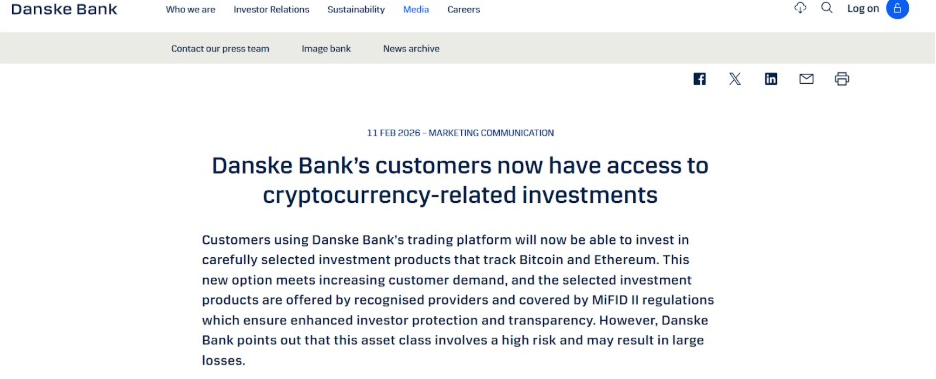
The EU’s Markets regulate all three ETPs in Financial Instruments Directive II (MiFID II). This framework will ensure investor protection and transparency of costs. This regulated structure, the bank says, offers obvious benefits over holding coins directly.
Investors get price exposure without having to deal with private keys or external wallets. Trading is done on existing brokerage accounts. Regulated providers manage custody and operational responsibilities.
From Crypto Ban to Controlled Exposure
Interestingly, Danske Bank’s move represents a major reversal of a previous stance. The bank had earlier in 2018 issued a warning to customers regarding the risks of cryptocurrencies. It further banned trading of crypto assets and trading tools on its platforms.
At the time, the bank cited concerns involving volatility, transparency, and regulatory uncertainty. Financial crime threats were also raised. For several years, the institution was cautious about digital assets.
In 2021, Danske updated its policy. It said that it would not provide direct cryptocurrency services. However, it would not prohibit customer transfers to crypto exchanges. Still, no crypto-linked products were available internally.
The MiCA framework has changed the bank’s evaluation. Kerstin Lysholm, head of investment products and offerings, said regulation has generally helped to boost confidence in the asset class. She added that the bank believes the time is right for controlled access to crypto ETPs.
Strong Risk Warnings and Suitability Controls
Despite the move, Danske Bank still focuses on risk. It calls cryptocurrencies opportunistic investments instead of long-term core investments. The bank, in particular, makes it clear that the offer of an Ether ETP or a Bitcoin product is not a recommendation.
The official release warned of a very high risk in crypto investments. High losses are still possible due to price fluctuations. Customers are required to undertake a suitability assessment before trading.
The evaluation comprises questions on knowledge and investment experience. The aim is to ensure clients are aware of the structure and risks of crypto ETPs. Only those who meet the criteria will gain access.
This approach is in line with European investor protection standards. It also reflects the bank’s cautious approach to its digital asset exposure.
European Shift in Bitcoin News
Danske Bank’s announcement is part of a larger trend in European Bitcoin news. Traditional banks are slowly launching regulated crypto products in more transparent legal regimes. Most institutions prefer exchange-traded structures and direct token sales.
Spain’s BBVA introduced Bitcoin and Ether trading for retail customers in 2025. Germany’s Deutsche Bank is reportedly preparing to launch a crypto custody service in 2026. These developments are indicative of steady institutional adoption throughout Europe.
Regulated products like Bitcoin and Ether ETPs provide exposure in familiar financial systems. Investors are shunning the operational complexity of stand-alone crypto platforms. For banks, the model eliminates compliance uncertainty.
Danske Bank’s decision doesn’t mean a complete endorsement of crypto. Instead, it is a structured, regulated approach to addressing the rising demand. As MiCA transforms Europe’s digital asset landscape, more banks may follow suit.



