
 astronaut
 Pearl
Pearl Zylo Ecosystem
 Bitcoin
 Bitway
 NEAR Protocol
 Zcash
Zcash
The U.S. Treasury has expanded its Iran sanctions authority to cover digital assets, gold, technology, aviation, and shipping. The new determination gives the Office of Foreign Assets Control wider power to target people and companies operating in those sectors of Iran’s economy.
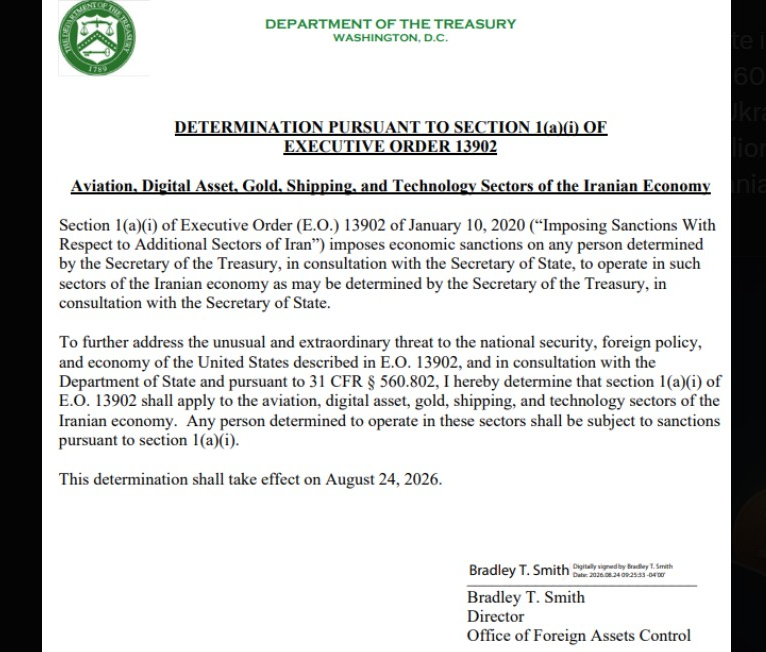
The measure took effect on August 24, 2026, under Executive Order 13902. Treasury also announced a fresh sanctions package covering nearly 60 Iran-linked individuals, entities, and vessels.
U.S. Treasury Adds Five Sectors to Sanctions Framework
The Treasury determination applies Section 1(a)(i) of Executive Order 13902 to five additional areas of Iran’s economy. OFAC can now sanction any person it determines operates in Iran’s digital asset, gold, technology, aviation, or shipping sectors. The authority applies regardless of where that person or business operates.
Also, the change expands the legal basis available to OFAC for future designations and does not automatically place every company connected to those Iranian sectors on a sanctions list. Instead, Treasury can review specific activity and designate parties it finds are operating in a covered sector or supporting sanctioned Iranian actors.
For service providers, the order widens the range of conduct that can trigger U.S. designation risk. OFAC can examine business relationships, transaction services, shipping support, technology transfers, or commodity dealing tied to the named sectors.
Crypto Activity Moves Deeper Into OFAC Focus
Treasury said Iranian authorities increasingly use cryptocurrency to move funds linked to sanctioned networks.
The department said digital assets have supported transactions tied to the Islamic Revolutionary Guard Corps and other Iranian officials. The new sector determination gives OFAC a broader legal route to target exchanges, brokers, payment providers, and other crypto businesses linked to Iran.
The move follows earlier actions against named Iranian crypto firms and wallets. Earlier in August, OFAC sanctioned exchanges Shelbit and Aban Tether over alleged transactions connected to sanctioned Iranian exchanges and the IRGC.
In July, Tether froze about $131 million across four wallets that OFAC linked to Iran’s central bank after the agency added those wallets to its sanctions program.
Treasury Targets Crypto Payments for Iranian Oil
Treasury also sanctioned Ukrainian shipping broker Ivan Obukhov, who operated from the United Arab Emirates. U.S. officials accused him of processing more than $100 million in cryptocurrency payments since 2023 to support Iranian oil sales for the IRGC-Quds Force. Treasury included the action in a broader package targeting Iran’s shipping and financial networks.
The sanctions package covered nearly 60 entities, individuals, and vessels connected to Iranian trade and financing activity. Treasury Secretary Scott Bessent announced the campaign under the name Operation Economic Outcast. The operation focuses on financial channels that Washington says help Tehran obtain revenue and move money outside conventional banking routes.
Gold, Technology, Aviation and Shipping Also Covered
The new determination extends beyond cryptocurrency. OFAC can now use the same sector-based authority against parties operating in Iran’s gold, technology, aviation, and shipping industries.
Those sectors can involve cross-border trade, logistics, equipment procurement, payment networks, and commodity transactions. OFAC may assess activity involving Iranian and overseas operators.
The U.S. government already uses Executive Order 13902 to target activity in several parts of Iran’s economy.
The August 24 determination adds the five new sectors after consultation between the Treasury Department and the State Department. Bradley T. Smith, director of OFAC, signed the determination, which took effect the same day.
Chainalysis estimated Iran’s crypto market at $7.78 billion in 2025, according to recent reporting. IRGC-linked wallets received more than $3 billion during the year and accounted for over half of Iranian crypto inflows in the fourth quarter.
Public sanctions listings identify only part of the wallet activity, so the figures do not measure every crypto transaction connected to Iran.




