
 streamoors
 IGNITION
 NEAR Protocol
 Injective
 LayerZero
 Pearl
Pearl Hyperliquid

Crypto.com has applied for a National Trust Bank charter with the Office of the Comptroller of the Currency. The firm disclosed this on Friday.
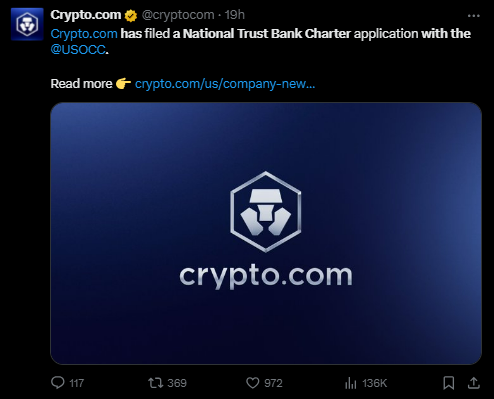
They noted that it is a step towards regulatory compliance and customer protection. The crypto exchange has now applied. It joins Coinbase, Circle, and Bridge, which have already done so.
Crypto.com Claims Charter Will Boost Custody Operations
According to the exchange, it is applying for a banking charter to improve its custody technology and services. Crypto.com offers staking and custody services for several digital assets.
It noted that getting the National Trust Charter effectively makes it a federally regulated service provider. This would enable it to provide custody services for ETFs, crypto treasuries, and other institutional investors.
The exchange CEO, Kris Marszalek, noted that regulated and secure offerings have always been Crypto.com’s focus.
He said:
Meanwhile, the exchange stated that it will continue to offer its custody service as a qualified custodian. It is currently regulated as a non-depository trust company by the New Hampshire Department of Banking.
Crypto Firms Keen on Banking License to Compete with Traditional Financial Institutions
Crypto.com’s application highlights the increasing interest in banking licenses among crypto entities. Already, stablecoin issuer Circle and crypto exchange Coinbase have applied.
Payments giant Stripe also applied through its stablecoin business Bridge, while Ripple, Paxos, and BitGo also applied. If approved, the bank charter allows these crypto and fintech entities to operate more like traditional financial institutions.
This would mean more legitimacy for the digital assets sector as custody will now fall under regulatory scrutiny. However, it could also challenge several crypto-focused banks that currently service the industry.
For instance, only Anchorage Digital Bank has a national trust charter. Erebor recently obtained conditional approval for its charter. This made it the second crypto-focused entity to receive a federal charter.
Regulatory Uncertainty Persists as Crypto.com and Peers Await OCC Approval
There is no clarity yet on whether the OCC will approve the charters for crypto exchanges. Crypto entities would need to demonstrate compliance with AML regulations, among other rules.
Crypto firms may argue that the OCC has already approved banks to trade and manage crypto assets. Nevertheless, the pro-crypto approach of most regulators under President Donald Trump may benefit the crypto entities.
Last week, Comptroller of the Currency Jonathan Gould stressed the importance of integrating digital asset activities. He said these activities must align with the federal banking system.
Federal Reserve governor Chris Waller also suggested that the Fed could issue “skinny master” accounts for eligible financial institutions. Many experts believe it will open the door for crypto entities to have a master account with the Fed.




