
 streamoors
 IGNITION
 Sword Inu
 no crying in the casino
 Altai the Tiger
 Pearl
Pearl Pudgy Penguins
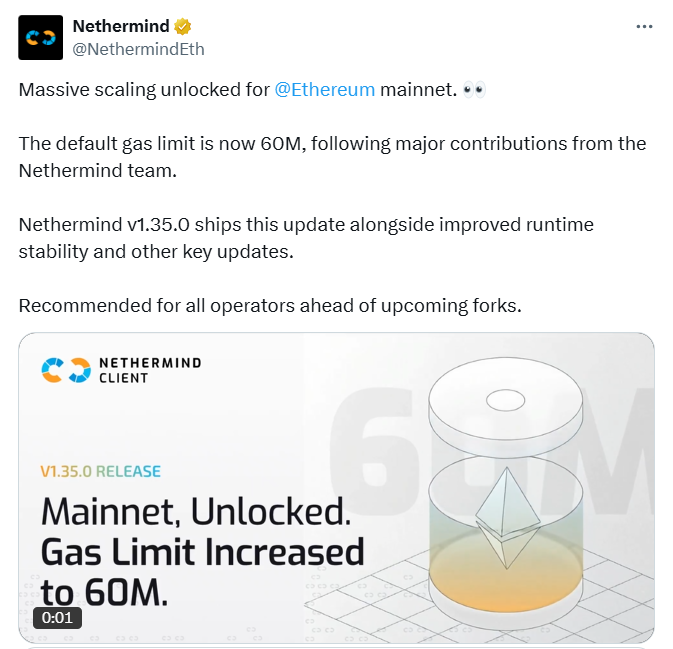
Ethereum gas limit has increased to 60 million on the mainnet after Nethermind released its v1.35.0 client update. The change aims to improve throughput and prepare operators for future forks.
Notably, the update also brings better runtime stability and is recommended for all node operators.
Ethereum Boosts Scalability with 60M Gas Limit via Nethermind v1.35.0
The Ethereum gas limit now stands at 60 million. This change arrives with Nethermind v1.35.0, which is now available to operators.
It is worth noting that the update supports higher transaction capacity on the mainnet. Nethermind says the shift follows technical work from its team to support scaling.
Block capacity on Ethereum depends on the gas limit. When the limit rises, more activity can fit into each block. That could help reduce waiting times when demand grows. The new limit may allow smoother and faster transaction processing in periods of high congestion.
According to the update, operators are encouraged to install the new version. The client update aims to bring stable performance while preparing systems for upcoming forks. It focuses on firming up runtime behavior so nodes stay reliable as the network changes.
Scaling has been a long-term priority for Ethereum. Developers continue to adjust network settings to handle growth.
A higher capacity could support more users and services without major delays. The upgrade marks one step in a wider effort to keep the network moving.
Nethermind also noted improvements to throughput across networks. Its client aims to keep pace with upgrades across the ecosystem. Notably, the company sees this release as a key update for performance and readiness.
New Stablecoin in Japan Expands Ethereum Use
In a major development, Japan has seen its first fully regulated yen-backed stablecoin launch. The new token is called JPYC. It is built on Ethereum and is supervised under Japan’s revised Payment Services Act. The peg is set at one Japanese yen per token.
JPYC uses reserves held in bank deposits and Japanese Government Bonds. This structure fosters trust in the peg and in the management of the funds.
Rules for operation are designed to keep the token backed at all times. JPYC Inc. develops and issues the stablecoin from Tokyo.
Sending payments with digital assets often takes less time than older methods. The company expects the settlement could fall from two days to a few minutes.
The change could help cross-border business in East Asia. Lower costs might also make yen-based transfers more appealing for trade.
A rise in on-chain yen volume is seen as possible if the token gains use. Market watchers mentioned that broader activity could help bring more liquidity into decentralized markets.
Yen-based markets may grow by 20% to 30% if interest continues. The move also adds variety to the stablecoin sector, which is still dominated by U.S. dollar tokens.
Companies Expand Ethereum Holdings
In a separate update, BitMine Immersion Technologies has reported new figures for its assets. The company holds crypto for long-term use. Its total mix of crypto, cash, and other positions comes to $14.2B.

According to recent developments, the firm now owns 3,313,069 ETH and 192 Bitcoin. Cash reserves stand at $305 million.
There is also an $88 million position in Eightco Holdings. BitMine now holds more Ethereum than any other organization. Its supply equals 2.8% of all ETH in circulation.
The company now ranks among the most active on U.S. markets by dollar volume. It sits near large established names, showing interest from investors.
Speaking on this development, Thomas Lee, Chairman of BitMine, points to calmer conditions between the United States and China.
He noted that crypto can move with general market risk trends. When equities rise, crypto may follow because of investor behavior.
The firm bought 77,055 ETH during the past week. It continues toward a goal of owning 5% of Ethereum’s supply.




