Pearl
Pearl Walrus
 Starknet
 Quantus
 Bitway
 Sui
Sui Zylo Ecosystem

Bitcoin price traded near $88,000 in late December as several bearish signals converged. Inflation-adjusted data challenged the $100,000 milestone narrative. On-chain metrics and sentiment indicators also pointed to unresolved downside risk.
This setup was significant because Bitcoin price narratives influenced positioning into 2026. Traders entered the year expecting a clean breakout cycle. Instead, the market delivered drawdowns, thinning liquidity, and fragile confidence.
Inflation Data Reframes the 100,000-Dollar narrative
Galaxy Research stated that the Bitcoin price never truly cleared $100,000 in real terms. Using 2020 dollar adjustments, Galaxy calculated Bitcoin’s peak at 99,848 dollars. Nominal highs, the firm noted, overstated real purchasing power.
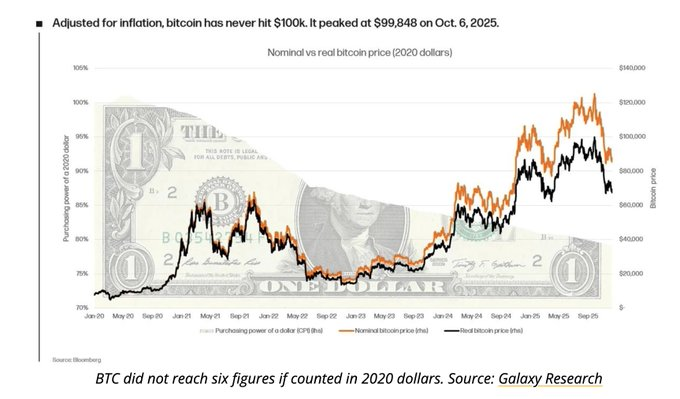
That distinction reframed the narrative of the 2025 cycle. Many traders anchored expectations around psychological round numbers. Inflation quietly eroded that benchmark, leaving Bitcoin price structurally weaker than headlines suggested.
Coin Bureau echoed this reframing in a Dec. post. The outlet said nominal highs “hit differently after inflation.” The comment reinforced growing skepticism around celebratory cycle claims.
Sentiment Breakdown After a Failed Breakout Year
Anthony Scaramucci said 2025 failed to meet expectations. Speaking on CryptosRus, he admitted that he expected the Bitcoin price to surge on the tailwinds of regulatory changes. Instead, the price stalled near $ 88,000, with sentiment turning negative.
Mike Novogratz shared a similar assessment. He stated that the market did not behave as expected, despite capital inflows and policy shifts. Novogratz added that healing, not hype, defined the next phase.
Still, Novogratz rejected the cycle-top argument. He said infrastructure growth remained intact beneath weak price action. That divergence placed the Bitcoin price in a consolidation rather than a structural collapse.
BCMI Signals a Deeper Market Reset Risk
On-chain data added weight to the bearish case. Bitcoin BCMI returned to the 0.5 zone on Oct. 21, initially signaling cooling conditions. Since then, both price and BCMI declined together.
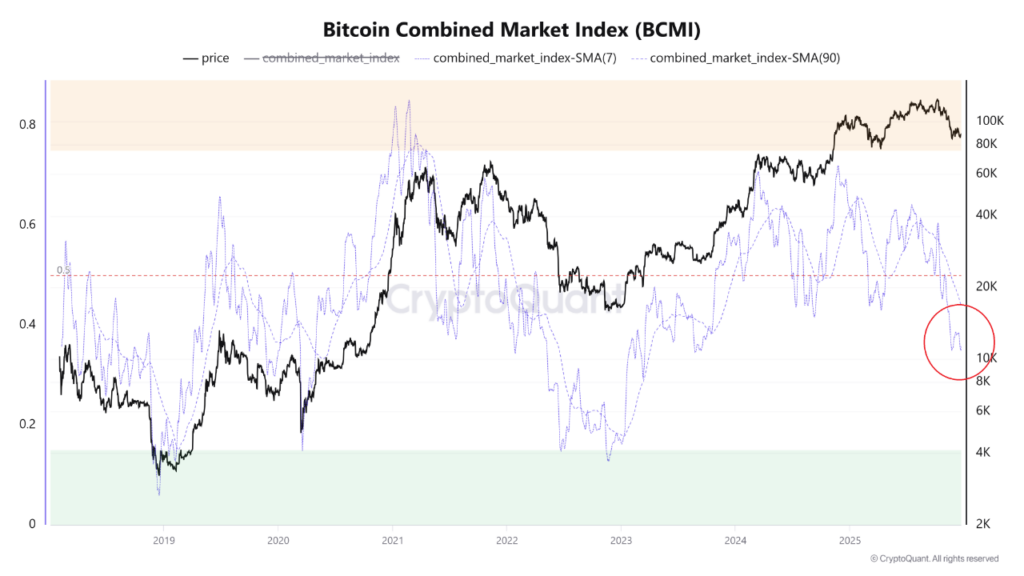
That joint decline mattered historically. BCMI bottoms in 2019 and 2023 formed near the 0.25 to 0.35 range. Current readings remained well above those levels, suggesting incomplete compression.
The BCMI update warned the market may be entering a bear phase. Analysts stressed this was not a forecast. They described it as a scenario supported by historical analogs and momentum behavior.
Whale Activity Shows Exhaustion, Not Recovery
Whale inflows to exchanges offered mixed signals. Data showed the 30-day trend dropped to the lower bound of the current cycle. Analysts said that this suggested selling pressure had been exhausted, not renewed demand.
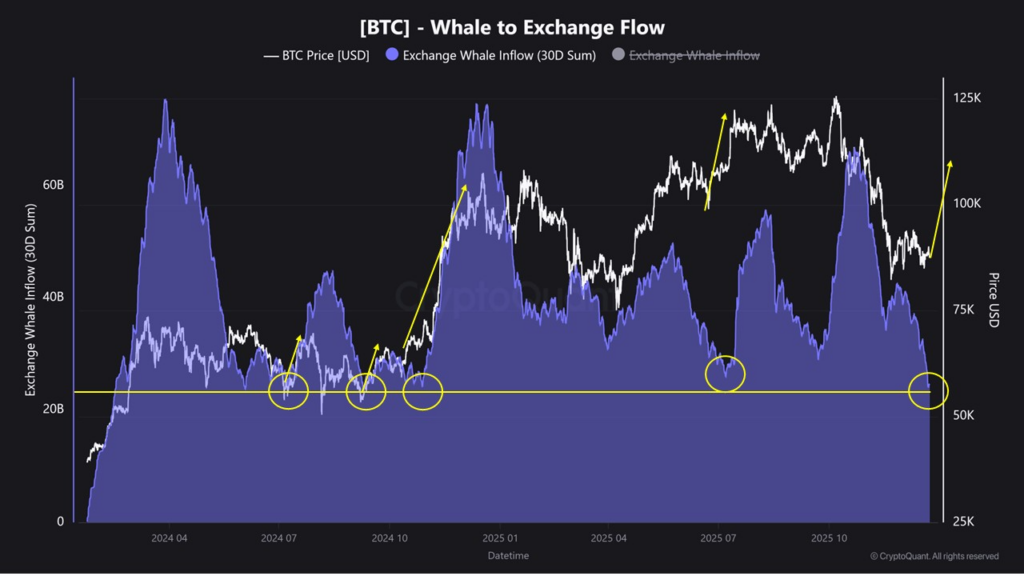
Historically, similar conditions preceded technical rebounds. However, rebounds did not always mark trend reversals. The metric reflected reduced selling intensity rather than fresh accumulation.
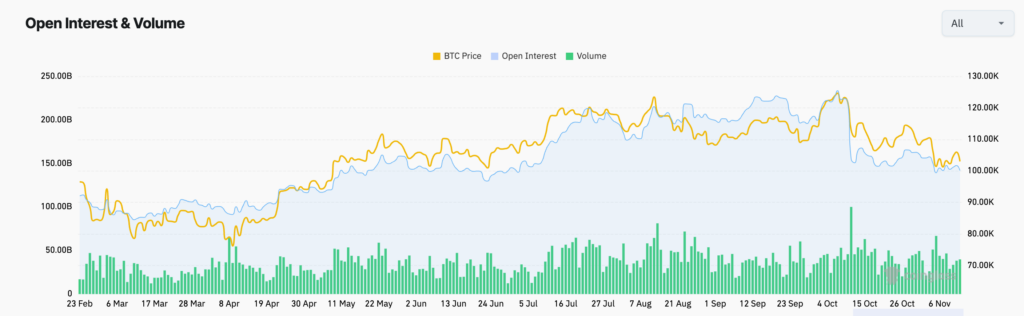
The daily chart reinforced that caution. Bitcoin price broke below its 50-day and 100-day moving averages in November. Price also failed to reclaim the descending trendline near 92,000 dollars, turning prior support into resistance.
Seasonal Liquidity Adds to Market Stagnation
Late December compounded these pressures. Analysts noted seasonal liquidity contraction across crypto markets. Holiday conditions reduced both buying and selling participation.
A major options expiration further dampened risk appetite. Traders avoided large directional bets ahead of settlement. Bitcoin price drifted as volatility compressed.
Historically, low-volatility phases have preceded large moves. Analysts described them as periods of energy compression. Direction, however, remained unresolved without a demand trigger.
Regulatory Confidence Clashes With Weak Price Action
Brock Pierce offered a contrasting perspective. He said Bitcoin’s largest historical risk was government uncertainty. Pierce argued that overhang faded under a pro-crypto U.S. administration.
Pierce said regulatory alignment shifted Bitcoin’s long-term positioning. Scarcity dynamics, he noted, remained unchanged. Only 21 million coins existed, with some permanently lost.
Still, Pierce acknowledged the pullback. He said markets often cooled after rumors met reality. Price consolidation, he argued, did not invalidate the adoption thesis.
Infrastructure Builds While Price Lags
Novogratz highlighted infrastructure as the real growth vector. He said that global teams continued to build crypto-native financial platforms. These included neobanks, tokenized equities, and prediction markets.
He compared the phase to post-dotcom infrastructure development. Price stagnated while systems quietly expanded. In this view, the Bitcoin price lagged behind adoption progress.
That disconnect defined the late-2025 market. Capital, belief, and plumbing persisted. Traders, however, lacked confirmation of momentum.
What Comes Next for Bitcoin Price
The immediate outlook remained cautious. BCMI stayed below equilibrium but above historical bottom zones. That placement left room for further downside before durable support emerged.
Analysts watched key psychological levels closely. Sustained trade below recent ranges risked reinforcing bear-phase narratives. Conversely, compressed volatility left room for sharp reversals.
Institutional rebalancing, expected to occur in early 2026, emerged as a wildcard. Analysts said latent demand exceeded whale capital. If activated, the Bitcoin price historically moved fast rather than gradually.