
 streamoors
 Altai the Tiger
 Sword Inu
 IGNITION
 no crying in the casino
 Quantus
 NEAR Protocol

Bitcoin news out of the UK courts is drawing global attention as a dispute over the world’s largest confirmed law enforcement crypto seizure reaches a critical stage.
At the center of the case is a £3.2 billion haul of 61,000 Bitcoin seized from a Chinese fraudster, and a growing conflict over who gets to keep it.
As per the FT report, the seized funds originated from a Ponzi scheme run by Zhimin Qian, who defrauded more than 128,000 victims in China between 2014 and 2017.
Qian was jailed at Southwark Crown Court in November after fleeing to Britain with a large crypto fortune. London police seized approximately 61,000 Bitcoin from electronic devices found at a mansion in Hampstead.
Bitcoin News: How a £3.2 Billion Haul Ended Up in UK Courts
The Bitcoin was seized when prices were far lower than they are today. Since the fraud took place, the price of Bitcoin has quintupled, pushing the value of the haul to roughly £3.2 billion.
That price surge has turned what was already a large seizure into one of the most contested crypto asset cases in legal history.
Various groups of victims are now fighting to prevent the UK Treasury from capturing the full inflated value of the Bitcoin.
Their legal route runs through Section 281 of the Proceeds of Crime Act, which allows crime victims to pursue criminal assets through the English courts.
UK authorities have proposed an out-of-court compensation scheme that would redirect funds to victims through an existing redress mechanism already operating in China.
Under this arrangement, the British state would likely retain the majority of the Bitcoin fortune, providing a substantial boost to public finances.
Victims Push Back Against Proposed Compensation Plan
A law firm named Candey, which represents around 5,700 victims, has challenged the adequacy of the UK’s proposed scheme.
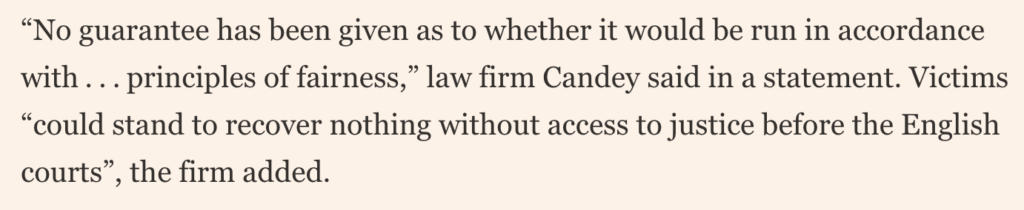
The firm stated that no guarantee has been given that the scheme will operate according to basic principles of fairness. They also warned that victims could stand to recover nothing without direct access to justice before the English courts.
Candey defended its involvement, stating that its payment arrangements are fair and equitable, and that victims would retain the vast majority of any recovered funds.
The firm also confirmed that total legal fees across its teams in both China and England are capped at 18% of any sums recovered.
The Crown Prosecution Service has raised a different set of concerns. Martin Evans KC, appearing on behalf of the Director of Public Prosecutions, submitted that the Section 281 claims would benefit only a small subset of victims along with their litigation funders.
Candey rejected this framing, arguing that the DPP’s suggestion that successful claimants would be excluding other victims is misleading. The firm stated that access to justice for victims must take precedence over securing what it called a windfall for the Treasury.
Bitcoin News: Key Court Dates Set as Legal Battle Escalates
The court has now set a preliminary hearing for July to resolve whether English or Chinese law will govern the victims’ claims to the seized Bitcoin.
That decision is expected to have a major bearing on how the case proceeds and which legal standards apply to the distribution of funds.
Mr Justice Turner also ordered that law firm Fieldfisher act as lead firm for claimants during this portion of the proceedings. A formal deadline of May 22 was set for all Section 281 applicants to file their claims.
One of the central challenges for individual victims in the Section 281 process is the requirement to trace a direct link between their specific stolen funds and the Bitcoin seized.
Given the scale of the fraud and the number of people affected, that tracing requirement is expected to be difficult for many claimants to satisfy.
A final resolution is not expected soon, and the litigation is likely to continue through multiple hearings into the remainder of the year.



