
 astronaut
 Pearl
Pearl Hyperliquid
 Walrus
 Pudgy Penguins
 Bitcoin
 NEAR Protocol

The crypto market fell on Friday, with the total valuation of all tokens declining 1.57% over 24 hours. Bitcoin price dropped more than 2% toward $64,000. Jito, Pi Network, Lighter, World Liberty Financial and Pump ranked among the weakest tokens.
The decline followed a wider risk-off move across global financial markets. Bitcoin exchange-traded fund outflows and rising geopolitical risks added further pressure. This article explains why Bitcoin, Pi Network, XRP and other cryptocurrencies fell today.
Crypto Market Crash Triggered by Risk-Off Sentiment
The crypto market crash is happening as investors embrace a risk-off sentiment as market volatility continues. Data shows that global stocks continued falling this week. In Japan, the Nikkei 225 Index dropped by over 3.13%, while the Shanghai Composite fell by 1.6%.
American stocks were relatively unchanged, a day after the S&P 500 and Nasdaq 100 indices dropped by over 2%. They have dropped by over 2.5% from their highest levels this year as the earnings season continues.
The main reason for the sell-off is the fact that companies like Tesla and Alphabet published mixed earnings. Alphabet stock dropped after the company boosted its capital spending plans. Tesla stock has dropped after its earnings per share (EPS) came short of expectations. Also, the company expects that its free cash flow will remain in the negative zone.
Stocks and crypto prices are also soaring after President Donald Trump announced new global tariffs, citing human rights abuses. These tariffs will, however, not have a big impact on the markets as they are simply replacing those that were to expire.
Meanwhile, there are concerns about the ongoing war in the Middle East. Trump has warned that the US will launch major attacks against Iran as soon as this weekend. Iran has warned that it will continue its attacks against US bases. As a result, crude oil prices have continued rising, with Brent hitting $100.
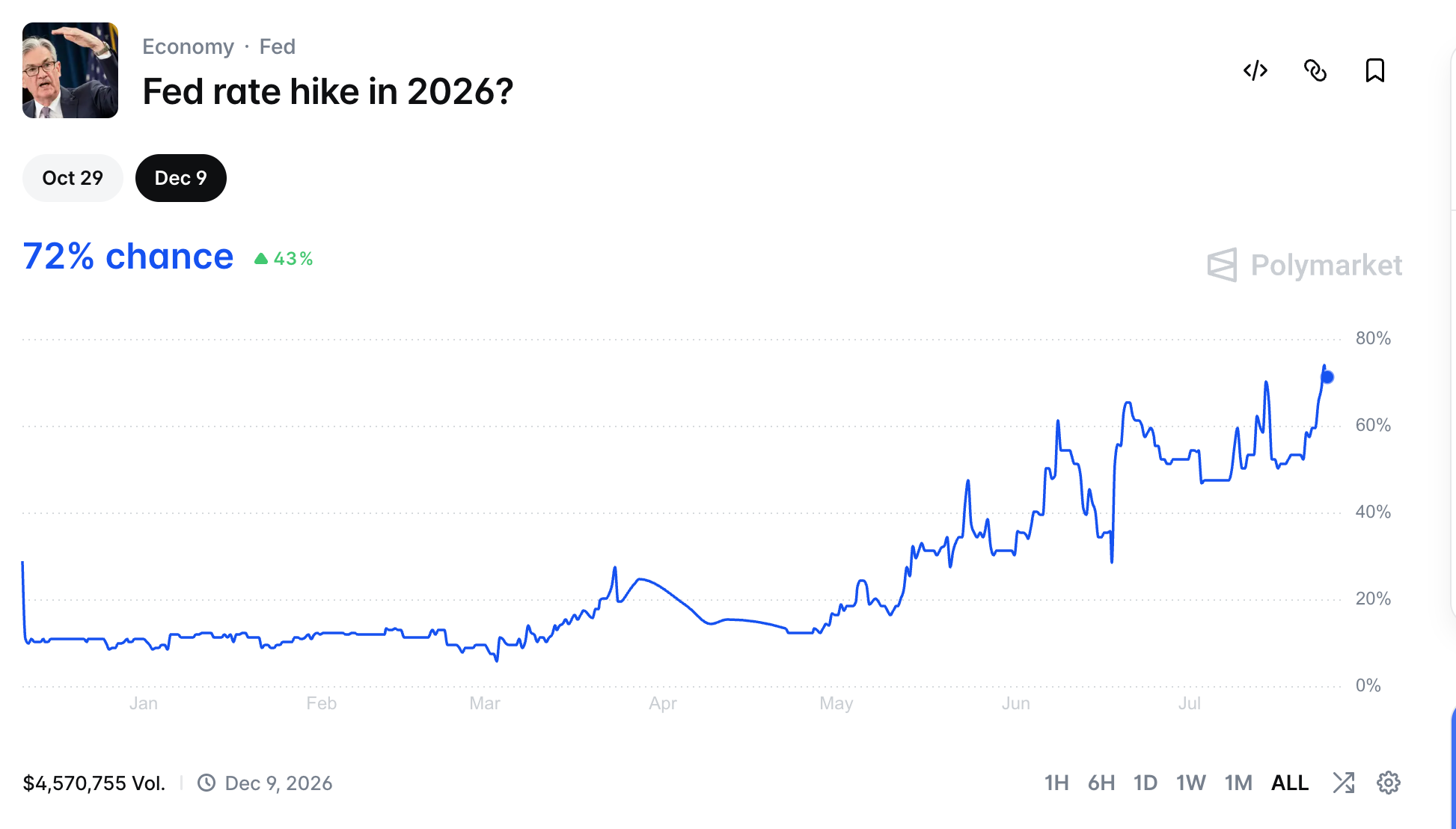
The rising oil prices mean that inflation will rebound, pushing the Federal Reserve to hike interest rates later this year. Indeed, data shows that odds of a rate hike have jumped on Polymarket.
Bitcoin ETFs Suffered Outflows on Thursday
Bitcoin, XRP, and Pi Network prices have wavered amid ongoing volatility in the ETF market. Data shows that spot Bitcoin ETFs shed over $225 million in assets on Thursday. The outflows were broad-based, with BlackRock’s IBIT shedding $202 million and Fidelity’s FBTC losing $5.6 million.
Bitwise’s BITB, Ark’s ARKB, Franklin’s EZBC, and WisdomTree’s BTCW lost over $4.3 million each. The only positive came from Morgan Stanley’s MSBT, which added $5 million in assets.
The start of selling could be a sign that investors believe that the rally is starting to fade.
Other crypto ETFs suffered outflows or no activity on Thursday. Spot Solana ETFs shed over $1.27 million on Wednesday and had no activity on Thursday. Spot XRP ETFs have not had any inflows in the past two consecutive days.
At the same time, crypto liquidations jumped by over 61% in the last 24 hours. Also, the futures open interest has dropped to $114 billion.
Bitcoin Price Technicals Add to Crypto Market Pressure
Bitcoin price retreated from about $67,000 earlier in the week toward the $64,000 region. The daily chart showed resistance near the 100-day exponential moving average. Bitcoin’s 100-day exponential moving average stood near $68,000 on Friday.
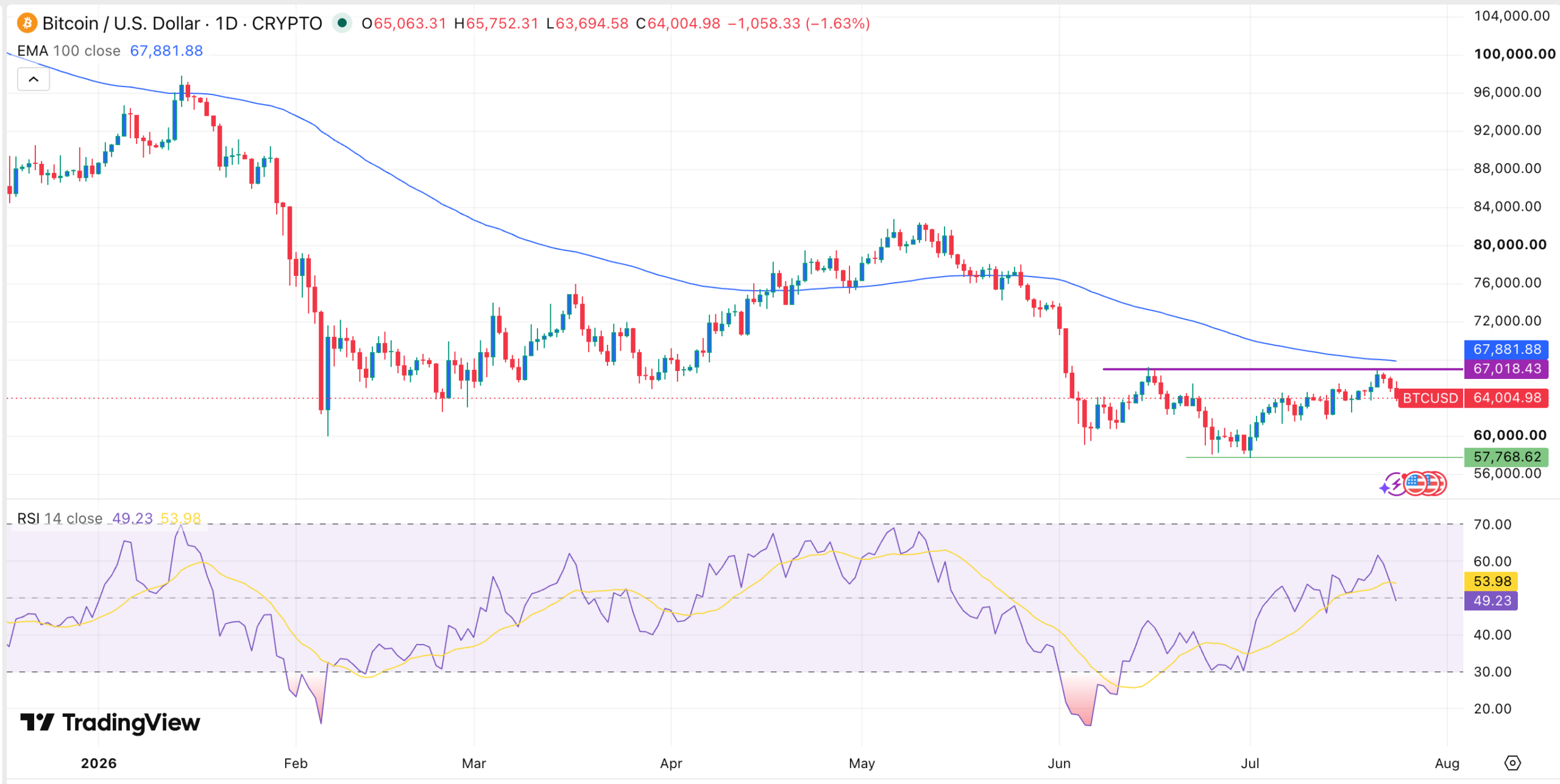
The Relative Strength Index moved closer to neutral territory as buying momentum weakened.
Bitcoin also appeared to form a short-term double-top pattern near $67,000. Traders often treat that formation as bearish when price breaks below its neckline.
However, the draft’s $57,768 neckline sat far below the current market. Bitcoin had not confirmed a full double-top breakdown at that level.
The immediate support zone remained between $63,600 and $64,000. A sustained close below that area could expose $62,000 and the psychological $60,000 level.
Resistance remained near $65,800, followed by $67,000 and the 100-day exponential moving average.
A recovery above $67,000 would weaken the bearish setup. It could also restore the rebound that began earlier in July.
The near-term outlook remained tied to oil prices, technology stocks and ETF flows.
Further Bitcoin ETF outflows could pressure the market. Renewed inflows or easing geopolitical tensions could support a recovery. The crypto market decline therefore reflected several pressures rather than one isolated event.



