
 astronaut
 Pearl
Pearl NEAR Protocol
 Walrus
 Zylo Ecosystem
 Bitcoin
 Hyperliquid

Tesla stock traded around $357 after losing momentum following its late-August rebound, while competition and heavy investment remain major risks for investors.
TSLA closed Sept. 2 at $357.01 after reaching $367.95 on Aug. 31. The stock remains about 20% above its 52-week low near $297, but it has struggled to extend its latest recovery beyond the upper-$360 region.
The technical slowdown comes as Tesla increases spending on artificial intelligence, robotics and autonomous vehicles. Competition in China and Waymo’s larger robotaxi deployment add separate risks to the company’s longer-term growth assumptions.
Tesla Stock Loses Momentum After Recent Rebound
Tesla shares recovered sharply during August after falling below $300 earlier in the summer.
The stock climbed toward $368 on Aug. 31 before retreating to $356.09 on Sept. 1 and closing at $357.01 on Sept. 2. That left TSLA below its recent high despite maintaining much of the broader summer recovery.
The supplied daily chart shows price moving inside a rising wedge-like structure. TSLA has also struggled to establish sustained momentum above the upper portion of the recent range.
That creates a more cautious short-term setup. A decisive break of lower trend support would provide stronger confirmation that the August rebound is losing momentum.
BYD Warned of Major Challenges in China’s EV Industry
BYD, a top company in the electric vehicle industry, warned that the Chinese market was going through major challenges this year. Precisely, it pointed to the rising competition as companies like Polestar, Nio, XPeng, Xiaomi, and Li Auto, compete for growth in the country.
At the same time, the company warned about the rising cost of doing business as key materials soar amid the ongoing US-Iran tensions. Some key materials like copper, rubber, steel, and aluminum have jumped during the war. These developments explains why many Chinese EV stocks have plunged in the past few months.
Tesla is a major player in the Chinese market, with estimates showing that it is its second-biggest market. While its Chinese sales have stabilized in the past few months, there is a risk that the situation will change as BYD’s risks escalate.
This is probably one of the reasons why Tesla is considering spinning off the company into a standalone business. Another reason is that it hopes to reduce the regulatory scrutiny if Elon Musk decides to merge it with SpaceX.
Waymo is Beating Tesla in Key Metrics
Another key risk that may affect the TSLA stock price is its robotaxi business, which is facing substantial challenges. This is important because Elon Musk has invested heavily in the industry. Also, the business is one of the main factors that differentiates Tesla from other automotive companies.
Data compiled by RobotaxiTracker shows that Tesla has just 209 robotaxis, over a year since its launch. In contrast, Waymo has over 4,000 vehicles in the US, and now plans to expand to Germany. As part of this expansion, the company is raising $3 billion in debt, a few months after it raised $16 billion. Amazon’s Zoox is also seeing strong growth.
These developments mean that Tesla will need to intensify its investments in the division in the coming months.
Tesla Spending is a Big Concern
The other key concern that may hit the TSLA stock price is its spending plans. In its most recent results, the company said that its revenues jumped by 26% in the second quarter as its deliveries rose. It made over $28 billion in revenues during the quarter.
However, the spending meant that its adjusted EBITDA margin dropped by 353 basis points to 11.6%, while its free cash flow dropped by 848% to minus $1 billion. Its capital expenditure rose by 142% to $5.7 billion during the quarter.
Tesla Stock Price Technical Analysis
The daily chart shows that the TSLA stock price has rebounded in the past few weeks, rising from $296 in late July to the current $357. It managed to fill the fair value gap that formed on July 23 when it published its financial results.
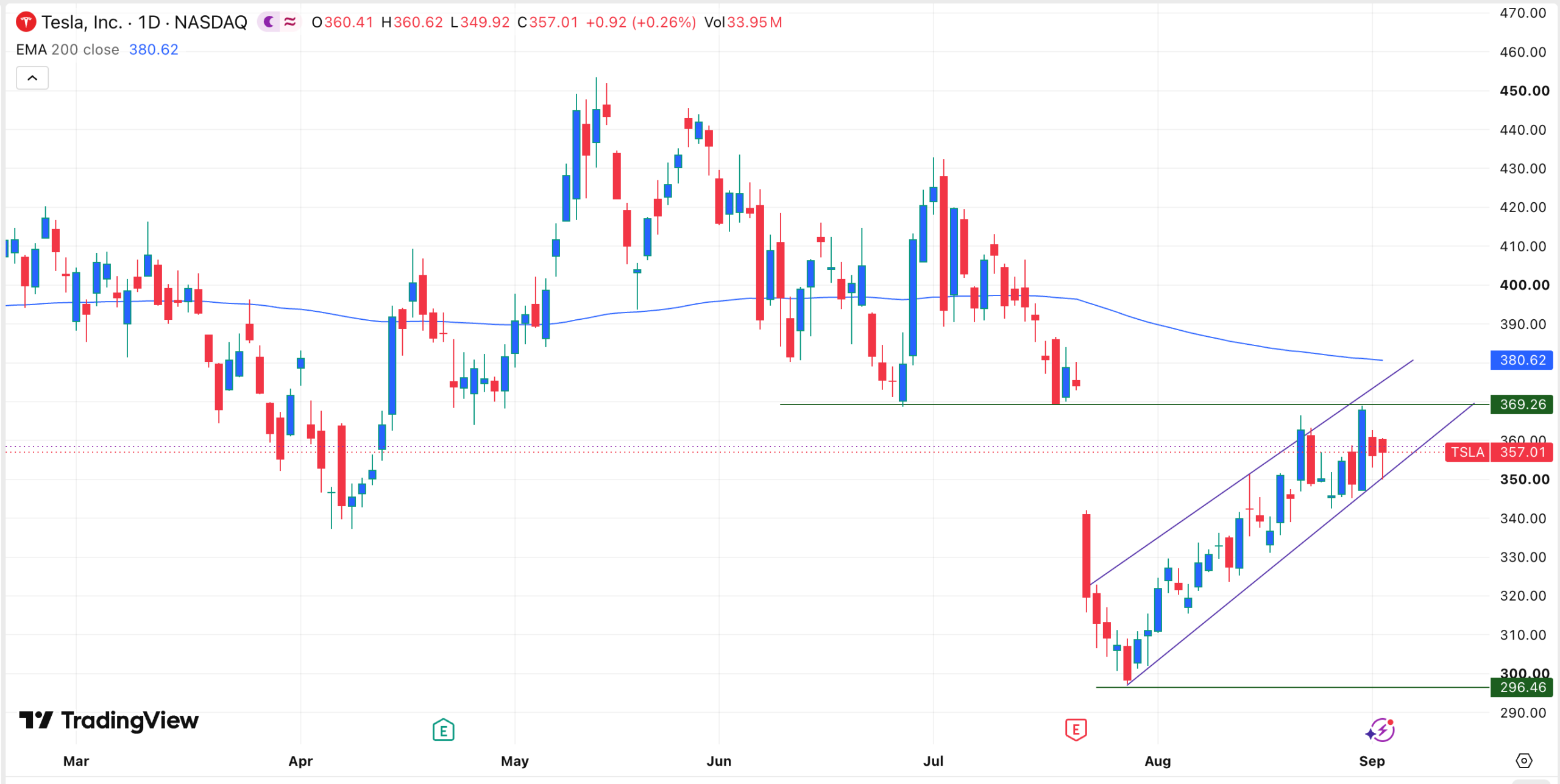
A closer look shows that it retested the lowest point before that report, confirming a break-and-retest pattern. Also, it is slowly forming a rising wedge-like pattern. It remains below the 200-day moving average, a sign that bears are in control for now.
Therefore, the path of the least resistance is downwards, with the initial target being at $320, which is about 10% below the current level.



