
 streamoors
 IGNITION
 Sui
Sui Quantus
 Bitcoin
 Pearl
Pearl Solana
SpaceX stock pulled back sharply this week even as the company announced a major expansion of its Starlink Mobile strategy. SPCX closed at $160.57 on Oct. 8, down from an Oct. 6 intraday high of $176.42.
The latest telecom agreement could strengthen SpaceX’s position against established U.S. wireless carriers. However, the company is simultaneously increasing its exposure to capital-intensive AI infrastructure through a proposed $40 billion financing package.
SpaceX to Become Bigger Competitor to AT&T, T-Mobile, Verizon
Elon Musk’s SpaceX is aiming to become a bigger competitor to companies like AT&T, T-Mobile, and Verizon. It has agreed to acquire a nationwide low-band spectrum license portfolio.
By doing that, the company will now be able to use its Starlink satellite service to become a major player in the carrier industry. After receiving approval from the Federal Communications Commission (FCC), it will combine its satellite-to-cell services with a terrestrial network that connects devices everywhere.
This is a major development since, if it works, the company will be in a good position to take a substantial market share in the United States. It can then use the same approach to apply for the same service in other countries.
The most recent results showed that Starlink is the biggest cash generator for the company for now. It now has 12 million customers globally with over 10.2k satellites in orbit. It generated over $4.2 billion in revenue, accounting for 53% of its total.
Most importantly, Starlink is also the only profitable part of its business. It made over $1.6 billion in the second quarter, compared with losses of $542 million and $1.25 billion in the space and AI businesses, respectively.
SpaceX is also working to improve its satellite business. It recently launched a test for its third version of the satellite, which weighs about 2,000 kilograms. It will be able to deliver about 1 terabyte of capacity and 160 Gbps of uplink capacity.
SpaceX Faces Some Risks
Despite growth in its business, SpaceX faces major challenges that explain why its stock has pulled back over the past few days. As we reported earlier this week, the company is seeking to raise $40 billion to buy Nvidia chips.
Its goal is to become the biggest provider of compute services to companies in the artificial intelligence (AI) industry. It has already won some major contracts with companies like Google and Anthropic. Google is paying it $925 million a month, while Anthropic is paying it $1.25 billion.
The challenge, however, is that the business will take time to become profitable. In the last quarter, its AI business made a loss of over $1.25 billion, while its capital expenditure jumped to over $15.8 billion.
The $40 billion raise has led to a surge in SpaceX’s bond yields. Also, the cost of insuring against a default has continued rising this year.
SpaceX Stock Technical Analysis
The daily chart shows that SpaceX shares have been in a strong upward trend in the past few months. It has jumped from a low of $105.27 in July to a high of $176.33. A closer look shows it formed a small shooting star candlestick pattern, a common bearish reversal signal in technical analysis.
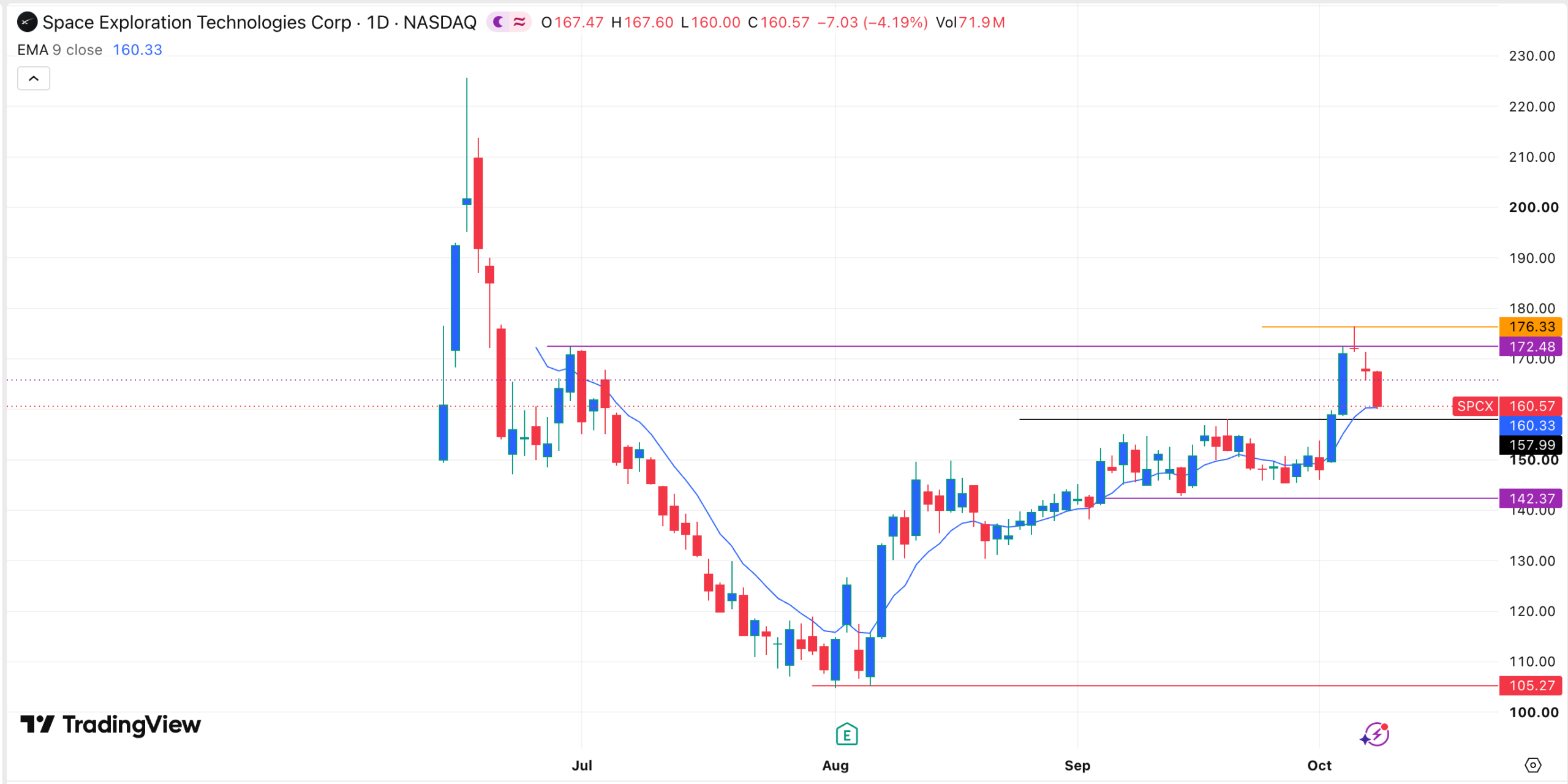
The stock has remained above the 50-day Exponential Moving Average (EMA). It is also seeking to retest the key support level of $157.9, its high on September 21. Therefore, the most likely scenario is where the stock will rebound, potentially to the resistance level of $176, followed by the psychological level of $200.
This article is for informational purposes only and does not constitute financial or investment advice. Stock prices, financing plans, regulatory approvals and technical levels may change as market conditions evolve.




