Injective
 Celestia
 streamoors
 Sui
Sui Pudgy Penguins
 Bitcoin
 Pearl
Pearl
Key Insights:
- Bitcoin price nears ATH as U.S. financial conditions hit loosest levels since 2022.
- Technical squeeze likely as BTC rebounds off the demand zone.
- Illiquid Bitcoin supply surpasses 14M, signaling strong long-term holder conviction.
Coinbase Derivatives confirmed the launch of U.S.-regulated perpetual-style futures products for BTC and ETH on July 21. The move marked a key step toward institutionalizing crypto derivatives within U.S. compliance frameworks.
Favorable U.S. Financial Environment Aligns with Bitcoin Price Strength
Analysts at Ecoinometrics have highlighted that Bitcoin’s performance aligns with a two-year trend of loosening financial conditions in the United States. The current reading of the National Financial Conditions Index (NFCI) shows a drop to nearly -0.5.
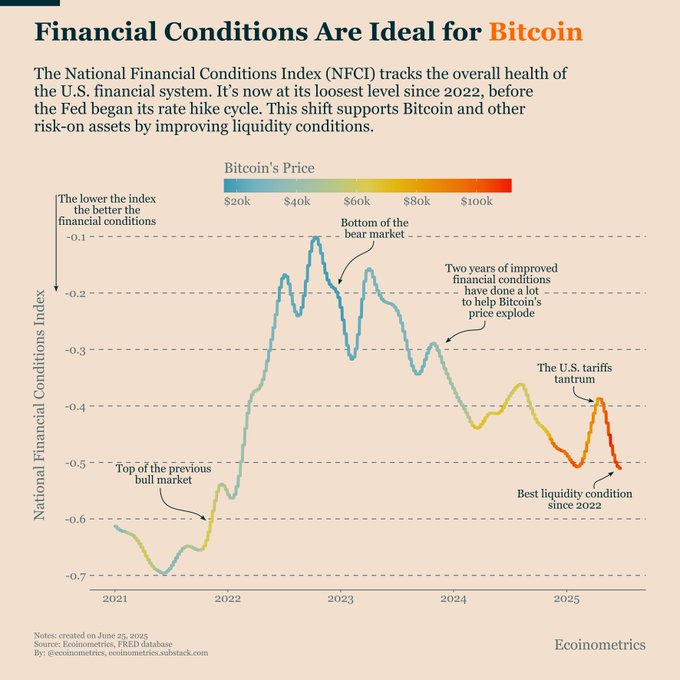
This level marks the most favorable liquidity environment since 2022, according to historical data tracked by the index. The NFCI measures systemic liquidity and the broader financial backdrop, and looser conditions have historically coincided with bullish sentiment in risk assets such as Bitcoin.
Bitcoin’s last major bull run in late 2021 occurred when the NFCI dropped near -0.6. In contrast, the 2022 bear market bottomed out as the index climbed toward -0.1, reflecting tighter financial conditions. Previous market cycles also demonstrate this correlation.
Ecoinometrics points to a steady improvement in liquidity since 2023 as a factor behind Bitcoin’s rally from below $60,000 to its current levels. This environment continues to support active participation in the market.
Liquidity Zones and Technical Pressure Shape Near-Term Movement
Elsewhere, technical indicators point to a potential price squeeze as Bitcoin approaches previous record highs. According to analyst Jelle, the price recently rebounded from a demand zone in the $104,000–$105,000 range.
After this rebound, Bitcoin surged to $107,899.99, approaching visible liquidity concentrations stacked between its current level and past highs around $112,000. This clustering suggests that market makers may push the price higher to tap into these liquidity pools or higher.
Jelle notes that volatility remains suppressed while funding rates are negative, which often precedes sharp price moves. The presence of a high number of short positions could trigger a short squeeze if price momentum continues upward.
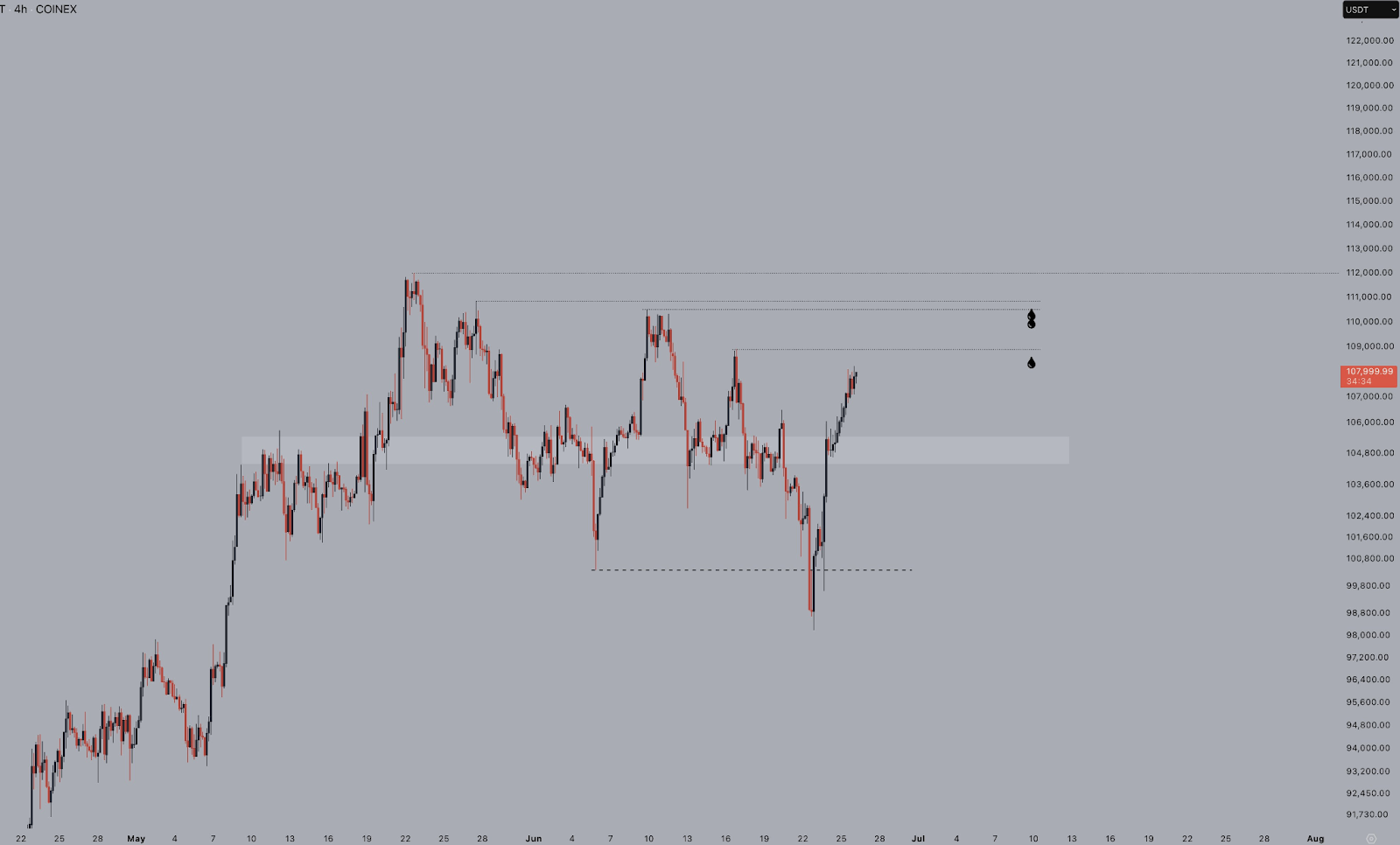
A squeeze could accelerate if Bitcoin breaks resistance levels near $109,000, $110,800, and $112,000. The proximity of these levels indicates potential pressure as market participants react to directional moves.
Bitcoin Price Long-Term Holders Add Upward Pressure Through Supply Contraction
Meanwhile, an increase in the illiquid supply of Bitcoin is possibly contributing to the total market momentum. According to the figure suggested by Glassnode and empasized by analyst Gordon, the illiquid BTC rate has been more than 14 million BTC as of mid- June 2025.
Illiquid supply means coins that are still stored in wallets that have little history of transactions and suggest low chances of quick sales. This increase suggests more coins are being moved into long-term storage. The total illiquid supply increased mainly between 22 December 2024 and June 2025, where the illiquid supply went up between 13.95 and 14.3 million BTC.
The metrics provided by Glassnode also indicate that this increase in accumulation started in mid-March, when the price of Bitcoin increased by an estimated value of 78,000 dollars, going up to almost 200,000 dollars. This kind of a supply contraction had been witnessed in the past during the upward price swings, which are a sign of reduced provision of BTC in active trade.
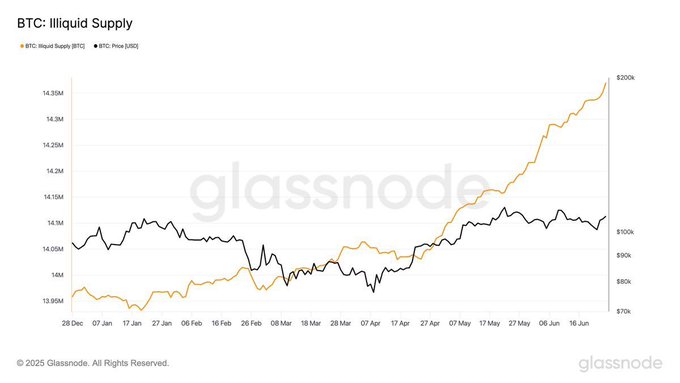
Such liquidity, combined with technical prices and shrinking available supply has the effect of a closely knit market environment. Everything points toward the notion that the path of Bitcoin is still being determined by macroeconomic factors, and influences in positioning on main exchanges.
Disclaimer
This article is for informational purposes only and provides no financial, investment, or other advice. The author or any people mentioned in this article are not responsible for any financial loss that may occur from investing in or trading. Please do your research before making any financial decisions.