
 Zylo Ecosystem
 Pearl
Pearl Walrus
 Derive
 Quantus
 Aerodrome Finance
 Sui
Sui

Key Insights:
- South Korea pauses CBDC testing as banks express concerns.
- Several major South Korean banks to launch a won-pegged stablecoin.
- The surge in stablecoin stocks fuels a 30% rally in the Kospi index.
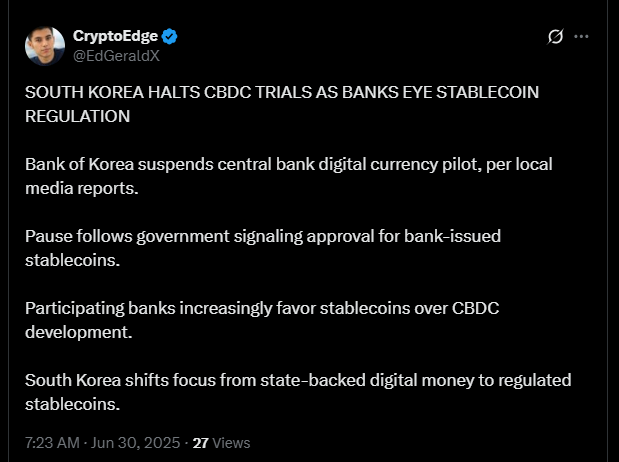
South Korea has witnessed the most dramatic change in its digital finance strategy, as the central bank moved to halt the pilot CBDC.
However, while the country’s major commercial banks work hard to build and launch their own pegged stablecoins, the dawn of a new era in South Korean digital assets is upon us.
Banks Change Track to Stablecoins
Following the conclusion of stage one of the pilot for North Korean central bank digital currency, which involved 100,000 users and major retailers, the Bank of Korea halted the second phase. Banks’ concerns about the high costs, scalability challenges, and indefinite path toward commercialization of the project were behind this decision. In accordance with this, regulators and the banking side seem to focus on the regulation and issuance of Korean-won-backed stablecoins.
The new president, Lee Jae-myung, who made digital assets a key campaign promise, has put his support behind stablecoins. His government is now fast-tracking the issuance and establishment of the regulatory framework for digital assets.
The Digital Asset Basic Act, whose conception has been mooted, will impose capital reserve requirements for stablecoin issuers and provide strict consumer protection rules.
According to a senior official at one of the participating banks in an interview with Yonhap News Agency, “Before the Bank of Korea goes ahead with the second phase of the CBDC trials, the government must provide clear guidance on stablecoins.”
Several Major Banks Eye Open Blockchain and Stablecoin Ventures
Eight major South Korean commercial banks – KB Kookmin, Shinhan, Woori, NH Nonghyup, Industrial Bank of Korea, Suhyup, Citibank Korea, and Standard Chartered First Bank – are forming a joint venture for the issuance of a won-pegged stablecoin. This consortium, with the Open Blockchain and Decentralized Identity Association acting as coordinator, aims to issue the stablecoin by the end of 2025 or early 2026, subject to the approval of the Financial Supervisory Service.
The initiative endeavours to reduce South Korea’s dependence on foreign dollar-pegged stablecoins, which have grown substantially in use and currently account for the larger share of domestic digital asset transactions. In the first quarter of 2025 alone, trade volumes in Korea reached ₩56.95 trillion ($41.6 billion) for dollar-pegged stablecoins such as USDT and USDC, nearly triple the amount seen in late 2024.
Stocks in Stablecoin Surge Amidst the Euphoria
The rise of stablecoins ignites a rally in South Korean stock markets. The Kospi is up approximately 30% from the beginning of this year, nearing four-year highs, making it the best-performing market in Asia in the first half of 2025. The rally is propelled by President Lee’s intention to legalize and back stablecoins and the new projects on digital asset that are going to be launched soon.
Shares of companies involved with BOK’s digital currency projects have risen steeply. Kakao Pay almost doubled its stock price in June, while LG CNS came very close to climbing 70% before retreating slightly. In the Kosdaq junior market, shares of Aton, a fintech security firm, went up 80%, and those of mobile game developer ME2ON tripled after the launch of a dollar-pegged stablecoin for casino platforms by one of its subsidiaries.
Retail investors rode this massive wave, with outstanding margin loans swelling to ₩20.5 trillion ($15 billion). This bullish attitude has remained, despite the government still not having presented a concrete draft on cryptocurrency regulations.
A New Road to Digital Finance in South Korea
South Korea’s shift from a centralized CBDC to bank-led, regulated stablecoins represents operational pragmatism and also makes a strategic move toward global trends. Allowing its largest banks to issue and manage won-backed stablecoins is the country’s way of regaining monetary sovereignty and encouraging innovation, enabling it to stand against a rapidly changing digital asset space.
South Korea’s stablecoin experiment may set an example for other nations navigating the future of money in the digital age.
Disclaimer
This article is for informational purposes only and provides no financial, investment, or other advice. The author or any people mentioned in this article are not responsible for any financial loss that may occur from investing in or trading. Please do your research before making any financial decisions.




