
 NEAR Protocol
 Bitcoin
 Puffer
 Hyperliquid
 ZKsync
 Pudgy Penguins
 Pearl
Pearl

Key Insights:
- NVIDIA stock price has stagnated this month amid multiple China news.
- Technicals suggest that the stock may retreat in the coming weeks.
- Palantir is a better and cheaper alternative to NVDA.
NVIDIA stock price rally has stalled this month as traders watch the ongoing developments in China, where it will now share its profits with the United States government. NVDA was trading at $182 on Thursday, a range it has been in the past few days. This article explores whether Palantir is a better AI alternative.
NVIDIA Stock Price Faces Risks
NVDA stock price has been in a strong bull run as investments in data centers have jumped this year. This growth has been driven by the robust spending by some of the top companies like Microsoft, Meta Platforms, and Google.
Analysts are optimistic that the stock has more upside. In a recent note, we highlighted Bank of America and Morgan Stanley analysts who believe that it will surge to $250, at which time it will be a $6 trillion company.
However, technical analysis point to a pullback as its earnings date near. The chart below shows that the stock has formed a bearish divergence as the MACD and the Relative Strength Index (RSI) have started to drift downwards.
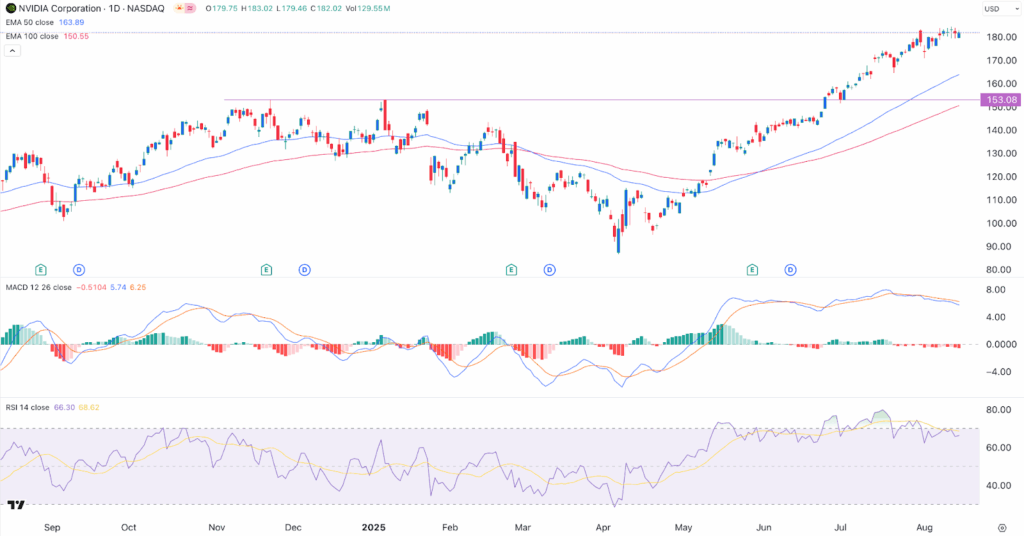
The stock may also drop because of mean reversion as it remains much higher than its moving averages. Additionally, it may drop to $153 to retest an important level that was its double-top point in November last year and January this year. A break-and-retest is a common continuation pattern, meaning that a surge to $250 is still possible.
Is Palantir Stock a Better Alternative to NVDA?
Palantir and NVIDIA are some of the biggest players in artificial intelligence. NVDIA focuses on building the hardware, which is used to run most AI operations today. It also has a small presence in the software industry through CUDA, which is used to convert its GPUs into general-purpose equipment.
Palantir, on the other hand, is a software company offering three key solutions: Gotham, Foundry, and Palantir Artificial Intelligence Platform (AIP).
Gotham is a platform mostly used by the government to integrate and analyze vast troves of data, while corporate clients use Foundry in industries like aerospace and energy.
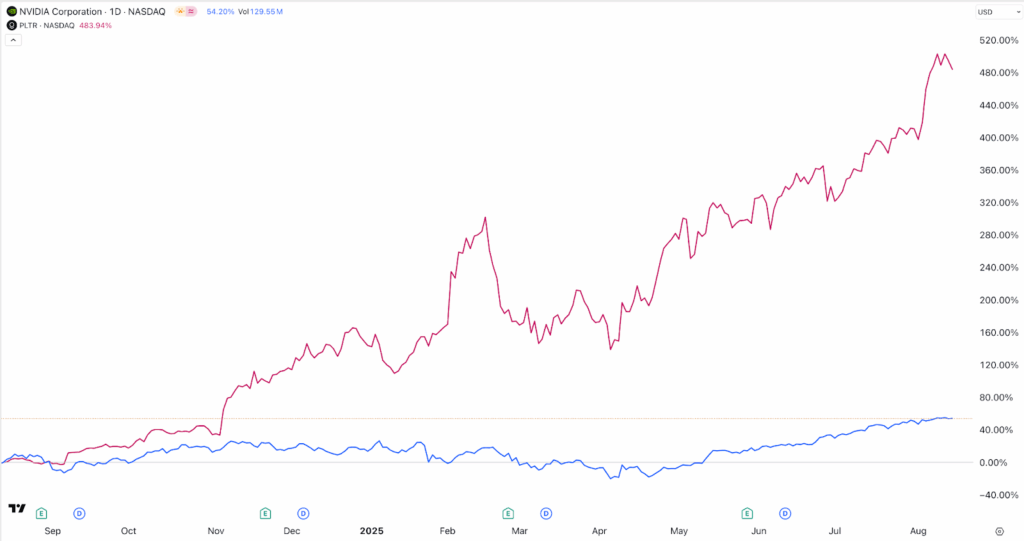
AIP, its main platform is used by companies to build artificial intelligence applications. It is one of the main reasons why the PLTR stock has beaten NVIDIA in the last 12 months, as the chart below shows.
Palantir is Still Cheap With Runway for Growth
One reason why PLTR is better than NVIDA stock is that its business, especially the commercial division, is growing. The most recent results showed that its revenue jumped by 48% in the second quarter to $1 billion.
The closely watched US commercial division grew by 93% year-over-year as more companies adopted its AI tools. Its commercial division’s customer count rose by 43%. The management hopes the commercial division will pass the government one soon.
Despite its high price-to-earnings multiples, PLTR is also a relatively cheap company. Yahoo Finance data shows a forward price-to-earnings ratio of 285, much higher than NVIDIA’s 50.
However, Wall Street investors use a different valuation approach for software companies. This approach, known as the rule-of-40, looks at companies’ revenue growth and their profit margin.
Ideally, adding the two figures shows whether a company prioritizes growth compared to profitability. A figure greater than 40 is a sign that a company is balancing the two.
PLTR reported 68% revenue growth and a 27% operating margin, giving it a Rule-of-40 score of 95%. This far exceeds the 40% benchmark, indicating potential undervaluation. Growth prospects remain as more firms adopt its platform.
At the same time, NVIDIA faces a risk in that most of its revenue comes from a handful of companies. As such, it may face headwinds when the data center spending boom fades.
Palantir’s stock price has beaten NVIDIA in the last 12 months, and odds are that it will continue doing that as demand for its products and services jumps. It is also a bargain using its rule-of-40 metric.
Disclaimer
This article is for informational purposes only and provides no financial, investment, or other advice. The author or any people mentioned in this article are not responsible for any financial loss that may occur from investing in or trading. Please do your research before making any financial decisions.



