NEAR Protocol
 Pyth Network
 Uniswap
 Pearl
Pearl Quantus
 Aerodrome Finance
 Starknet

- MSTR stock price has sunk into a bear market this year.
- The shares have decoupled from Bitcoin.
- MSTY ETF has a big dividend yield but its total return is not appealing.
The MSTR stock price has crashed and entered a bear market as it continues to decouple from Bitcoin. Strategy, formerly known as MicroStrategy, has declined by 37% from its peak in November of last year. This article explores whether the 170% yielding MSTY ETF is a better alternative.
Why the MSTR Stock Price Has Decoupled From Bitcoin
Historically, MSTR stock price was known for moving in lockstep with Bitcoin. At the time, it would jump higher whenever Bitcoin rose and drop further whenever it dropped.
The correlation was so close such that some analysts recommended investing in it instead of Bitcoin ETFs, citing its premium and the fact that it does not have an expense ratio.
Recently, however, the two have decoupled, and the correlation has largely ended. For example, Bitcoin price surged to a record high of $124,200 on August 14. On that same day, MSTR stock price declined by over 4%.
There are a few possible reasons why the Strategy stock price has deviated from Bitcoin. First, it could be because the Bitcoin treasury sector has become highly saturated, with the number of companies rising. There are now over 100 companies with Bitcoin in their balance sheet, which has made investors lose interest in MSTR.
The MSTR stock crash could also be because of its NAV premium, which, while it has dropped recently, is still above the par level of 1. It has a NAV ratio of 1.358, meaning that investors value its Bitcoin holdings much higher than their real value.
In line with this, there are lingering concerns about the company’s valuation, especially when one looks at the sum of parts. The sum-of-parts valuation looks at the different parts of a company to identify the real value.
Doing such a valuation for Strategy is a relatively simple process and involves less assumptions. On this, its Bitcoin holdings are worth $71 billion, while its software business is valued at about $1.5 billion, giving it a combined value of $72.5 billion.
Strategy also has about $50 billion in cash, $8 billion in debt, and $14 billion in preferred stock. Altogether, the company’s real value is much lower than where it is now.
Is MSTY ETF Better than Strategy Shares?
In a recent article, we warned that the MicroStrategy stock price was at a significant risk of crashing as it has formed a double-top pattern on the daily chart and the correlation with Bitcoin has ended.
As such, this potential crash could make the YieldMax MSTR Option Income Strategy ETF (MSTY) more attractive to investors because of its strong yield.
MSTY is an ETF that gives investors an exposure to the MSTR stock, while still giving a monthly dividend whose yield is much higher than Strategy’s preferred shares like STRD amd STRC. It has a dividend yield of a whopping 170%.
MSTY achieves this return using the covered call strategy, where it invest in the MSTR stock and sells call options on the same.
A call option is a financial transaction that gives an investor the right to buy a stock at a certain price within a set timeframe. In this case, it collects the premium but is then obligated to sell at the strike price if the buyer exercises the option.
MSTY and other covered call ETFs typically take their premium and distribute it to investors as a dividend. In its case, a $10,000 investment in the MSTY ETF can turn into $27,000 if the yield remains.
The challenge, however, is that in most cases, covered call ETFs underperform the underlying asset in the long term. In this case, MSTY’s total return in the last 12 months was 92%, while MSTR jumped by 144%. The same thing happened this year as the MSTR has risen by 18%, while the MSTY has gained 14%’
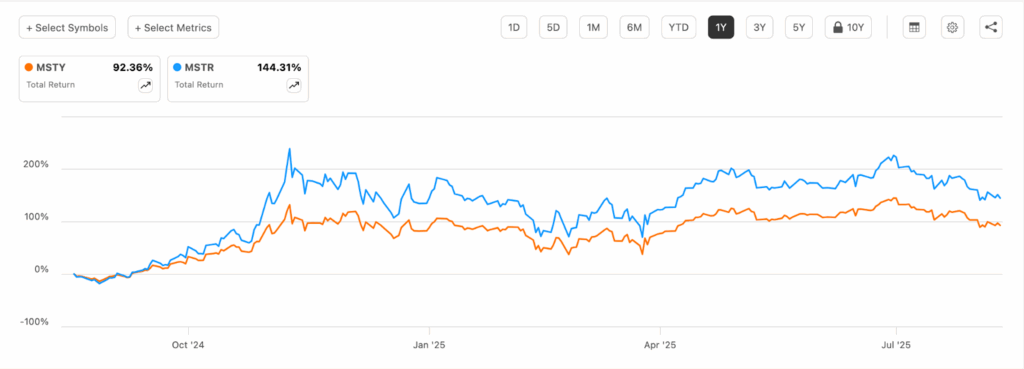
Therefore, while the allure of a 170% return may sound appealing, history suggests that holding tight with the MSTR stock is a better option.
Disclaimer
This article is for informational purposes only and provides no financial, investment, or other advice. The author or any people mentioned in this article are not responsible for any financial loss that may occur from investing in or trading. Please do your research before making any financial decisions.