
 astronaut
 Zylo Ecosystem
 Pearl
Pearl Sui
Sui Walrus
 Quantus
 Quant
Quant

The Fed is anticipated to cut interest rates at a unique time for the American economy. This would occur for the first time in 2025 despite stock markets reaching all-time highs. Meanwhile, the disparity in wealth keeps growing.
Only a small portion of the nation’s wealth is owned by the poorest half of American households. These patterns paint a nuanced picture. Despite the boom in financial markets, many Americans are falling behind.
Fed Rate Cuts While Markets Boom
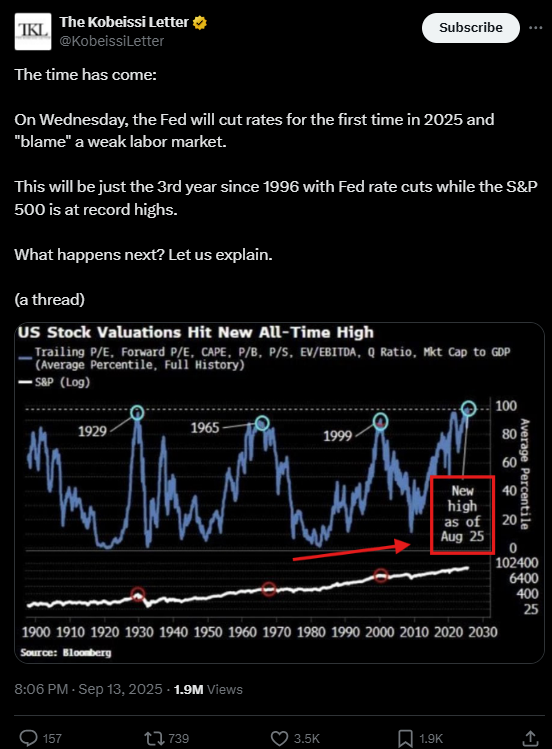
At its September 16–17 meeting, the Federal Reserve is generally anticipated to lower interest rates. This occurs at the same time that the Dow Jones, Nasdaq, and S&P 500 all reached all-time highs in early September.
This would be only the third time since 1996 that the Fed could lower interest rates during high stock prices. What is causing the Fed to lower interest rates now? There are indications that the labor market is weak.
The United States only added 22,000 jobs in August 2025, far less than anticipated. At 4.3%, the unemployment rate reached a four-year high. Jobless claims increased to 263,000 early in September, the highest level since October 2021.
The Fed’s target inflation rate of 2% is still exceeded. In August, the Consumer Price Index (CPI) increased 2.9% from the previous year. Despite this, the Fed is more concerned with promoting employment than managing prices.
Stock Valuations Reach New Heights
The value of US stocks is at an all-time high. Metrics like price-to-book (P/B), price-to-earnings (P/E), and market cap-to-GDP are all higher. The Buffett Indicator was significantly higher than its historical average, at 217% as of August 2025.
The Buffett Indicator contrasts GDP with total market value. According to this, the market is “strongly overvalued.” A few tech giants have reaped most of the market’s gains.
The market capitalization of companies such as Microsoft, Nvidia, and Meta Platforms has increased significantly. The broader indexes are rising as a result. This narrow rally may be risky, according to analysts. The market as a whole may be impacted if these few firms falter.
Wealth Inequality Is Deepening
Wealth disparity in the US keeps rising as markets soar. By 2024, just 2.5% of all wealth was held by the poorest 50% of households. The top 10%, on the other hand, control roughly 67%.
One of the main causes of this divide is stock ownership. Just 17% of the bottom 20% of earners own stocks, compared to nearly 96% of the top 10%. This implies that the wealthy gain the most from rising stock prices.
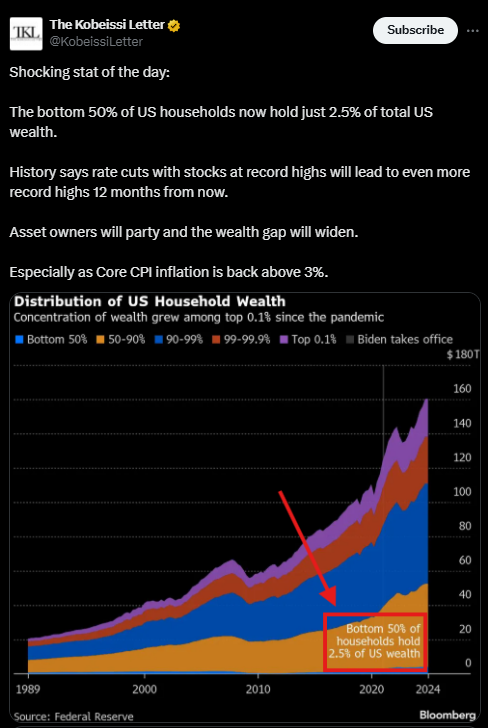
Nearly half of all stocks and mutual funds are currently owned by the top 1% of Americans. In contrast, only 1% is owned by the bottom half. There are wider implications to this inequality. One of the main factors influencing the accumulation of wealth is asset ownership.
Lower-income families find it difficult to establish long-term financial security. This usually happens if they cannot access stocks, real estate, or business equity. Even as the economy grows, the gap between the rich and the poor widens.
There are contradictions in the U.S. economy in 2025. This includes rising stock values, increasing wealth inequality, and fed rate cuts during market booms.
These patterns demonstrate how complicated contemporary economic policy is. They also point to the necessity of finding answers dealing with daily life and financial markets.




