
 streamoors
 IGNITION
 no crying in the casino
 Sword Inu
 Altai the Tiger
 NEAR Protocol
 Quantus

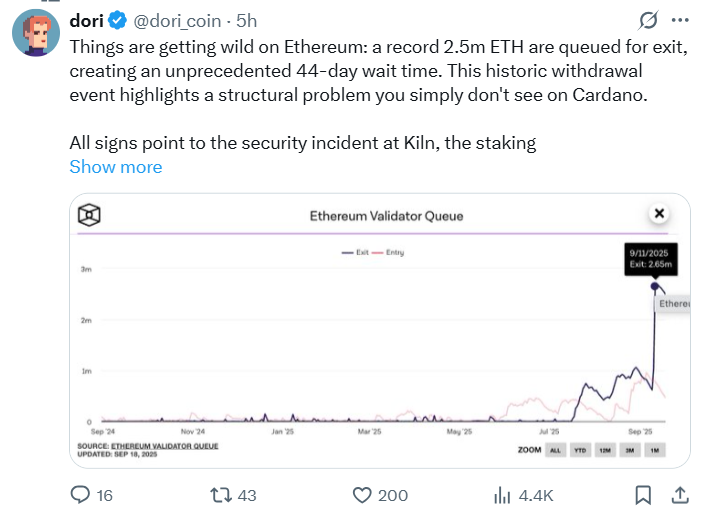
Cardano news is in the spotlight amid a shift in ETH staking ecosystem. A record 2.5 million ETH is waiting to leave the Ethereum network, creating a 44-day backlog for validators.
Notably, the queue follows a security breach at Kiln, a staking provider in the Ethereum ecosystem.
The event has drawn attention to Cardano, which runs a staking model without slashing or lock-ups for delegators.
Ethereum’s Backlog and Cardano’s Different Model
Ethereum is facing its longest validator exit queue since staking began. Data shows more than 2.5 million ETH are lined up for withdrawal.
At current rates, validators must wait about 44 days to complete the process. The surge is linked to Kiln, a staking infrastructure firm that recently suffered a security incident.
Kiln had funds stolen in a breach involving 192,600 SOL. As a precaution, the company removed its Ethereum validators, adding pressure to the exit system.
Ethereum’s design includes slashing and reducing funds if a validator fails or acts against the network.
This rule aims to protect consensus but requires funds to stay locked while staked. This means delegators’ assets could be cut if a validator makes errors.
Cardano takes a different approach. There are no lock-ups and no slashing. Users can delegate sstakesto a pool and move them freely.
A stake pool operator cannot take control of delegated assets. This design reduces the risks of mass withdrawals and slashing events.
Cardano’s consensus, often called Nakamoto-style Proof-of-Stake, can withstand attacks from almost half of the network.
In contrast, Ethereum’s Byzantine Fault Tolerant system could fail at one-third.
As a result, Ethereum depends on slashing as an added safeguard, but Cardano does not require it.
Cardano supporters have used this difference to highlight a safer staking system.
Cardano News: The Big Question on Market Value
With Ethereum’s exit queue in the spotlight, discussion has shifted to whether Cardano is undervalued.
Some traders argue that Cardano’s staking model makes it more attractive for long-term use. Others pointed out that its current price does not reflect its structural strengths.
At the time of reporting, ADA price was trading at $0.8970. The market capitalization is $32.09 billion, with daily trading volume near $1.9 billion.
Volume has fallen by 16.06% in the past 24 hours, showing less short-term activity. Still, ADA has gained in price for four straight days.
On charts, it is approaching the resistance line of a triangle pattern. A breakout above $0.95 could lead to $1.01, the next key level.
Analysts noted rising open interest in ADA derivatives. Data shows an increase to $1.87 billion, up from $1.78 billion a day earlier.
Long positions comprise 51.31% of activity, higher than earlier in the week. These figures point to more bullish bets from traders.
Technical indicators also reflect stronger buying pressure, though reversal risks remain. This mix of solid staking design and uncertain market value has fueled debate.
Some believe ADA’s current price leaves room for growth, while others remain cautious due to broader market conditions.
Governance Loan Backed by SNEK
Cardano’s governance process is also active in other Cardano news beyond the staking and price debates.
EMURGO, a founding entity, has favored a $5 million Treasury loan to support global exchange listings.

The proposal is backed by SNEK, a community-driven project that has already funded listings on major platforms, including Kraken, Crypto.com, and KuCoin.
The loan plan introduces a model where Treasury funds are repaid over time. This allows money to return to the ecosystem for future use.
EMURGO stated that the proposal fits Cardano’s goals of improving visibility and liquidity.
It also stressed the need for clear repayment terms and measurable results in future governance actions.
Supporters see the move as a sign of growing maturity in Cardano’s governance.
By combining community funding, advisory support, and repayment models, the system aims to balance growth with accountability.
As Ethereum works through its validator exit queue, Cardano gains attention for its simpler, more flexible staking structure.




