
 streamoors
 IGNITION
 Injective
 NEAR Protocol
 Pearl
Pearl LayerZero
 Hyperliquid

- Ethereum News: Vitalik Buterin compared Low-risk DeFi on Ethereum to Google’s search as a dominant revenue base.
- Aave Founder Stani Kulechov outlined plans for global yield distribution with low-risk DeFi.
- Ethereum price stood at $4,462.68 with muted short-term movement.
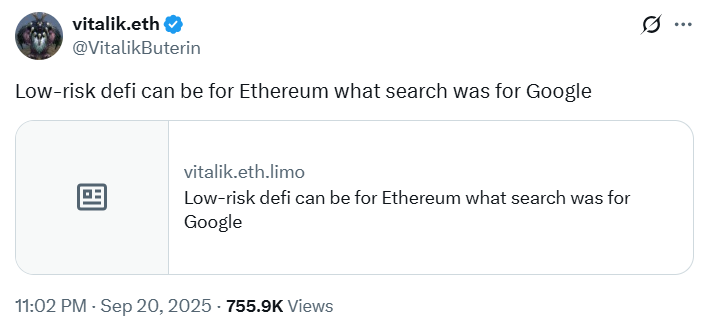
Leading current Ethereum news is the take from Vitalik Buterin, who recently noted that low-risk decentralized finance could become the protocol’s main engine of growth.
He compared its role to how search became Google’s most important business.
His comments sparked reactions from community members, including Aave founder Stani Kulechov, who shared his own plans.
Ethereum News: Vitalik Buterin Explains Why Low-risk DeFi Matters
Vitalik Buterin has often spoken about the tension inside the Ethereum community.
Some innovations, such as NFTs and memecoins, bring high fees and short-term activity but do not provide lasting value.
Other projects, such as Lens, Farcaster, and ENS, match Ethereum’s goals of openness and decentralization but do not generate enough revenue to sustain the network.
In a new post, Buterin said low-risk DeFi could finally bridge this gap. He defined low-risk DeFi as payments, savings tools, synthetic assets, and fully collateralized lending.
These services are less about speculation and more about offering useful, stable financial products to people worldwide.
He argued that Ethereum has reached a point where these products can succeed.
In earlier years, security risks and uncertain rules made DeFi attractive only for risky speculation.
Protocols are now stronger, code is more reliable, and user demand for stable savings and lending is higher.
Buterin compared the shift to Google’s reliance on search. While Google has built many products, search and advertising remain its financial base.
He believes Ethereum could follow a similar path, with low-risk DeFi becoming the steady source of fees that support the rest of the ecosystem.
Unlike advertising, he said, low-risk DeFi aligns with Ethereum’s values and can expand global access to finance.
Big Take on the Ethereum News and Lending Correlation
Commenting on the Ethereum news In a separate update, Stani Kulechov, founder of the lending platform Aave, shared Buterin’s view.
He called low-risk DeFi Ethereum’s “workhorse” and said it is simple, strong, and useful everywhere.
He added that Aave could one day distribute yield to billions of people across the world.
Other community members also backed the idea. Investor DCinvestor said lending and borrowing is the “killer app” for programmable money.
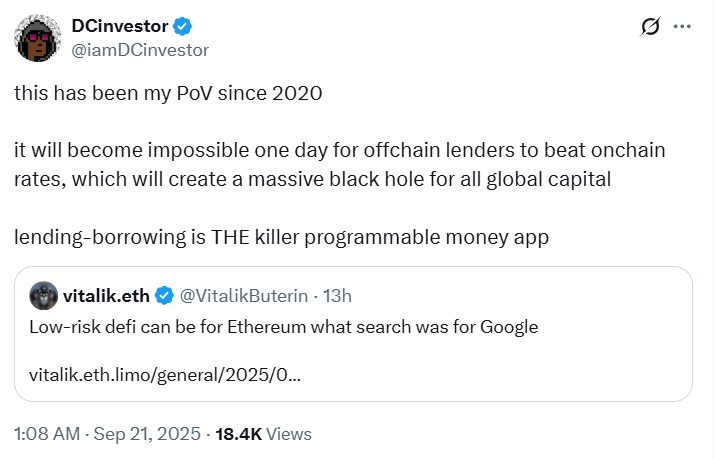
He believes it will be difficult for banks and other lenders outside blockchain to keep up with interest rates offered onchain.
If that happens, he said, a large flow of capital could move into Ethereum-based lending markets.
Basically, the comments highlight growing agreement among leaders in the space.
Many now see lending and savings products, not speculation, as the most likely way Ethereum can grow while staying true to its purpose.
What This Could Mean for Ethereum’s Price
As of writing, Ethereum’s price stands at $4,462.68, down 0.23% over the past day.
Its market cap is $538.8 billion, while daily trading volume has dropped 32.86% to $17.97 billion.
These short-term moves are small, but Buterin’s thesis has longer-term implications for the ecosystem.
If low-risk DeFi becomes the core of Ethereum, it could provide steady demand for ETH as collateral and ensure ongoing transaction fees.
This base could support the network in both bull and bear markets.
More importantly, it could draw new users who want safe and simple savings, lending, and payment tools.
For people in regions with limited banking options, Ethereum-based platforms might offer access to global markets they could not reach before.
Vitalik Buterin also sees room for growth beyond basic lending. Over time, low-risk DeFi could evolve into undercollateralized loans, prediction market hedging, or new stable assets not tied to the U.S. dollar.
Each step would build on the foundation of today’s simpler products. The Ethereum community agrees that low-risk DeFi may be the missing piece.
If it proves reliable, it could give Ethereum both cultural legitimacy and economic strength, while keeping the network aligned with its open access mission.




