
 Walrus
 Quantus
 Pudgy Penguins
 Bitway
 Quant
Quant Sui
Sui Bitcoin

Bitcoin price held steady around $111,400 on Thursday after slipping below key resistance levels earlier in the week.
Exchange supply is shrinking, sparking debate about what comes next for the broader market.
At the same time, Adam Back has defended Bitcoin’s decentralized design, while traders warn of a possible final wave in the current cycle.
Bitcoin Falling Exchange Supply and What It Could Mean
Recent figures show that the amount of Bitcoin held on exchanges is decreasing. The seven-day average of inflows to trading platforms has declined for several days.
This is important because exchange flows are often seen as signs of what traders may do next.
When inflows to spot exchanges rise, it usually points to selling pressure. Fewer Bitcoins moving to exchanges can mean holders keep coins in personal wallets.
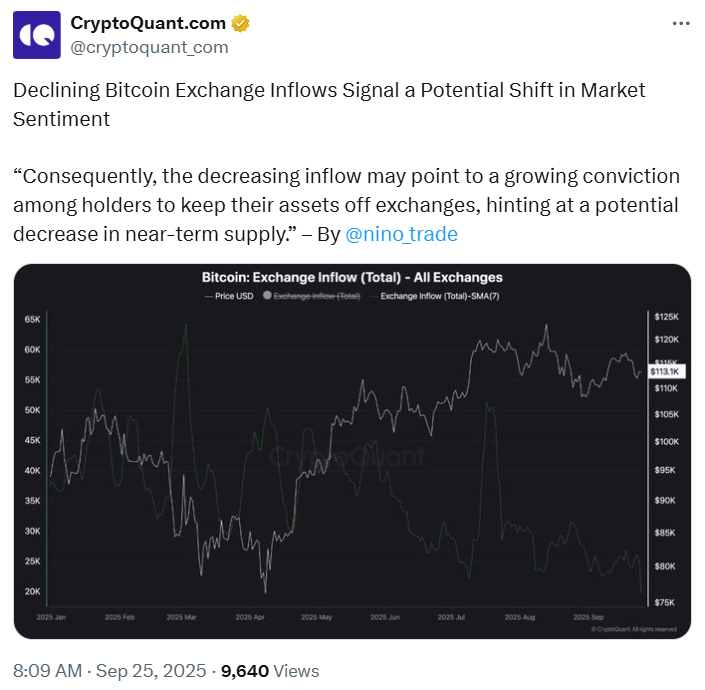
That often signals reduced supply in the short term. For derivatives exchanges, the picture is different.
Money flowing in can be used to open long or short positions, so it does not always reveal which way the market will turn. What it does show is the chance of higher volatility.
The steady decline in inflows may mean investors are more confident in holding their coins off exchanges.
With fewer coins available for quick sale, some analysts say this could limit near-term supply and set the stage for sharper moves if demand rises.
Adam Back Warns Against Weakening Bitcoin Price
Blockstream chief executive Adam Back has spoken out strongly in defense of Bitcoin’s decentralization.
In a post on X, Back argued that the system’s strength comes from its peer-to-peer design, where people run independent nodes.
He said this model is too decentralized and anonymous to be stopped, and is what protects individual control over money.
Back warned that weakening these structures, even with good intentions, risks pushing Bitcoin down the path of centralization.
He said a long history and even legal precedent proves that decentralization is vital for Bitcoin to survive.

He criticized those in the community who argue that decentralization is less important.
According to him, such views overlook decades of experience and ignore how systems fail in the real world.
He explained that smart people can make convincing arguments but often miss the weight of risks and incentives outside theory.
Back compared this to a “slippery slope,” where well-meaning efforts to simplify the system could destroy what makes Bitcoin strong.
He urged people to remember past lessons and not to repeat mistakes. In his view, decentralization is not an option but a requirement for Bitcoin’s future.
Where Bitcoin Price Could Go Next
Bitcoin price is struggling to hold key levels after falling back from $113,500. When writing, it is trading near $111,442, down about 1.4% on the day.
Market data shows that whales have been selling more, which is adding to downward pressure.
Charts show that $107,000 is a critical area tied to a $17.5 billion options expiry soon.
Traders often call this the “max pain” level, where many contracts lose value. Prices sometimes move toward this point before reversing.

Analysts warn that if Bitcoin breaks below support between $112,000 and $110,000, it could slide further toward $100,000. That would mark about an 11% drop from current levels.
Technical indicators also show weakness. The price is below the 50-day and 100-day moving averages, and the relative strength index has dropped, showing less demand.
Even so, some signs point to possible recovery. Institutional buyers and companies continue to add Bitcoin to their holdings, which may absorb some selling.
A quick rebound is possible if Bitcoin climbs back above $116,000. That level triggers liquidating short positions, which could fuel a short squeeze.
Some traders call this the “final wave” for Bitcoin in the current cycle. It is unclear whether it ends in a sharp top or a deeper fall.



