Dacity Coin
 astronaut
 streamoors
 Celestia
 NeoSoul
 Sui
Sui Injective

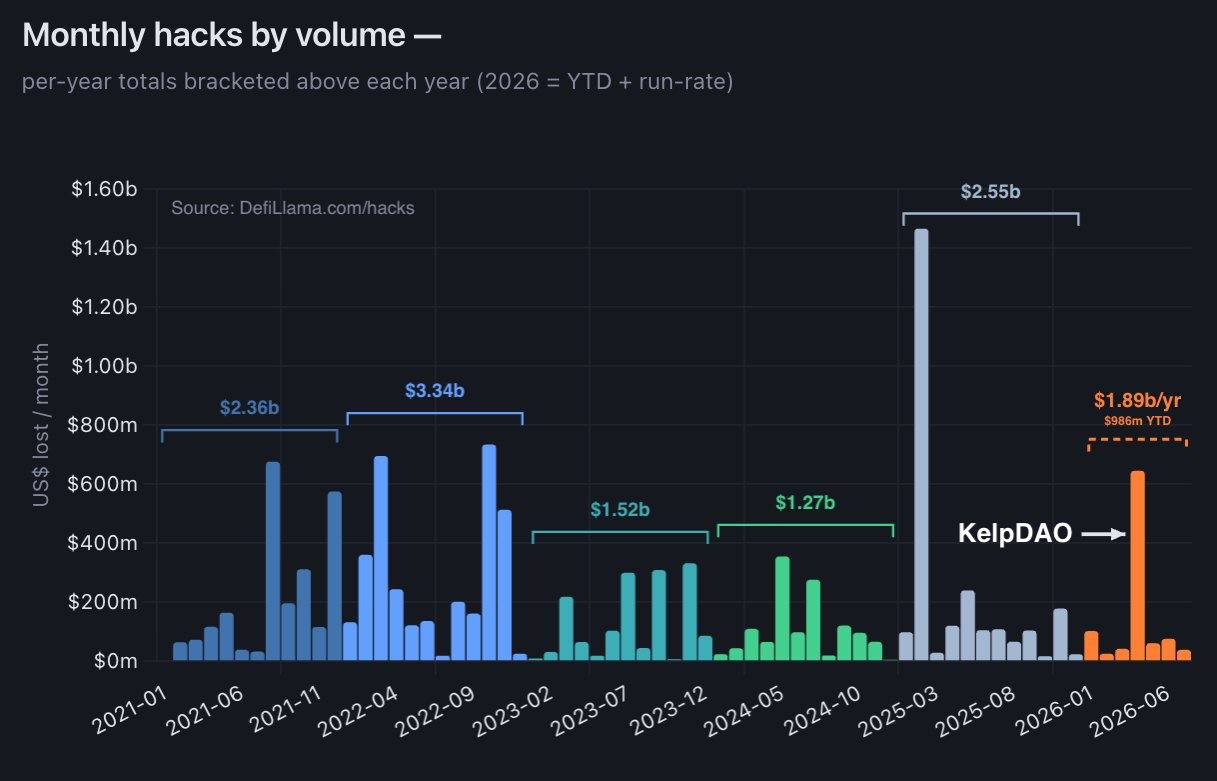
Crypto protocols lost $1.32 billion across 244 publicly disclosed hacks in the first half of 2026. Onchain Lens shared data on X, noting that the majority of the losses came from a few incidents.
The massive losses highlight how crypto hacks remain an existential threat even after several years. However, losses in the first half of 2026 represent a sizable drop from last year. The Bybit hack in February 2025 alone resulted in $1.4 billion in losses.
Crypto Hacks Due to Access Control Failures and Phishing Dominate Losses
According to Onchain Lens, most attacks resulting in massive losses in the first half of 2026 were due to access-control failures. These included hackers compromising permissions or gaining privileged access to these protocols.
The two biggest incidents in the period occurred in April and involved failures of access controls. The names include the hack of Kelp DAO and Drift Protocol for $292 million and $280 million, respectively.
In the KelpDAO attack, the hackers compromised the off-chain RPC nodes to exploit the LayerZero verifier setup. They tricked it into releasing ETH. The Drift Protocol also involved using social engineering to gain access to the protocol Security Council and presign transactions.
Other major crypto hacks also involved hackers finding several unique ways to compromise access and steal funds. BonkDAO lost $21 million from its treasury with a governance exploit.
Phishing and social engineering attacks also resulted in a loss of $282 million. At the same time, Oracle issues are the third major attack vector. Bonzo Finance, Ostium, and the Blend protocol all lost millions due to oracle exploits.
Small-Scale Attacks Increase as Expert Warns About AI Risks
Interestingly, one notable pattern in the first half of 2026 is the prevalence of small-scale attacks. Blockchain security firm TRM Labs noted in its 2026 H1 report that the period saw more crypto hacks. That figure is lower than in any previous six-month period.
However, the average loss from a hack is now around $220,000. With this information, the majority of hacks are smart contract exploits targeting DeFi protocols, token projects, and decentralized exchanges.
Experts, including OpenZeppelin founder Manuel Aráoz, believe advances in AI technology will affect all of DeFi. A few months ago, an AI discovered a vulnerability that allowed the minting of unlimited ZEC tokens on the Zcash network.
Anthropic also released a report in December 2025. This showed that its AI agent successfully exploited 63% of 405 smart contracts breached between 2020 and 2025.
However, not everyone agrees that AI will accelerate crypto attacks. DragonFly managing partner Haseeb Qureshi stated that it is mostly a false alarm. That’s because major crypto protocols will also increase their defenses.
He noted that while the number of hacks has increased, the size of attacks has decreased. This suggests that attackers are focusing on small protocols and projects that have not improved their code against AI.