
 astronaut
 Zylo Ecosystem
 Pearl
Pearl Bitcoin
 Quantus
 Pudgy Penguins
 Bitway

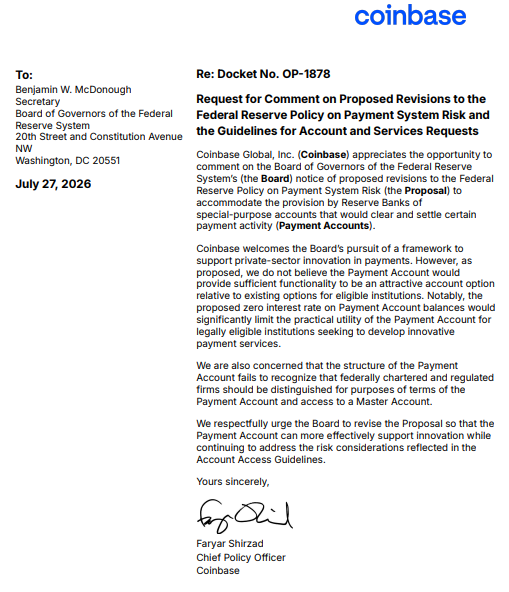
Coinbase called for revisions to the Federal Reserve’s proposed Payment Account framework for eligible financial institutions.
Coinbase Chief Policy Officer Faryar Shirzad said the crypto exchange submitted comments supporting the framework while recommending changes to make the accounts commercially viable.
The Fed first requested public input on a Payment Account prototype in December 2025. It issued a formal proposal in May 2026 after reviewing the initial feedback.
The accounts would allow legally eligible institutions to clear and settle payments through Federal Reserve infrastructure.
However, they would provide fewer services than traditional master accounts. Holders would receive no interest, intraday credit or access to the discount window.
Coinbase Proposes Changes to Payment Account Framework
Coinbase commended the Fed’s move to expand access to the Fed master account, but also requested revisions to the proposal. According to Coinbase, this framework is necessary to make the Payment Account viable.
The exchange recommended that Payment Accounts be allowed to earn interest on at least a portion of their balance, rather than the zero interest currently proposed.
Coinbase is also requesting limits on overnight balances to reflect the institution’s needs. It noted that there should be greater certainty about how closing balances will be set.
Meanwhile, the exchange further recommended that oversight must match actual risks. It specifically emphasized that the Fed should not impose additional illicit finance requirements on firms that are already subject to federal supervision.
Shirzard believes getting this right will ensure that the Payment Account serves its purpose. “Get these details right, and payment accounts can lower costs, strengthen competition, and keep the U.S. at the frontier of global payments,” he wrote.
US Banks Oppose Payment Accounts, Recommend Stricter Rules
Meanwhile, banks continue to oppose the Payment Accounts. With over 16,000 public comments on the proposal, most major banking advocacy groups have proposed stricter requirements.
The American Bankers Association (ABA), in its comment back in February, argued that a master account should be reserved for institutions that are federally supervised and have insured deposits.
Beyond supporting proposed restrictions for Payment Accounts, ABA also recommended new ones. These include initial transaction limits, surety bond requirements, prohibitions on nesting and correspondent-like services, and others.
Unsurprisingly, other banking advocacy groups share a similar view. The Bank Policy Institute and The Clearing House released a 50-page paper, noting that Payment Account is risky and could undermine the payments systems.
“It would allow uninsured institutions subject to less rigorous supervision and regulation to access directly the payments system, which could undermine the integrity of the payments system and pose risks to financial stability,” they wrote.
However, Crypto advocate and adjunct professor at Columbia Business School, Omid Malekan, criticized the paper. According to him, banks also fall short on most of the perceived risks and criticisms highlighted in the paper.
Malekan added that most central banks worldwide grant eligible non-banking institutions access to their infrastructure, and the US is an outlier. He cited Brazil and India, noting that the US restriction is why payments in the US are suboptimal.





