
 Pearl
Pearl Walrus
 Starknet
 Quantus
 Bitway
 Sui
Sui Zylo Ecosystem
- GBTC has recorded $21 Billion in outflows since January 2024 due to high fees (1.5%).
- Competitors like BlackRock and Fidelity attract billions with fees under 0.25%.
- Grayscale’s ETHE also faces losses, with $3.5 Billion in outflows since July 2024.
The U.S. Bitcoin ETF market is currently a high-stakes race for capital, with dramatic contrasts in fund flows. At the forefront of this competition was Grayscale Bitcoin Trust (GBTC). GBTC, once a dominant player, is now facing a steep decline. Since January 2024, the trust has recorded more than $21 Billion in outflows, a sign of shifting investor sentiment.
In sharp contrast, GBTC’s competitors are thriving, attracting billions in fresh investments. These newer Bitcoin ETFs are luring investors with lower fees and more efficient structures. While GBTC charges a hefty 1.50% fee, most of its rivals charge less than 0.25%. This is making them far more attractive to cost-conscious investors.
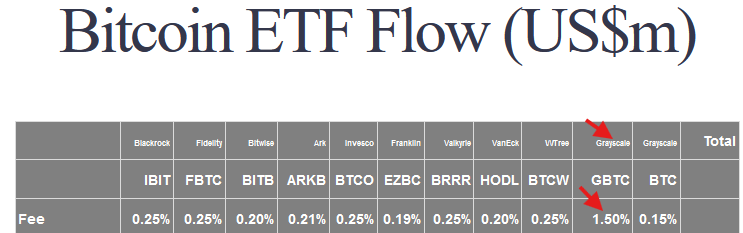
This stark divergence shows a broader trend in the market, as investors are flocking to Bitcoin ETFs that are more competitively priced and better regulated. The growing preference for these newer funds also marks a pivotal moment and is seen positively in the evolution of the crypto investment landscape.
Continue reading for more insights.
GBTC Faces Massive 1-Year Outflows as Rival Bitcoin ETFs Record Positive Inflows
Grayscale Bitcoin Trust (GBTC) has faced significant challenges, experiencing average daily outflows of $89.5 Million over the past 11 months, Farside data shows. Since its conversion into a spot ETF in January 2024, GBTC has recorded cumulative losses totaling $21.027 Billion.
In contrast, several other U.S.-approved spot Bitcoin ETFs have maintained positive inflows. Though GBTC’s losses still outweigh the combined gains of these competing funds, as illustrated by Farside’s data.
A key factor driving GBTC’s decline is its steep management fees, which have made it less attractive to investors. Competitors like BlackRock and Fidelity have capitalized on this by offering significantly lower fees, drawing investor interest. Although Grayscale attempted to counter this trend by introducing its Mini-Bitcoin Trust with reduced fees, the initiative has struggled to gain traction.
BlackRock’s iShares Bitcoin Trust (IBIT) Attracts Strong Inflows, Driving Market Momentum
Despite massive outflows from Grayscale Bitcoin Trust (GBTC), the overall spot Bitcoin ETF market has seen impressive growth. BlackRock’s iShares Bitcoin Trust (IBIT) has emerged as a standout performer, defying broader trends. With inflows reaching $36.301 Billion, IBIT has is the driving force behind the market’s upward momentum.
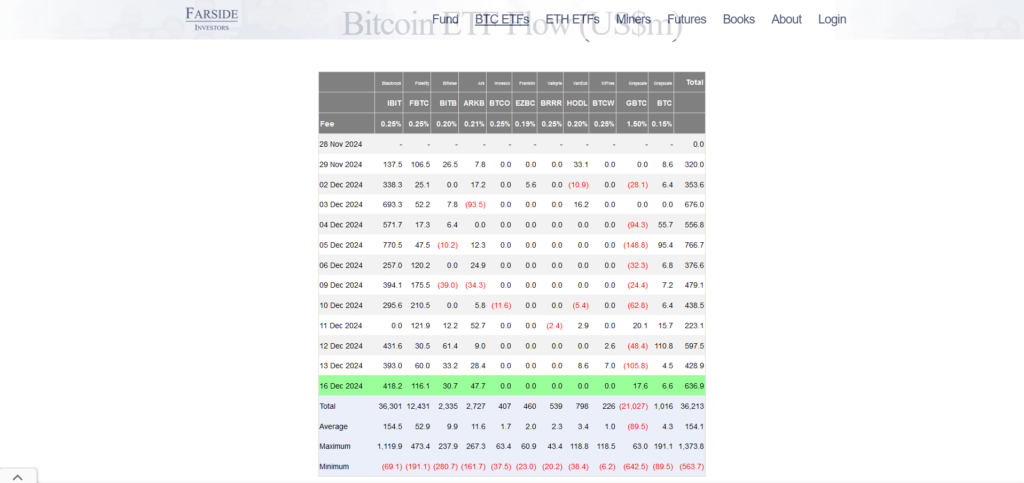
Notably, IBIT has outpaced all its competitors, pushing its total assets under management (AUM) beyond the $50 Billion mark as Bitcoin’s price holds strong above $100,000. Since its inception, IBIT has attracted an average of $154.5 Million in daily inflows, highlighting its unprecedented success.
This achievement underscores BlackRock’s powerful reputation and extensive experience in asset management. Investor confidence in the financial giant has played a pivotal role in IBIT’s dominance.
Grayscale’s ETHE Sees $3.5 Billion in Outflows Amid Rising Competition
Grayscale’s struggles are not limited to Bitcoin; its Ethereum Trust ETF (ETHE) has also seen significant outflows. Since its launch in July 2024, ETHE has recorded losses of $3.516 Billion, echoing the challenges faced by GBTC.
In contrast, competing spot Ethereum ETFs have gained substantial traction. BlackRock’s iShares Ethereum Trust has brought in $3.230 Billion, while Fidelity’s Ethereum Fund has attracted $1.382 Billion in inflows.
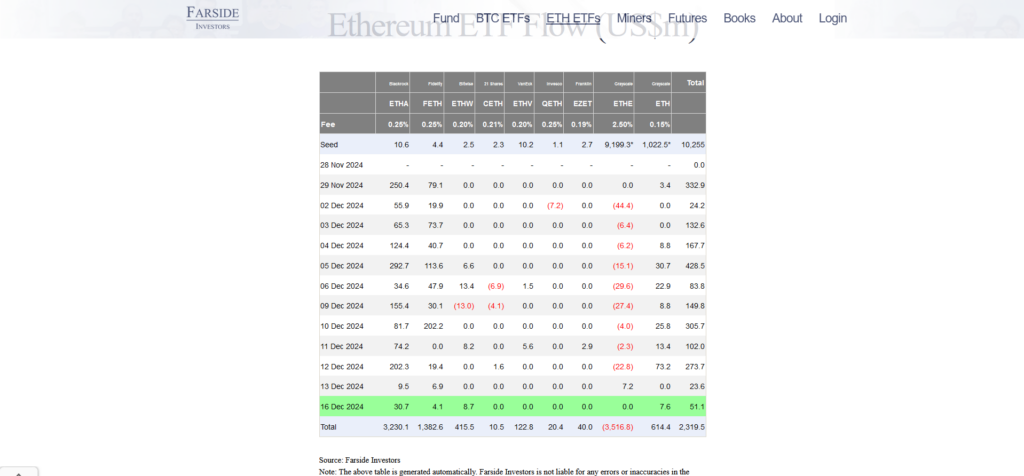
The success of these rival funds highlights a growing demand for diversified and well-regulated Ethereum ETF options. Grayscale, however, has struggled to instill investor confidence in its Ethereum offerings, which have lagged behind the market’s key drivers, further amplifying its difficulties.
Disclaimer
In this article, the views, and opinions stated by the author, or any people named are for informational purposes only, and they don’t establish the investment, financial, or any other advice. Trading or investing in cryptocurrency assets comes with a risk of financial loss.




