Injective
 Bitcoin
 Quantus
 Sui
Sui Derive
 Pump.fun
 Quant
Quant
- MicroStrategy chairman highlights a case where an investor turned $30 daily contributions since 2016 into a multimillion-dollar Bitcoin portfolio, with a 2,086% return.
- The BTC price plateaued in late 2024 after a strong rally, sparking debates over the viability of continued Bitcoin DCA.
- Analysts suggest altcoins like Ethereum, Solana, and meme coins may offer a better risk-to-reward (R/R) profile as Bitcoin consolidates.
Dollar-cost averaging (DCA) has emerged as a favored strategy for those seeking long-term exposure to Bitcoin, with MicroStrategy chairman Michael Saylor being one of its most vocal advocates. Saylor frequently encourages investors to make periodic Bitcoin purchases and adopt a patient, long-term holding mindset.
Saylor recently highlighted the success story of an investor who diligently bought Bitcoin daily with modest sums. It eventually turned those investors’ small, consistent contributions into a multimillion-dollar portfolio. Sharing this example, Saylor emphasized Bitcoin’s potential to reward disciplined and patient investors who stick to the Bitcoin DCA approach.
Is Bitcoin DCA Flawless?
While Bitcoin DCA offers clear advantages, such as easing investors into understanding Bitcoin and eliminating the need for a large upfront commitment, it is not without drawbacks. A key limitation is that it can take time to achieve meaningful exposure. Besides, the strategy may underperform during rapid bull markets, when lump-sum investments might yield better returns.
As the Bitcoin price stalls in the final days of 2024, some traders are re-evaluating their strategies. Growing sentiment suggests that a pivot toward accumulating altcoins could offer more lucrative opportunities as the market enters a potential altcoin season.
Investor Makes Millions in Bitcoin Via the Bitcoin DCA Strategy
According to Michael Saylor’s disclosure, a disciplined investor utilized the Bitcoin DCA strategy by consistently purchasing $30 worth of Bitcoin daily. This commitment began in 2016 when Bitcoin was trading below $800.
Over nine years of unwavering dedication, the investor spent a total of $98,640 on Bitcoin. The Bitcoin DCA tactic has proven incredibly rewarding, as Bitcoin’s price skyrocketed to a record-breaking $108,000.
Even with the asset currently trading slightly below $100,000, the investor’s portfolio has seen substantial growth. That highlights the potential of long-term Bitcoin DCA strategy for those with patience and conviction.
Remarkably, the investor’s Bitcoin holdings have surged to a value of $2,157,090. It’s a phenomenal 2,086% increase from the $98,640 total capital invested. This extraordinary return far outpaces the performance of traditional assets like gold, stocks, and bonds over the same period.
Michael Saylor highlighted that MicroStrategy is adopting a similar approach, scaling the disciplined investor’s periodic buy-in strategy to a corporate level. It demonstrates their continued commitment to long-term Bitcoin accumulation.
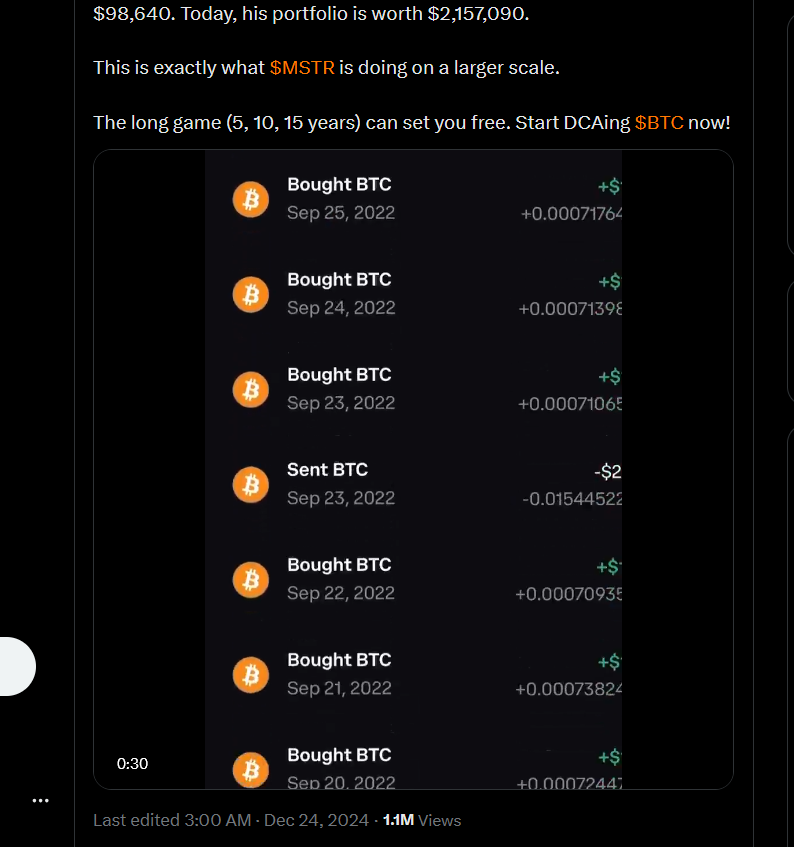
Michael Saylor, in his latest statement, emphasized Bitcoin’s transformative potential. He asserted that holding the leading cryptocurrency for a span of 5 to 15 years offers significant financial rewards.
He cited the impressive returns of the dedicated investor who turned modest daily contributions into millions. Thus, he even encouraged enthusiasts to embrace the dollar-cost averaging strategy for Bitcoin accumulation.
“The long game can set you free,” he remarked, reinforcing his belief in Bitcoin’s power to deliver life-changing gains over time.
People Say Bitcoin DCA Should End & Move To Altcoins
The remarkable surge in the Bitcoin price during the final two months of 2024, fueled by a series of post-election catalysts, now appears to have lost momentum. With Bitcoin’s price stalling in the last days of the year, concerns about a potential bear market have surfaced, sparking debates across online forums.
Despite consistent endorsements from prominent advocates like Michael Saylor, critics question the sustainability of the recent rally. They wonder whether current conditions favor continued accumulation.
One analyst went as far as suggesting that Bitcoin DCA strategies should be paused for those who have already secured strong profits. They should only continue to stay in the asset if sitting deep in the money and haven’t booked the profits yet.
According to this perspective, with potential headwinds on the horizon, Bitcoin DCA may no longer yield the desired results for at least the next 1.5 years. By saying so, he underscores the growing caution among investors amid an uncertain market outlook.
A recent survey revealed that 83.5% of crypto investors have adopted the dollar-cost-averaging (DCA) strategy. While a report says, 59% are still relying on it as their primary method for accumulating crypto assets. This underscores its popularity as a steady and disciplined approach to investing in volatile markets like cryptocurrency.
Is DCA a Reliable Investment Tactic?
For those unfamiliar, Bitcoin DCA involves investing a fixed amount of USD into Bitcoin at regular intervals, regardless of price. This approach effectively smooths out the impact of market volatility, yielding an average purchase price over time.
However, the analysts have questioned the continued viability of this strategy in the current market climate. They argue that altcoins now present a more compelling risk-to-reward ratio, especially as the Bitcoin price appears to have plateaued in the final days of 2024.
These experts suggest that diversifying into promising altcoins could yield better returns than adhering strictly to a Bitcoin DCA strategy at this stage of the market cycle.
Overall, it all depends on the market participants’ approach, whether they like better RR-based assets or wanna stay on strategies like Bitcoin DCA.
Disclaimer
In this article, the views, and opinions stated by the author, or any people named are for informational purposes only, and they don’t establish the investment, financial, or any other advice. Trading or investing in cryptocurrency assets comes with a risk of financial loss.