
 Bitcoin
 NEAR Protocol
 Pudgy Penguins
 Puffer
 ZKsync
 Bitway
 Pearl
Pearl

Key Insights
- Tether has issued over $12 billion in new USDT this year, with most flowing directly to exchanges, signaling growing dominance.
- USDC shows consistent exchange outflows despite stable reserves, indicating weakening utility and investor preference.
- The imbalance in liquidity access is impacting altcoin momentum, as capital increasingly stays within USDT-dominated markets.
Tether’s dominance in the stablecoin market is accelerating. Its 2025 minting spree—already above $12 billion—has sent most newly issued USDT straight to exchanges. This growing presence is reshaping liquidity dynamics and favoring assets paired with Tether, while stablecoin competitor USD Coin (USDC) suffers persistent outflows and stagnant demand.
The shift marks a deeper structural trend. As capital consolidates into USDT, altcoins relying on USDC-based pairs are showing reduced market activity.
Tether’s Supply Surge Sends Billions to Exchanges
Tether’s aggressive minting strategy has seen more than $12 billion in new USDT issued since Jan. 2025. According to CryptoQuant, most of that supply now sits in exchange wallets rather than idle in Tether’s treasury.
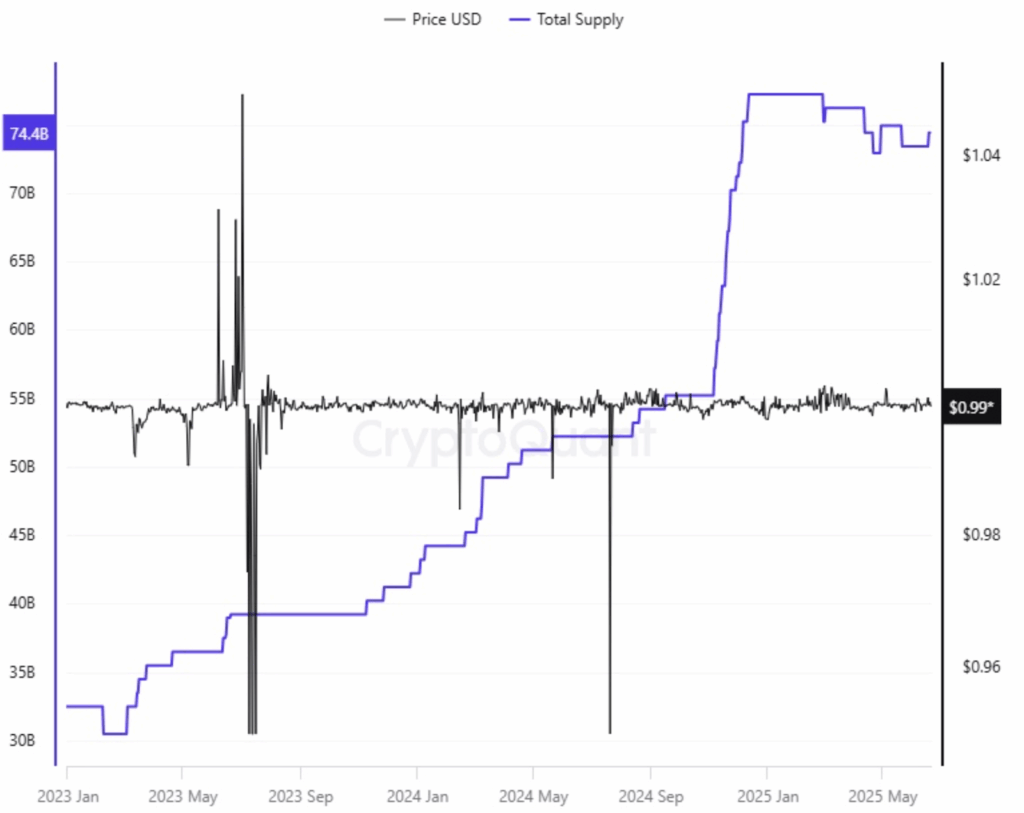
USDT’s total circulating supply has surpassed $74 billion, with over $8.8 billion in exchange reserves. The stablecoin consistently trades near its $1 peg (currently $0.999), showing both trust and active usage.
Rather than serving as a passive hedge, USDT appears to be powering trading volume, leveraged speculation, and capital rotation. This liquidity support has made Tether an increasingly dominant layer in the market structure.
As volume flows through Tether rather than other stablecoins, its influence over sentiment, volatility, and price movement continues to grow.
USDC Faces Persistent Exchange Outflows
As USDT is growing, USD Coin is going the other way. Even though the price of USDC has stayed near its peg, exchange netflows paint a more concerning picture.
The daily flows have been in the negative range throughout most of 2024 and 2025, and the withdrawals have been far outpacing the deposits in large trading platforms.
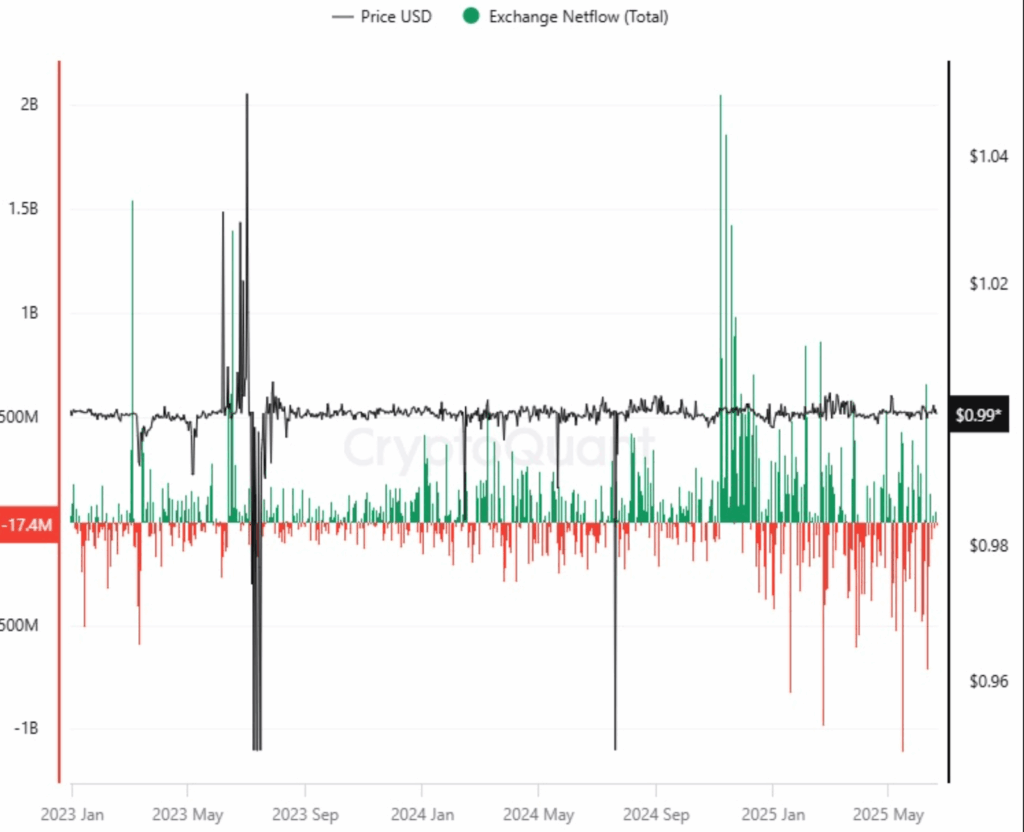
Consequently, the overall exchange coverage of USDC has not increased, and its market cap has remained stagnant in the wake of crypto expansion.
This current outflow trend undermines the capacity of USDC to compete to dominate altcoin pairing, DeFi platforms, and institutional settlement rails. Traders seem to be finding a preference in Tether due to its larger coverage and quicker transaction routing.
This mismatch has resulted in a liquidity imbalance that is dangerous. With the USDC reserves declining and its market activity decreasing, altcoins that are largely pegged on USDC-based pairs are losing trade volume. Thus, the preference of stablecoins is not just a backend indicator, it is a market force.
Altcoins Struggle as Liquidity Concentrates in Tether USDT
As USDT takes over and USDC is on the run, the effects of this liquidity shift are beginning to be felt by the altcoins. The activity of many altcoins relies on balanced stablecoin activity to maintain healthy order books, and recent activity indicates that money is becoming concentrated in Tether-paired assets. This trend is constraining rotation of capital into smaller cap assets.
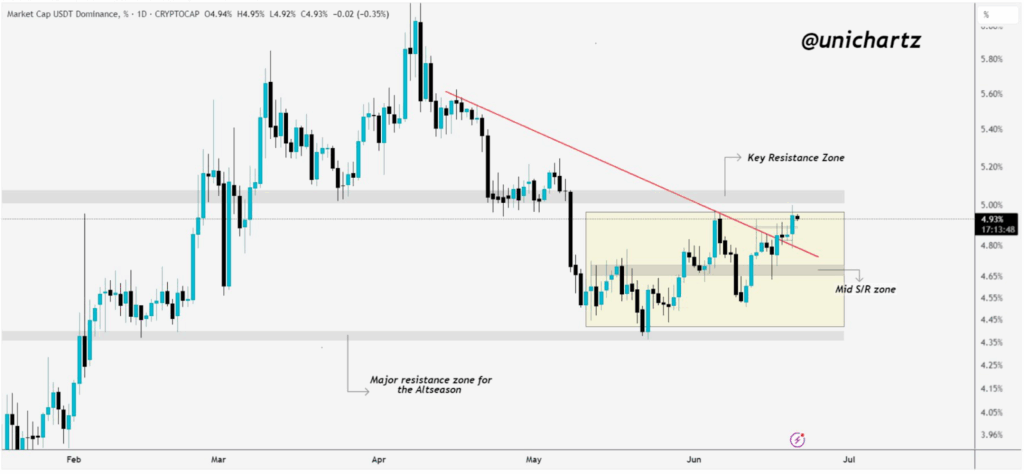
Furthermore, according to the data provided by UniChartz, USDT dominance is approaching a major resistance at 5%. In case this dominance breaks above, traders might prefer to park capital in stablecoins instead of risking venturing into volatile altcoins.
Nevertheless, in case it is rejected, it can pave the way to a short-term altcoin rally, but the issue of liquidity is still a concern.
The USDC is not the only project that is being crowded out by Tether, but it is also reducing the range of possibilities that developers, investors, and projects have. The rest of the ecosystem can be more unstable and centralized as more platforms and trading routes rely on USDT to provide depth.
Structural Risk Grows as Tether Influence Deepens
The role of Tether has become systemically significant to the crypto market. Tether has a circulating value of more than $110 billion and a growing treasury operation, which makes it much more than a mere stablecoin issuer.
Its CEO believes that the company may be valued at more than 500 billion dollars, which is more than some of the financial giants in the world.
This assessment is an indicator of the trust in the financial support of Tether, treasury exposure, and the increasing regulatory strength. It does, however, come with the risk of concentration, where one party is now essentially the anchor of global liquidity in crypto trading.
A hiccup in Tether would cause thousands of assets, protocols, and decentralized applications to fall out of balance in a single stroke.
In the meantime, the decline in the momentum of USDC is an indication that regulatory alignment and institutional branding might not suffice. Stablecoins are doomed to a sudden death in the absence of long-term utility and on-chain demand, irrespective of compliance regimes. Conversely, USDT is still becoming popular among retail and institutional markets.



