
 Zylo Ecosystem
 astronaut
 Pearl
Pearl Walrus
 Starknet
 Pudgy Penguins
 Bitcoin

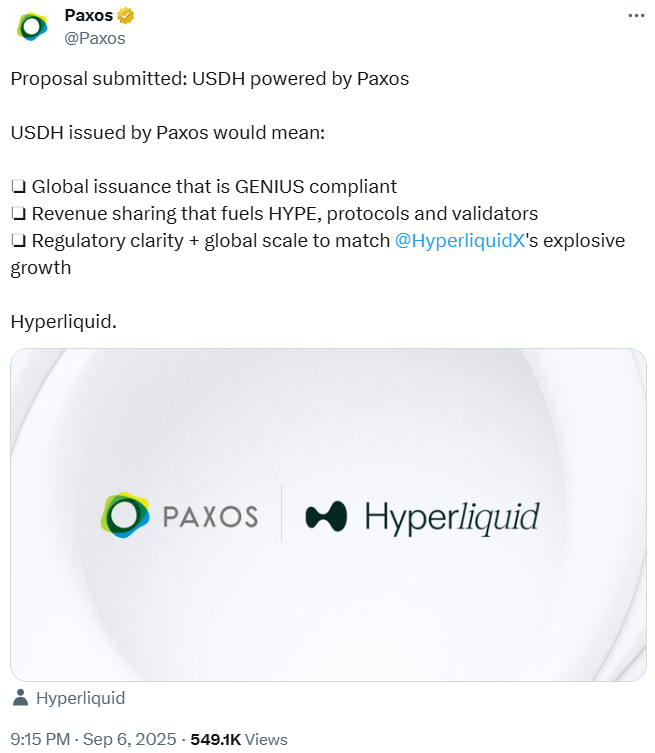
Paxos has submitted a proposal to launch the USDH stablecoin from Hyperliquid. The stablecoin would follow regulatory rules, share revenue with validators and the protocol, and use reserve interest to buy back HYPE.
The plan comes as Hyperliquid is growing fast and its token nears a record price milestone.
Paxos Sets Out Hyperliquid USDH Plan
Paxos has put forward a plan to create USDH, a stablecoin designed for the Hyperliquid platform. The company says USDH will be fully regulated under the GENIUS framework. It explains that 95% of the interest earned on USDH reserves will go into buying back HYPE, the token linked to the network.
According to the update, the proposal also promises a revenue-sharing system that supports the protocol and its validators. Paxos said the goal is to make USDH a foundation for long-term growth, while also keeping it safe for wider use.
Paxos has been in the stablecoin space for over a decade. It is known for running Binance USD, which at one point reached more than $25 billion, and PayPal USD, which passed $1 billion in supply.
Other firms that have worked with Paxos include Kraken, Robinhood, and OKX. Paxos claims its record proves it can issue stablecoins at scale while following strict rules.
To help drive the new project, Paxos has set up Paxos Labs, a unit focused on stablecoins in decentralized settings.
Paxos Labs has also acquired Molecular Labs, the group behind tools that initially supported Hyperliquid. These include LHYPE and WHLP, which are building blocks of the platform. Industry voices say the USDH plan could unlock big revenue. At present, about $5.3 billion in USDC sits on Hyperliquid.
If that money shifts into USDH and earns 4%, it would bring in about $212 million a year. That extra income could raise the value of HYPE and support the ecosystem.
Hyperliquid Builds Its Ecosystem
Hyperliquid has grown into more than a trading platform. It started with spot and perpetual markets, but it now allows anyone to create their own perpetual market.
This change, through HIP-3, makes Hyperliquid more like a base layer for financial activity, not just an exchange. Alongside trading, Hyperliquid runs Hyperevm, a system for smart contracts. This allows for DeFi lending, money markets, NFTs, and other blockchain uses.
With the addition of USDH, Hyperliquid would now cover three main businesses in crypto, exchange, blockchain, and stablecoin. Analysts often point to these as the most profitable areas in the sector.

Paxos noted that USDH could help Hyperliquid reach new groups. The firm argues that the next step for the platform is to build trust with banks, enterprises, and large user bases outside the crypto space.
By tying USDH to its global distribution network, Paxos believes it can connect Hyperliquid more deeply into traditional finance.
HYPE Price Moves Toward Record Level
HYPE, the token that powers Hyperliquid, is trading close to its all-time high. At $46.99, it sits only 9% below the peak of $51.18 reached in late August. Market charts show momentum is still positive, with the Relative Strength Index holding above 50.
Analysts say the next key level is $48.70. If HYPE rises past this and holds the line, the chance of reaching a new high grows stronger. If the price falls below $46.05, the trend could weaken, leaving room for a pullback before any recovery.
Traders are watching the Paxos proposal closely. If USDH gains traction, HYPE may see stronger demand, since the plan links reserve earnings directly to token buybacks.
For Hyperliquid, the launch could mark a new stage of growth as it works to become a full financial platform.




