
 streamoors
 Sword Inu
 Altai the Tiger
 IGNITION
 no crying in the casino
 NEAR Protocol
 Pudgy Penguins

The Coinbase Bitcoin premium fell to one of its lowest levels this week amid a continuous selloff by investors in the United States.
Notably, the shift came as markets waited for the December Federal Reserve meeting and as questions grew about Bitcoin’s future range and the end of the four-year cycle pattern.
Coinbase Premium Drop Showed Rising Pressure From US Traders
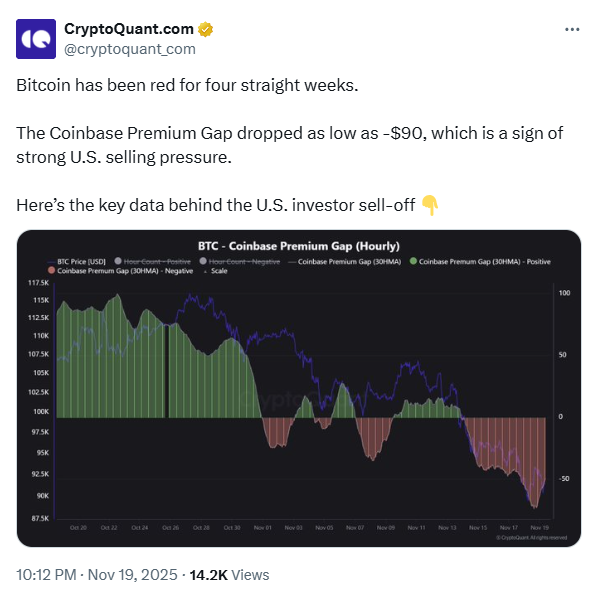
Coinbase Bitcoin premium reached a historic low as United States traders reduced exposure during recent sessions.
The premium gap dropped to almost negative $90, which showed a clear difference between the United States demand and activity in other regions.
Europe and APAC stayed mostly flat or slightly positive. The trend also continued through four straight weeks of red candles for Bitcoin, which showed how strong the selling pressure had become.
Trading activity during United States hours stayed negative for most of the month. This pattern pushed the Bitcoin price lower and added stress to the spot market.
ETF flows turned negative for three weeks in a row, which increased the weight on price action.
Outflows reached almost 8,000 in Bitcoin for the quarter so far. This was far from last year’s fourth quarter, which brought inflows of 194,000 Bitcoin.
Additionally, the decline in ETF flows created the second-largest drawdown since ETFs began trading.
Bitcoin ETFs were almost $3.98 billion below their all-time high. The ETF realized price sat near $86,586.
The average position was still positive with an MVRV reading of 1.08, but activity showed hesitation across the market.
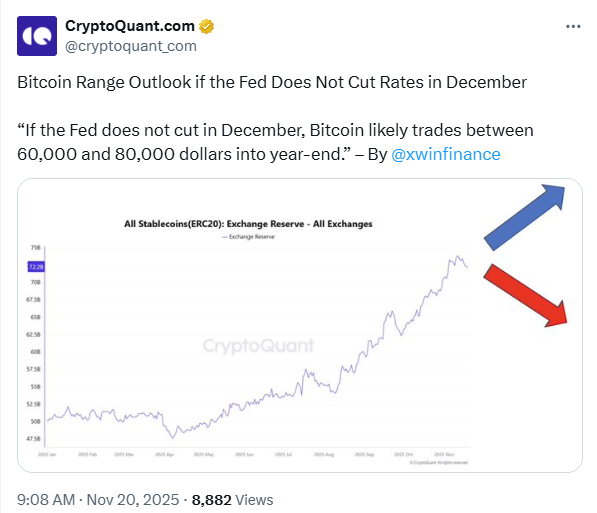
Stablecoin reserves on exchanges reached about $72 billion. This level matched conditions seen before major rallies earlier in 2025.
These reserves showed that liquidity was available, but buying activity did not increase.
Many holders kept stablecoins unused because of the wider uncertainty in global markets. The strong buildup of reserves did not turn into direct buying pressure.
December Rate Cut Delay Could Keep Bitcoin in a Tight Range
In a separate development, expectations for a December rate cut declined to almost 40% to 50%.
The United States government shutdown delayed two months of employment data, which left the Federal Reserve with very limited information going into the meeting.
Several members leaned against a cut, while others still considered it possible. The lack of updated numbers created a cautious mood as the meeting approached.
If the Federal Reserve pauses action in December, conditions could remain tight. If Inflation stays under or near 3%, it could add to concerns about easing too soon.
The US Bureau of Labor Statistics’ delayed labor report (Non-farm payroll data) showed a marginal rise in the unemployment rate (4.4% versus the estimated 4.3%). The employment data showed a jump in non-farm employment (excluding jobs in the farming sector, self-employed, and active military personnel) by 119,000 against the estimated 51,000. Essentially, the odds of a rate cut likely fell further.
Bitcoin showed similar movement earlier in November when cut expectations dropped and the price fell sharply.
A narrow range between $60,000 and $80,000 appeared likely if the Federal Reserve held its position.
Meanwhile, market participants suggest that a reduced risk appetite could limit movement on the lower end of the range.
Buying interest might build only when policy direction becomes clearer after the meeting.
Stablecoin reserves could give support, but heavy United States selling might continue to influence direction.
Bitwise CEO Hints at a Break in the Four-Year Cycle
Hunter Horsley, Bitwise CEO, described a change in the usual four-year cycle. Many traders expected 2026 to be a down year based on past cycles.
Some therefore sold in 2025 to avoid possible weakness. This early selling pushed pressure deep into 2025 and altered the pattern. The cycle that guided earlier periods did not appear to hold in the same way.
Bitcoin showed only small gains of about 2.5% for the year. As of writing, it was trading at $88,432, down by over 2.5% over the hour.
Horsley explained that the market had grown and changed. Broader access and new types of participants shaped price movement in different ways.
The old cycle might no longer direct each phase. With the pattern disrupted, 2026 did not have a set direction.
Movement could depend more on market structure, liquidity, and new flows rather than past timing cycles.



